Wednesday, August 22, 2018

WHEN IN THE COURSE OF HUMAN EVENTS ... THE CARROT AND THE STICK

 
Interesting geopolitical read!

The author is Joel Ross, Principal, Citadel Realty Advisors, 15 West 36th Street, NYC, NY. Mr. Ross publishes the Ross Rant, a $300 per year subscription newsletter, which makes predictions based upon economic data.

Ross Rant

July 29, 2018


To understand the trade war with China, you need to understand that China at the moment is having a major slowdown economically. The stock market is down 25%. Many banks are being bailed out by the government. Everything and everyone in China is way over-leveraged, and the economy is therefore in a high-risk position which the government was trying to fix. The trade war got in the way, forcing the government to subsidize the smaller banks. China is loaning tens of billions to countries like Pakistan to build ports and railroads and infrastructure. Problem is, these countries have zero possible way to ever repay these loans. So now they are faced with stopping the projects or asking the IMF to bail them out. It is a mess for China and the countries who took the loans. There is starting to be pushback against China for this. So, Trump’s timing to go after China is exactly right. They are in a weakened position right now. Ignore all the hype about how they could sell their $1.4 trillion of US Treasuries to who?? Not going to happen. The whole world agrees China violates every rule on trade and steals IP. Trump is just the only one who is willing to take them on, with the rest of the world cheering him on from the sidelines. Now it appears the EU is willing to cooperate with Trump and revise the WTO and to push China on IP and other trade violations. Something they were never willing to do before.

Can 4% GDP growth continue?
Maybe. But 3.5% would be great. Remember the left, and the press saying in 2016 and early 2017, 2% was the new normal maximum, and the U.S. was at its peak and we faced stagflation, economic decline, etc. 2% was the accepted number as what good growth would be. Larry Summers was right out there saying 4% was impossible. Some in the mainstream media and Wall St said getting above 2% was pure fantasy and Trump was dreaming.

So, as I have said often, ignore the talking heads, and the mainstream media. They all have an agenda. Almost none are objective. The tax bill and deregulation was a huge boost. The left just can’t admit it. There are even stories now in the press that 4% is really a bad thing??? 4% is great, it may not be 4% next quarter, but 3.5% would be terrific. If Trump really does a deal with the EU, Mexico, and Canada, and then Japan, 3.5%, or better, is very realistic. Capital expenditures will ramp up further once the tariff issues subside and that uncertainty goes away. They say exports were hyped due to pending tariffs, but to do that, inventories were drawn down so this quarter inventories will be rebuilt, pushing up GDP growth upward. The press does not want you to believe it because it means the Republicans win in November so they will try to convince you otherwise. Even my very liberal economist friends admit privately to me that the economy is going to be booming for at least 6 more quarters. The key is to reelect Republicans to control Congress.

Keep in mind Maxine Waters is chair of the finance committee if the Dems get control, and Nancy is the speaker. Think about that combo, and the ability to get budgets and more tax reform done. It should drive you to the polls and to take all your friends with you to vote. What a trade: Trump, and 4% GDP, or Maxine Waters.
If you want to understand Russia, and the whole gas pipeline issue --- gas and oil is 52% of Russia’s GDP. The GDP of Russia is slightly smaller than NY State, around $1.5 trillion. GDP per capita is only $8,748 in 2017. Far lower than in 2013. We heard this first hand when I was in Russia, but now the stats show it to be true. The standard of living in Russia is declining. 20% of the Russian budget goes to weapons and the army.

So Trump is right - how can Germany build a new gas pipeline with Russia which will fund more weapons spending, when they are supposedly having sanctions because of weapons and Crimea. It is nuts. The gas line will provide Russia billions of new cash flow for weapons which
are aimed at ---- Germany. But Merkel also thought to let in over 1 million Muslims was also a great idea until the voters rebelled, and the rest of the EU voted right wing in response.

Reality is Russia is now in economic decline due to lower oil price and corruption. Defense spending was reduced this year. So what does Merkel want to do – build the pipeline to pay them for more badly needed money. Trump is not out of line for his comments. The pipeline is the same as Obama paying Iran $150 billion just as their economy was tanking. Truth is Russia cannot afford to wage a real war in Europe now that Trump has forced NATO to materially up spending and readiness.
If Obama was still in power Putin could take over Baltic states and have only a few sanctions because under Obama NATO was militarily unable to react. That was why Putin felt he could go into Crimea with no big problem. Putin also knew he could continue his cyberwar with no real consequences under Obama. Don’t believe the crap about Trump favors Putin, or they have something on him. It is more lefty nonsense. The US pays 71% of NATO costs. Germany pays less than 1.2% of their GDP for their own defense. We pay far more for Germany’s defense than Germany does, and they can afford to pay.

Trump is right for making this a major issue. So in 2018, NATO and the US are upping spending on defense and Russia cannot keep up Russia is forced to reduce spending because oil prices did not rise as much as Putin needed.

Under Obama, US defense spending went down from 2013 on, and Russia went up a lot, and China even more. Obama left us in a very bad and weak shape vs our main adversaries. It was massive US defense spending by Reagan vs Russia, that won the cold war. The story now is very similar vs Russia and Iran. The best way to win a war is too far outspend the bad guys until they fold with no shots being fired. A strong offensive capability and willingness to use it (missiles fired at Syria) is the best defense. Putin and Xi got the message. Putin blew it by favoring Trump. The last thing he wanted was a much stronger US military and stronger, capable NATO.

Iran’s GDP is $439 billion, less than that of 14 states. And now it is tanking. Obama gave them $150 billion - 34% of their GDP. Iran cannot compete with the US and Israel. Israel is much smaller by population and has a GDP of $320 billion. With sanctions Trump is imposing, Iran is in real economic trouble, and cannot afford a war with us, the Sunnis and Israel.

The Obama nuke deal just empowered Iran to go on an expansion into Syria, Iraq, Yemen, and Lebanon. Now Israel and the US are pushing back with the help of the Sunnis. Reimposing sanctions will severely cripple Iran and they will likely try to attack shipping in the straits and the Red Sea. It will end very badly for them now that the Sunnis, Israel, and the US are teamed up, the US military is being rebuilt, Sadr is pushing back on Iran trying to control Iraq, and the Iranian people are protesting and ready to revolt.

The entire Mideast situation is going to change by year end when sanctions go back into effect. Iran will run out of money to continue their expansion. What is astonishing is Merkel and the EU prefer to try to get around the US sanctions and trade with Iran instead of cooperating with us and destroying the regime. And the press thinks Trump acts badly with the EU??? The EU doesn’t pay for their own defense and they favor Iran.

The US economy is on a roll. It will be strong well into 2019 and maybe into 2020. The stock market will go up. Just be patient. Bond prices will decline further. All equities will continue to work. They will resolve trade in the next 90 days. 

Before November. NAFTA will get revised. WTO will get revised. Putin is in no economic shape to invade anyone or do another Syria. He is now motivated to try to work with Trump. If oil prices stay around where they are, Russia is hurting. Q3 GDP will be over 3%. This is like under Reagan.

Trump will bury Putin in military spending and Putin will have to concede on some issues. It will just take time. It took Reagan three years. If the result is no pipeline, Russia is in more trouble. Farm products in the EU will still be a big problem. Macron cannot give in on this and stay in office. From here on it is all about China, and how Xi can give in and not lose face.

Bottom line, a very strong US economy and big defense spending will overwhelm Russia and Iran. A strong economy, allowing big defense spending, matters a lot in terms of geopolitics. The price of oil is strategic, not just economic.

Nicky Haley will be elected president in 2024 She will be the first woman president. Mark it down…

BREAD IN CAPTIVITY ... OR HOW YOU GO'IN KEEP'EM DOWN ON THE FARM (THE CHICAGO PLANTATION)

The State of Illinois ' debt Is currently $203,000,000,000.00 (billion) and growing rapidly ... 

One reason is: The state has too many “breadwinners”. 


Hard to believe, but it's happening all over the country. 

An emergency room physician in Chicago tells of a woman in her late 20's came into the ER with her 8th pregnancy. 

She told the doctor: "My Momma told me that I am the 'breadwinner' for the family." 

He asked her to explain. 

She said that she can make babies, and babies get money from the State of Illinois for the family.


It goes like this: The grandma calls the Department of Child & Family Services, and states that her unemployed daughter is not capable of caring for all of her kids.

DCFS agrees and tells her the children will need to go into foster care.

Then, the grandma volunteers to be the foster parent and receives a check for $1,500 per child, each month in Illinois.
The total yearly income is: $144,000. 

$1,500 x 8 = $12,000 per month x 12 = $144,000, per year. 

She is in her late 20's, how many more can she have?
Tax-free, and nobody has to go to work. 

In fact, they get more if there is no husband/father/man in the home! 
 

Not to mention free healthcare (Medicaid), plus a monthly card entitling them to free groceries and a voucher for 250 free Obama phone minutes each month. 

This does not include WIC and other welfare benefits that they are "entitled" to. 

Indeed, grandma was correct that her fertile daughter is the "breadwinner" for the family, and now Illinois is hopelessly overrun with people who vote only for those who will continue to keep them on the dole. 

No wonder our country is broke 

Worse, the Muslims have been paying attention, and by mandating that each Muslim family have eleven children, they will soon replace the voting bloc above and can be running this country within 25 years. 

The Muslim population is growing faster in Illinois than any other state. 


Read the above again, until it sinks in, and then ask yourself if your children, grandchildren, and great-grandchildren will survive these severe changes to America! 

Are you alarmed yet? 
Is anybody listening? 
Don't forget to pay your taxes! 
There are a lot of "breadwinners" depending on you. 

NOTHING TO SEE HERE, MOVE ON ... NO, NO NOT MOVE-ON.ORG ... JUST MOVE ON!

FLASHBACK: Remember When Obama Campaign Was Fined $375,000 for Campaign Reporting Violations AND NO JAIL TIME?

On Tuesday, Trump’s former personal attorney Michael Cohen surrendered himself to the FBI after it was reported he reached a plea deal with federal prosecutors.

Michael Cohen admitted he violated campaign finance laws in relation to the Stormy Daniels payment at the direction of a ‘candidate.’ He paid off the porn star over $100,000 in a hush money agreement which she later violated.

Democrats and their liberal media cheered that this was the end of the Trump “regime.”

But it wasn’t that long ago that a presidential campaign was charged with much worse.

In 2013 Maggie Haberman at Politico reported on the criminal campaign reporting violations against the Obama campaign.
WE WOULDN'T EXPECT ANYTHING LESS!
According to the Politico the Obama campaign was fined $375,000.

President Barack Obama’s 2008 campaign was fined $375,000 by the Federal Election Commission for campaign reporting violations — one of the largest fees ever levied against a presidential campaign, POLITICO has learned.

The fine — laid out in detail in FEC documents that have yet to be made public — arose from an audit of the campaign, which was published in April.

Comments
As a privately owned web site, we reserve the right to edit (change your comments to something we like or that supports our narrative) or remove comments that contain spam, advertising, vulgarity, threats of violence, racism, anti-Semitism, or personal/abusive attacks on other users. The same applies to trolling, the use of multiple aliases, or just generally being a jerk. Enforcement of this policy is at the sole discretion of the site administrators and repeat offenders may be blocked or permanently banned without warning. Guest posting is disabled for security reasons.

Tuesday, August 21, 2018

DUMB AND DUMBER ...

WHEN YOU GO FISHING YOU NEED A BOBBER WITHOUT A HOOK YOU'RE WASTING YOUR TIME


Bobber

Bobber may refer to:
  • Bobber (fishing), a small float used in angling to suspend the lure at a predetermined depth
  • Bobber (motorcycle), a motorcycle with many standard parts removed to reduce weight or to present a "clean" or minimalist aesthetic
  • Bobber Caboose, rail road car with four wheels (two axle) rather than the standard eight
  • Bobber (legal), a team of losers used to entrap and snare without a crime.

BRUCE OHR ... KING OF THE COUP OR JUST A LOW-LIFE EMPLOYEE OF DOJ --- EITHER - OHR!

!  A TROJAN HORSE OR A DEEP STATE SCUMBAG! ... OHR PERHAPS DESIGNATED DOJ SURVIVOR ... 'THE BACK HOLE'...

At the Weekly Standard yesterday Eric Felten blasted the New York Times’s depiction of Bruce Ohr as “a midlevel government worker” and “little-known career Justice Department official.”

Indeed, according to one of the Times’s classic triple-byline stories (concluding with credit to two more reporters), Ohr was a faceless bureaucrat deposited “deep into the government bureaucracy.” In case you missed the Times’s point, the team of three plus two reporters also puts it this way: Ohr is “[a] largely anonymous part of the 113,000-person Justice Department workforce.”


If You Don’t Read the Newspaper You Are Uninformed, If You Do Read the Newspaper You Are Misinformed


Sometimes it takes five Times reporters to obscure the critical facts. The Times’s treatment of Bruce Ohr — the apparent conduit for Christopher Steele to the FBI after the FBI was compelled to terminate its relationship with Steele, as Felten also explains — presents a valuable case study. “Anyone familiar with Washington could be forgiven for assuming that means Ohr is a GS-14, or maybe at most a GS-15,” wrote Felten, “the typical job scale for a midlevel federal careerist. You’d never think from reading the New York Times article that until recently Ohr was one of the most senior officials at Justice Department—associate deputy attorney general.”


Tucker Carlson invited Felten to discuss his column on Fox News last night. Felten commented: “What’s funny is they keep referring to Bruce Ohr as ‘little-known.’ And he is ‘little-known’ if you read the New York Times or the Washington Post, where they don’t tell you about Bruce Ohr.” Exactly.

Sunday, August 19, 2018

ALL THE EGGS IN ONE BASKET ... DUH WHAT COULD GO WRONG!

“Everybody Immediately Knew That It Was for Amazon”: Has Bezos Become More Powerful in D.C. Than Trump? 
August 13, 2018 4:02 pm

Amazon

The deal for an obscure $10 billion Pentagon contract suggests the extent to which Jeff Bezos is gobbling up the swamp—without the guy in the White House even batting an eye.


There’s a new scandal quietly unfolding in Washington. It’s far bigger than Housing Secretary Ben Carson buying a $31,000 dinette set for his office, or former EPA chief Scott Pruitt deploying an aide to hunt for a deal on a used mattress. It involves the world’s richest man, President Trump’s favorite general, and a $10 billion defense contract. And it may be a sign of how tech giants and Silicon Valley tycoons will dominate Washington for generations to come.

The controversy involves a plan to move all of the Defense Department’s data—classified and unclassified—on to the cloud. The information is currently strewn across some 400 centers, and the Pentagon’s top brass believes that consolidating it into one cloud-based system, the way the CIA did in 2013, will make it more secure and accessible. That’s why, on July 26, the Defense Department issued a request for proposals called JEDI, short for Joint Enterprise Defense Infrastructure. Whoever winds up landing the winner-take-all contract will be awarded $10 billion—instantly becoming one of America’s biggest federal contractors.

But when JEDI was issued, on the day Congress recessed for the summer, the deal appeared to be rigged in favor of a single provider: Amazon. According to insiders familiar with the 1,375-page request for proposal, the language contains a host of technical stipulations that only Amazon can meet, making it hard for other leading cloud-services providers to win—or even apply for—the contract. One provision, for instance, stipulates that bidders must already generate more than $2 billion a year in commercial cloud revenues—a “bigger is better” requirement that rules out all but a few of Amazon’s rivals.

What’s more, the process of crafting JEDI bears all the hallmarks of the swamp that Trump has vowed to drain. Though there has long been talk about the Defense Department joining the cloud, the current call for bids was put together only after Defense Secretary James Mattis hired a D.C. lobbyist who had previously consulted for Amazon. The lobbyist, Sally Donnelly, served as a top advisor to Mattis while the details of JEDI were being hammered out. During her tenure, Mattis flew to Seattle to tour Amazon’s headquarters and meet with Jeff Bezos. Then, as the cloud-computing contract was being finalized, Donnelly’s former lobbying firm, SBD Advisors, was bought by an investment fund with ties to Amazon’s cloud-computing unit.

Congressional insiders who have reviewed the process question whether Donnelly violated a federal law that bars executive-branch employees from participating in government decisions that affect their personal interests. “We recently became aware of serious and possible criminal violations related to the Amazon cloud DOD contract process,” says a high-ranking congressional staffer who spoke on the condition of anonymity. “We are concerned about the implications of the appearance of conflicts of interest and impropriety related to how Pentagon personnel with close ties to Amazon may have influenced multi-billion-dollar cloud contracts.”

Donnelly, through her lawyer, denies any wrongdoing. “Ms. Donnelly sold her entire stake in SBD Advisors before setting foot in the Pentagon,” the lawyer said. “From that moment forward, she has had absolutely no financial or other interest in SBD Advisors or its clients.”

But whether or not any legal or ethical boundaries were crossed, Amazon’s high-ranking connections in the Pentagon underscore how Jeff Bezos continues to wield influence in Washington, even as the president himself rails against the online goliath. It also raises a larger question: How do you drain a swamp when the alligators are bigger than ever? “When you have that kind of access during a $10 billion procurement, that compromises the integrity of the procurement,” says John Weiler, an industry expert who runs a trade group that includes many leading IT firms. “Amazon was basically able to write the playbook.”

The details of the JEDI contract provide a window into how new players like Amazon are faring in the notoriously insular world of defense contracting. Donnelly, the lobbyist at the center of the controversy, is a former reporter for Time who set up her own lobbying shop a half mile from the White House in 2012. Stacked with former high-ranking officials from the NSA and the Pentagon, SBD Advisors boasted that it helped clients “navigate the political and media environment in the national security space” and “maximize opportunities.” Among Donnelly’s clients was Amazon Web Services, the online giant’s cloud-computing unit.

During her time at SBD, Donnelly grew close to General Mattis. When Mattis was nominated by President Trump to lead the Pentagon, she was brought on to run his Senate confirmation process. The day after he was sworn in, Donnelly went to work for him as a special advisor.

Donnelly enjoyed direct access to Mattis, and the cloud community knew it. “It was a well known thing that if you needed something you would give it to Sally, and Sally would give it to the defense secretary,” says an insider who worked closely with Donnelly. As one of the secretary’s top advisors, Donnelly vetted his schedule and arranged his meetings. And among the most signficant meetings that took place under her watch was a visit to Amazon’s headquarters in Seattle on August 10, 2017. Amazon CEO Jeff Bezos personally tweeted a photo of himself hosting #SecDef Mattis.

Amazon insists that Bezos and Mattis did not discuss the cloud bid during the visit. But the defense secretary reportedly returned from the visit convinced that the Pentagon needed to turn its data over to a commercial cloud provider. A month after Mattis met with Bezos, on September 13, 2017, the Pentagon put out a memo citing the defense secretary’s visit to Seattle, which it hailed as an “epicenter of innovation.” The memo then called for a cloud bid that would cover all of the Pentagon’s data for its 2.3 million employees and service members. Amazon, it appeared, was suddenly in prime position to land a $10 billion defense contract.

Much of the language of JEDI, in fact, seems specifically tailored for Jeff Bezos. “Everybody immediately knew that it was for Amazon,” says a rival bidder who asked not to be named. To even make a bid, a provider must maintain a distance of at least 150 miles between its data centers, a prerequisite that only Amazon can currently meet. JEDI also asks for “32 GB of RAM”—the precise specification of Amazon’s services. (Microsoft, by contrast, offers only 28 GB, and Google provides 30 GB.) In places, JEDI echoes Amazon’s own language: It calls for a “ruggedized” storage system, the same word Amazon uses to tout its Snowball Edge product.

The Defense Department says that neither Mattis nor Donnelly were involved in shaping JEDI. But congressional insiders plan to take a closer look at how and when Donnelly benefited from the sale of her lobbying firm. According to her financial disclosure forms, she sold her stake in SBD Advisors for $1.17 million two days before she went to work for Mattis. But she continued to receive payments while she was working at the Pentagon, at a time when Amazon remained a client of the firm. And in March, two weeks after Donnelly left the Pentagon, SBD was bought by C5 Capital, a private equity firm with direct ties to Amazon.

On its website, C5 trumpets that it is working with Amazon Web Services to “meet the growth opportunity being created by the geographic expansion of AWS.” In 2016, C5 and AWS partnered in Bahrain-based fund that backed cloud startups in Africa and the Middle East. “We’ve been partnering with C5 around the world for a long time,” Teresa Carlson, Amazon’s vice president for worldwide public sector, said at a joint event in Washington in May 2017.

Leading Amazon rivals like Google, Microsoft, and IBM are up in arms about the way JEDI was crafted to benefit Amazon. “Everybody in the industry was quite surprised,” says one rival bidder who asked not to be identified. On August 7, Oracle filed an official protest with the Government Accountability Office, arguing that JEDI violates federal procurement laws. In addition, some cybersecurity experts warn that allowing a single company to manage the Pentagon’s data will make it vulnerable to cyberattacks and reduce innovation.

Amazon and others says that it makes sense not to spread the data around. “If you don’t have good experience and a workforce that understands cloud, it’s going to be really hard to try to absorb multiple clouds and create multiple architectures,” Carlson told the Washington Post. And the company’s widely perceived edge in the JEDI process underscores that bigger is still considered better when it comes to defense contracts. Amazon Web Services generated $17.5 billion last year—nearly 10 percent of the online giant’s total revenues. “Amazon was an early mover in this market,” says William Schneider, a defense analyst with the Hudson Institute. “It’s a dominant player, and they are the initial providers of cloud services in the intelligence community.”

In a larger sense, the JEDI contract represents the growing clout that technology companies are wielding in Washington—and how they are increasingly wiring the swamp for their own benefit. Amazon has spent $67 million on lobbying since 2000—including more this year than Citigroup, JP Morgan Chase, and Wells Fargo combined. Its Washington office employs more than 100 lobbyists, including 68 so-called “revolvers”—officials who have moved from government employment to the private sector. The company also employs many former officials with insider connections, including Scott Renda, who worked for the Office of Management and Budget’s cloud computing division, and Anne Rung, who served as the government’s chief acquisition officer.

If you think the JEDI contract is big, consider this: Last year, working for Bezos, Rung helped pass the so-called Amazon amendment, a provision buried in a defense authorization bill that will establish Amazon as the go-to portal for every online purchase the government makes—some $53 billion every year. President Trump may enjoy firing off incendiary tweets attacking Amazon. But Bezos is quietly finding new ways to bolster his empire with billions in federal tax dollars. And the Pentagon, it appears, is helping him do it.

Jeff Bezos

HANSEL AND GRETEL, GPS AND POLITICAL AD DISCLOSURE

News outlets challenge Maryland online ad law

GREENBELT, Md. (AP) — News outlets filed a lawsuit on Friday challenging a Maryland law meant to fight foreign meddling in online political advertising because they say it creates unfair burdens on media sites that publish such ads.

The Maryland-Delaware-D.C. Press Association and several newspapers, including The Washington Post and The Baltimore Sun, filed the federal lawsuit challenging the constitutionality of the legislation passed in April. The law went into effect without the signature of the governor, who had concerns about its requirements.

The challengers argue the law infringes on free speech because it requires them to publish information about political ad buyers. The newspapers also say the law includes onerous requirements for them to make data on ad buyers available to election officials on request.

The lawsuit states that "there is a stark difference between requiring speakers to disclose who they are and the source of their funding, and imposing that burden on newspapers and other Internet publishers, especially in the circumstances here."
The plaintiffs asked for an expedited court schedule because they say the state won't delay the rules while the lawsuit plays out.

A spokeswoman for state Attorney General Brian Frosh declined comment on the lawsuit, as did the office of the administrator of the Maryland Board of Elections. Both are named as defendants.

Supporters of the measure said it was the first of its kind in the country because of the powers it gave the attorney general and elections officials. New York also enacted a measure this year to increase transparency for online political ads.

A sponsor of the law, Maryland Delegate Alonzo Washington, had argued in February that the law would provide greater accountability and transparency for ads on social media platforms. He cited online political ad buys linked to Russia during the 2016 election cycle.

But Maryland's Republican Gov. Larry Hogan expressed concerns about the legislation and declined to sign it. He said that while the law had admirable goals, he was concerned about its constitutionality because of the requirements it would put on media organizations.

COST OF THE PARADE THAT NEVER HAPPENS, A ROCK-BOTTOM $0. POLITICAL REWARD: PRICELESS!

Is Trump Winning Again?

Chinese and U.S. negotiators are mapping out talks to try to end their trade standoff ahead of planned meetings between President Trump and Chinese leader Xi Jinping at multilateral summits in November, said officials in both nations.

The planning represents an effort on both sides to keep a deepening trade dispute—which already has involved tariffs on billions of dollars of goods and could target hundreds of billions of dollars more—from torpedoing the U.S.-China relationship and shaking global markets.

Scheduled midlevel talks in Washington next week, which both sides announced on Thursday, will pave the way for November.

Of course, talks alone don’t assure a deal can be reached. But it does seem to me that China has blinked first.

Moreover, turns out some folks on the left think so, too. Robert Kuttner, the editor of the lefty journal The American Prospect, wrote yesterday to his email list:

Trump as China Diplomat: Suppose His Shock Diplomacy Works? Trump started a tariff war with Beijing. China vowed to retaliate in kind. But Beijing was more vulnerable because China has more to lose—it exports far more than it imports and China indeed violates trade norms of fair pricing and fair access.

A number of commentators, I included, faulted Trump for the incoherence of his moves. But Trump’s blunderbuss approach seems to be harming the Chinese economy and catching the leadership off guard. Whether by luck or design, Trump picked a moment when China’s economy was precarious, due to its heavy reliance on debt, the instability of many of its money-losing enterprises, and its inflated stock market.

Now Chinese President Xi Jinping, who seemed to have consolidated power, is facing criticism for bungling the trade conflict to China’s detriment. With the value of China’s currency falling, some observers are even comparing China to Turkey.

You almost have to feel a little sorry for Xi. The Chinese leadership is skilled at scoping out America’s trade policy, cutting separate deals with multinational corporations, buying influence, and besting Washington at trade negotiation. But how do you play chess when the other guy is playing a schoolyard game that he makes up as he goes along?

Bottom line: China was more vulnerable all along than America’s Wall Street-dominated trade elite was willing to believe, or act on. We might have had a trade policy that looked out for the interests of U.S. manufacturing and American workers—something that Trump’s approach does not deliver—and that did not risk starting a wider conflagration with Beijing, as Trump’s approach does.

But the last several American presidents were too compromised and too wedded to a preposterous, corporate conception of “free trade.” And so America rolled over.

We do need a resetting of the U.S.-China relationship, but a mortally wounded Chinese economy is in nobody’s interest. Yet Trump’s apparent success, flawed as it is, offers one more illustration of how the corruption of ruling U.S. elites created a vacuum that opened the door to Trumpism.

When your opposition is sputtering in grudging admiration and veiled support, you can mark it down in the “winning” column.

P.S. Ann Althouse thinks Trump has trumped the critics of his military parade idea:

Military parades are always political theater, but this one was purely a rhetorical game — set up and won by Trump.

“Trump Takes Credit For Cancellation of His Own ‘Ridiculously’ Expensive Military Parade” — Mediate scoffs — but Trump is right. Full credit due. I never thought this military parade was going to happen. Trump lured his antagonists into looking like they were attacking the military and then, in an effort to make him look bad, getting the price jacked up to an atrocious $92 million, which was just the move that he needed them to make to justify cancellation and then to blame them for obstructing what would have been a glorious patriotic display — a display that, as ever, exists only in the mind. . .

Cost of the parade that never happens, a rock-bottom $0. Political reward: priceless.

NY TIMES SUNDAY $5.00, WAPO SUNDAY $5.00 ... FAKE NEWS PRICELESS!

The demise of print newspapers may have far-reaching consequences for communities and the nation

For those of us who still love getting our news from newspapers, those inky, crinkly, thin sheets of wood pulp you hold in your hands and read, these indeed are sad times. Print newspapers, thanks in large part to the meteoric rise of smartphones and online and social media, are in serious decline.


That decline is even more dramatic in places where they are needed most – the villages, towns and smaller cities across America where print newspapers have long been a key link to the community.

In the short four-year period between 2012 and 2016, the number of daily newspapers in the United States fell from 1,425 in 2012 to 1,286 in 2016.
 

And the print decimation continues. In late June, the Pittsburgh Post-Gazette published a long explanation of why it is cutting the weekly number of days it prints from seven to five. The stated reason in a letter to union employees, that most-hurt by the cutback: “We have decided that becoming a digital newspaper is our future.”

This week Post-Gazette Editor David Shribman explained to readers that the cutback is a “… dramatic step into the digital future of news, transforming itself from a medium steeped in print into a fresh new profile committed to all the potential of the new communications world.”

Translation: Print newspapers are not our top priority anymore. It is much cheaper to place news stories onto a website with the click of a button than to print them on paper. Newspapers require buying newsprint by the ton, ink by the barrel, hugely expensive printing presses and trucks to distribute them, not to mention paying the many carriers needed to deliver them to your home.

Newspapers feeling the financial strain have already made deep cuts where it is easiest: in newsroom reporters and editors. The Pew Research Center recently reported that due to declining readership and advertising sales, employment of news personnel since 2007 – a time when smartphones and social media burst onto the scene - dropped by nearly half: 74,000 to 39,000.

Many media analysts believe it won’t be long before print newspapers disappear. If it happens, they in large part will be devoured by a voracious horde of online and social media, many of which have little respect for the notion that the first function of news reporting is to present good, honest, factual and relevant information about the community it serves.

That means holding up a mirror to the community and reflecting it back – an honest mirror, not a distorted funhouse mirror, as is often the case these days.

All of that is too bad, not only for reporters and editors who are losing jobs, but more so for newspaper readers themselves. They are missing out on a daily chance come together as a community and celebrate the things that unite us, not the things that divide us. Much of today’s news reporting, in all media. doesn’t make us feel better. It makes us feel worse.

Back in the days when most households read a daily paper, we were a kinder and gentler people. While newspapers reported on the mayhem of day-to-day living – crime, war, disease, crooked politics and human tragedies -- they also balanced it with plenty of human-interest news about the good in people:

The burly construction workers who raised dimes and quarters for a little boy with cerebral palsy to buy a computer, so he could “talk.”


The first-grade teacher who taught her students to read took them on their first trip to a library and opened their eyes to a whole new world.


The fireman who had his hands burned into two lumps of charcoal but expressed no bitterness about his fate. “Part of the job,” he said.


The Confirmation class of a Catholic school that attended the funeral of a homeless man who had no one to mourn him.
The politician who went out and spent time working at everyday jobs, so he could feel and understand what his constituents go through every day.

These examples are all real. I know. I wrote all of them and more. And I got more positive reader reaction from those kinds of stories than all the hundreds of political stories I wrote in a nearly 50-year career.

Where are such stories now? There might be some, but they are few and far between. Reporters are reluctant to suggest such stories for fear that their editors might accuse them of “going soft” and relegate them to the back bench. So, they give them what they want: more nasty, negative stories about politics and politicians.

Moreover, newspapers I worked for took their roles as community citizens seriously. The Buffalo (N.Y) Evening News sponsored a crippled children’s summer camp, the annual Western New York Science Fair, a Newspaper in the Classroom program, a summer snapshot contest and (talk about a day gone by) a teen Back-to-School Fashion Show.

The News even sent reporters out in summer to cover “neighborhood days” at Crystal Beach, an amusement park, across the Niagara River in Canada. Their task was to gather the results of the kids’ (the word “kids” was banned from The News; it was always “children”) three-legged races, beanbag-throwing and horseshoe-pitching contests, all of which were reported in the afternoon paper by the time they got home. And as grizzled editors warned us under penalty of death: “Don’t spell anyone’s name wrong.”

The Utica (N.Y.) Observer-Dispatch sponsored Operation Sunshine which raised money for needy children and families at Thanksgiving, Christmas and in the summer for camp. Stories of children, whether it be for sports or for school or for just good deeds, were always a big feature in the O-D.

Many other newspapers had similar programs. And some still do. But will that kinder and gentler reporting and community involvement continue when print newspapers are gone?

If the steady stream of negative reporting and snarky comment that dominate online and social media today become the norm, and our political polarization as a people escalates, I doubt it.

But I prefer to be an optimist. As a founding member of USA Today, I took seriously the words of the late Al Neuharth, chairman of the Gannett Co. printed in 1982 on the paper’s first front page:

“USA Today hopes to serve as a forum for better understanding and unity to make the USA truly one nation.”
Without print newspapers, that hope is likely to dwindle and fade away.

Richard Benedetto is a retired USA Today White House correspondent and columnist. He teaches politics and journalism at American University and in The Fund for American Studies program at George Mason University. benedett@american.edu

INTELLECTUCAL FROG LEGS ...


The Media That Cried Trump [Blocked By YouTube Again]


ALTERNATE Viewing option: Watch now on UGETube.  Watch now on Real.Video.  Watch now on BitChute (available soon].BLOCKED BY YOUTUBE again.

Crazy is as crazy does….350 newspapers launched a coordinated attack against Trump to prove they don’t do things like coordinate attacks on Trump.
See how that works?  And that pretty much summarizes where we are.  LOL…
In the meantime, contrary to the loudmouth media, America is back—and she is rockin’.
This is an awesome time in our nation’s history—- and a friend said, “Ya know, the planet is billions of years old—and we’re lucky enough to be here during the Trump era— how about that?”
Yeah… how about that! LOL
Our economy is a rocket—while the liberals gently weep.
Thanks for the tips and donations. Contribute here and subscribe here..
I hope ya’ll enjoy the show. God bless.
Joe Dan

EVERY AMERICAN SHOULD KNOW HOW TO COOK BACON --- SERIOUSLY!

Brennan Called Trump “Treasonous” But He Didn’t Mean “Treasonous”
August 18, 2018
treasonous | ËˆtrÄ“zÉ™nÉ™s | adjective involving or guilty of the crime of betraying one's country: a treasonous act against the State | he was accused of a treasonous conspiracy to topple the government | they're branding dissenters as unpatriotic and treasonous. • involving or guilty of the betrayal of someone or something: he never paid for his treasonous act against Valerie | dropping out of school was considered downright treasonous | it seems almost treasonous to criticize the film.Remember when the former CIA director John Brennan said the President meeting with Russian President Vladimir Putin in Helsinki was treasonous? He was very specific and he clearly meant the meeting was “treasonous” and the President was a trait

It was an imbecilic comment for a former CIA director to make when it would in no way met the constitutional definition.

Just the same, people took it seriously with 216,000 ‘liking’ it and nearly 100,000 retweeting it, sending fake news around the world.

Brennan tweeted about the so-called “treason” on July 16 of this year.

Brennan: ‘I Stand Very Much’ By the Claim That Trump Committed Treason

‘The type of things he is doing, I need to speak out’


TODD: "You have been more outspoken than really any former official. And in fact, it may be why many Republican legislators feel comfortable taking the president's side, they believe your comments have been over the top. Do you regret essentially accusing the president of treason? Do you regret some of the things you have said?"

BRENNAN:
"I called his behavior treasonous which is to betray one's trust and aid and albeit the enemy and I stand very much by that claim."

TODD:
"You are the former CIA director accusing the sitting president of the United States. It’s not a private citizen. A lot of people here, the former CIA director accusing the sitting president of the United States of treason, that’s a monumental accusation.

BRENNAN:
"Well, I think these are abnormal times and I think a lot of people have spoken out against what Mr. Trump has done and maybe it’s my warning, training as an intelligence professional. I have seen the lights blinking red in terms of what Mr. Trump has done and is doing and is bringing this country down on the global stage and he's fueling and feeding divisiveness in our country. He continually lies to the American people. The type of things that he is doing, I think I need to speak out. So I have been speaking put rather forcefully because I think it is important to do so. I don’t believe I’m being political at all. I am not a Republican. I am not a Democrat. And many members of the Congress over the years who have security clearances have spoken out rather forcefully against whoever was in the Oval Office if they weren’t from the same political party. So now as a private citizen, they are telling me that I should not do that? I am sorry, I just fundamentally disagree with them."

“Donald Trump’s press conference performance in Helsinki rises to & exceeds the threshold of “high crimes & misdemeanors,” he wrote, “It was nothing short of treasonous. Not only were Trump’s comments imbecilic, he is wholly in the pocket of Putin. Republican Patriots: Where are you???”

Donald Trump’s press conference performance in Helsinki rises to & exceeds the threshold of “high crimes & misdemeanors.” It was nothing short of treasonous. Not only were Trump’s comments imbecilic, he is wholly in the pocket of Putin. Republican Patriots: Where are you???

— John O. Brennan (@JohnBrennan) July 16, 2018

That seems rather clear. Brennan said the meeting was “treasonous” and exceeded the threshold of “high crimes & misdemeanors”.

Well, as it turns out, he didn’t mean treasonous meant treasonous although that’s the term he used.

Remember when John Brennan said Trump’s behavior was “treasonous”? Turns out he didn’t mean it: pic.twitter.com/PVm7mVkiJ5

— Aaron Maté (@aaronjmate) August 18, 2018

It was a very reckless thing for Brennan to say and now he nonchalantly admits it wasn’t treasonous. At the same time, he is denying he said it. Brennan’s lying has gone to new heights with this one, but no one should be surprised that the man who lied to Congress under oath also lies about what he said when he was on the record and we have instant replay.

This is who the Resistance is. This is the Democrat Party today. It’s also a good example of what you can expect from MSNBC. He is their highly-paid commentator.

Friday, August 17, 2018

YOU WANT A PARADE JOIN THE MILITARY ... $92 MILLION WILL BUY ALOT OF TOLIET SEATS!

Trump nixes $92M parade, says 2019 costs will be 'WAY DOWN'

WASHINGTON (AP) — President Donald Trump said Friday he had canceled plans for a Veterans Day military parade, citing the “ridiculously high” price tag — a day after U.S. officials said the November event could cost $92 million, more than three times the price first suggested by the White House.

Trump on Twitter accused local Washington, D.C., politicians of price-gouging. But preliminary estimates from the Pentagon showed that more than half the price tag would come from military aircraft, equipment, personnel and other support. The remainder would be borne by other agencies and largely involve security costs.

The Defense Department had announced Thursday there would be no parade in 2018. Trump tweeted that perhaps something could be scheduled next year when the price “comes WAY DOWN.” He did not explain how the costs would be reduced.

Trump said he would instead attend an event at Andrews Air Force Base on another day and travel to Paris for Nov. 11 events marking the centennial of the end of fighting in World War I.

The president added: “Now we can buy some more jet fighters!” He did not offer additional details.

Col. Rob Manning, a Pentagon spokesman, said Thursday that the military and the White House had “agreed to explore opportunities in 2019,” an announcement that came several hours after reports about the projected parade price tag.


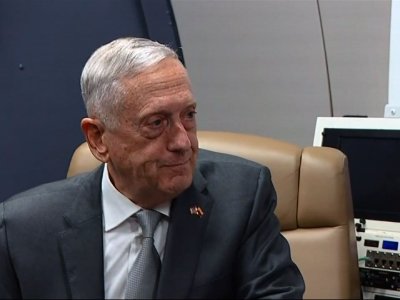
Defense Secretary Jim Mattis says he hasn’t seen an estimated cost of the planned military parade in Washington. The Defense Department said the parade would not happen in 2018, after the AP reported its estimated cost is $92 million. (Aug. 17)

The Associated Press reported that the parade would cost about $92 million, according to U.S. officials citing preliminary estimates more than three times the price first suggested by the White House. The officials spoke on condition of anonymity to discuss early planning estimates that have not yet been finalized or released publicly.

Officials said the parade plans had not yet been approved by Defense Secretary Jim Mattis. Mattis himself said late Thursday that he had seen no such estimate and questioned the media reports.

The Pentagon chief told reporters traveling with him to Bogota, Colombia, that whoever leaked the number to the press was “probably smoking something that is legal in my state but not in most” — a reference to his home state of Washington, where marijuana use is legal.

Mattis, who spoke before the announcement that the parade would not happen in 2018, added: “I’m not dignifying that number ($92 million) with a reply. I would discount that, and anybody who said (that number), I’ll almost guarantee you one thing: They probably said, ‘I need to stay anonymous.’ No kidding, because you look like an idiot. And No. 2, whoever wrote it needs to get better sources. I’ll just leave it at that.”

The parade’s cost has become a politically charged issue, particularly after the Pentagon canceled a major military exercise planned for August with South Korea, in the wake of Trump’s summit with North Korean leader Kim Jong Un. Trump said the drills were provocative and that dumping them would save the U.S. “a tremendous amount of money.” The Pentagon later said the Korea drills would have cost $14 million.

Lt. Col. Jamie Davis, a Pentagon spokesman, said earlier Thursday that Defense Department planning for the parade “continues and final details are still being developed. Any cost estimates are pre-decisional.”

The parade was expected to include troops from all five armed services — the Army, Navy, Air Force, Marine Corps and Coast Guard — as well as units in period uniforms representing earlier times in the nation’s history. It also was expected to involve a number of military aircraft flyovers.

A Pentagon planning memo released in March said the parade would feature a “heavy air component,” likely including older, vintage aircraft. It also said there would be “wheeled vehicles only, no tanks — consideration must be given to minimize damage to local infrastructure.” Big, heavy tanks could tear up streets in the District of Columbia.

The memo from Mattis’ office provided initial planning guidance to the chairman of the Joint Chiefs of Staff. His staff is planning the parade along a route from the White House to the Capitol and would integrate it with the city’s annual veterans’ parade. U.S. Northern Command, which oversees U.S. troops in North America, is responsible for the actual execution of the parade.

Earlier this year, the White House budget director told Congress that the cost to taxpayers could be $10 million to $30 million. Those estimates were likely based on the cost of previous military parades, such as the one in the nation’s capital in 1991 celebrating the end of the first Gulf War, and factored in some additional increase for inflation.

One veterans group weighed in Thursday against the parade. “The American Legion appreciates that our President wants to show in a dramatic fashion our nation’s support for our troops,” National Commander Denise Rohan said. “However, until such time as we can celebrate victory in the War on Terrorism and bring our military home, we think the parade money would be better spent fully funding the Department of Veteran Affairs and giving our troops and their families the best care possible.”

Trump decided he wanted a military parade in Washington after he attended France’s Bastille Day celebration in the center of Paris last year. As the invited guest of French President Emmanuel Macron, Trump watched enthusiastically from a reviewing stand as the French military showcased its tanks and fighter jets, including many U.S.-made planes, along the famed Champs-Elysees.

Several months later Trump praised the French parade, saying, “We’re going to have to try and top it.”

Thursday, August 16, 2018

PERSON OF INTEREST ... INTEREST TO WHOM ... FAMILY PHOTO'S

The Vast, Secretive Face Database That Could Instantly ID You In A Crowd


Amid questions of accuracy and legality, the FBI and police can search images for millions of Americans’ faces, potentially in real time.

If you’ve been to the DMV to have your driver’s license photo taken, there’s a good chance your face is in a little-known group of databases that functions like a digital police lineup. Except, in this case, you needn’t even be suspected of a crime, and soon the searching could take place virtually anywhere, anytime.

It’s just one example of the exploding use of facial recognition technology in law enforcement, and it’s raising major concerns among U.S. lawmakers and privacy advocates.

“I’m frankly appalled,” Representative Paul Mitchell, a Republican from Michigan, told Kimberly Del Greco, the FBI’s deputy assistant director of criminal justice, during a House oversight committee hearing last week. “I wasn’t informed when my driver’s license was renewed my photograph was going to be in a repository that could be searched by law enforcement across the country.”

Watch the exchange between Rep. Mitchell, the FBI’s Kimberly Del Greco, and Alvaro Bedoya of Georgetown’s Law Center:

Mitchell’s face and those of more than 125 million Americans—more than half of the country’s adult population—are thought to be stored in a vast network of databases used by local and federal law enforcement to scan photos and videos of individuals. Many of these faces, which can be searched without reasonable suspicion, belong to people who have never been charged with a crime and have no idea they are being searched.

Yet there are few guidelines or legal rulings that govern exactly how face recognition, like a number of other new technologies, should be used by police. In a report last May on the FBI’s system, the Government Accountability Office (GAO) found the FBI had “not fully adhered to privacy laws and policies and had not taken sufficient action to help ensure accuracy of its face recognition technology.” In response to the report, which urged the FBI to conduct regular audits of the system, “the Department of Justice and the FBI disagreed with three recommendations and had taken some actions to address the remainder, but had not fully implemented them,” the GAO said.

“No federal law controls this technology, no court decision limits it,”
said Alvaro Bedoya, executive director of Georgetown Law’s Center on Privacy and Technology, and the coauthor of “The Perpetual Lineup,” a report on the FBI and state face recognition databases. “This technology is not under control.”

While a few attempts to set limits are inching slowly through state legislatures, the technology is racing ahead. Advancements in machine vision and artificial intelligence are widening the scope of the lineup too: Via body-worn police cameras, which are rapidly proliferating, face searches could happen up-close, at street level and in real-time—anticipating a future in which anonymity in certain public places could disappear.

It’s this pairing of technologies in particular—the ability to scan and identify faces on the street—that is the “most concerning” from a privacy and First Amendment perspective, said Jason Chaffetz, Republican representative from Utah and chairman of the House Oversight committee. A 2014 Justice Dept. report also highlighted the combination, warning that using body cameras with “facial recognition systems and other new technologies like live feed and auto recording . . . may pose serious risks to public privacy.” In the legal vacuum surrounding their use, agencies exploring these technologies should “proceed very cautiously,” the report said.

“Imagine the world where the cops are going down the street and they’ve got Google Glass on and their body cameras are recognizing people,” says Barry Friedman, the director of the Policing Project at New York University School of Law. “And it’s not just recognizing them, but they’re getting their security scores at the same time, and people are getting colored based on how dangerous the algorithms think they are. That’s one scary world.”

Already law enforcement is pairing real-time face recognition software with footage from surveillance cameras, and police officers around the country are using face recognition apps on mobile phones to more quickly identify suspects they stop on the street. In New York, it emerged this week that police are beginning to acquire face recognition technology to scan the faces of all drivers commuting between the five boroughs.
Questions Over Legality And Accuracy


Of  immediate concern to Congress was the legality of the FBI’s system. With the FBI’s Del Greco in the hot seat, a number of committee members asked why the agency hadn’t published a privacy report of its face recognition system until 2015, years after it first deployed the technology in public, in 2010.


A timeline of the FBI’s facial recognition system illustrates the delay in the FBI’s privacy auditing. Image via GAO.

Had anyone at the FBI been reprimanded for the delay? Rep. Mitchell asked.

“I have no knowledge,” Del Greco said. “There are days ignorance is bliss,” he fired back.

Del Greco said the FBI had advised its privacy attorney internally throughout the roll-out of the system.

“We don’t believe you,” Chaffetz said, “and you’re supposed to make it public.” He also alleged that the FBI “went out of its way” to exempt its facial recognition database from the Privacy Act.

“So here’s the problem,” said Chaffetz. “You’re required by law to put out a privacy statement and you didn’t and now we’re supposed to trust you with hundreds of millions of people’s faces.”

Del Greco defended the agency’s use of what she referred to as “face services,” saying it had “enhanced the ability to solve crime,” emphasized that privacy was of utmost importance at the FBI, and said that the system was not used to positively identify suspects, but to generate “investigative leads.” In one recent positive outcome for the technology, Charles Hollin, an alleged child molester, was caught after spending 18 years as a fugitive, thanks to a database that contained his passport photo.

Currently, 18 U.S. states let the FBI use face-recognition technology to compare suspected criminals to their driver’s license or other ID photos. These, in addition to criminal and civil mug shots, and photos from the U.S. State Department’s passport and visa records, are part of a set of databases used by the FBI and police across the country. Over the past decade and a half, 29 states have allowed police agencies and the FBI to search their repositories of drivers’ faces during investigations.

“I have zero confidence in the FBI and the [Justice Department], frankly, to keep this in check,” Rep. Stephen Lynch, a Democrat from Massachusetts, said.

After the hearing, Bedoya, a former chief counsel for Sen. Al Franken of Minnesota, noted that the discussion had inspired a rare moment of bipartisan agreement. “The opposition to the use of driver’s licenses was remarkably strong and remarkably uniform across party lines,” he said. “In my five years as a Senate staffer, I never saw anything like it on a similar privacy issue.”
In some ways, the FBI’s approach to face recognition resembles how police traditionally try to match fingerprints at a crime scene to those of criminals. In this case, however, the “prints” include the faces of millions of innocent people, often collected and scanned without their knowledge, according to the analysis by Bedoya and his colleagues. It estimated that around 80% of the faces searchable by the FBI belong to individuals who have never been charged with a crime.
In under half a decade, they found, the FBI searched drivers’ faces more than 36,000 times, without warrants, audits, or regular accuracy tests. In Florida, police are encouraged to use face recognition “whenever practical.” (Individually, dozens of states also use face recognition to crack down on fraudsters applying for duplicate driver’s licenses, for instance.)

To access the FBI’s networked databases of faces, an authorized, participating police agency need only show that its search is for “law enforcement purposes,” said Del Greco of the FBI. Those criteria are determined by individual states, she noted.

Imagine going to the DMV to renew your license, Bedoya wrote in a recent op-ed in the Washington Post. “What if you—and most other teens in the United States—were then asked to submit your fingerprints for criminal investigations by the FBI or state police?”

In scope, he argues, the face-matching system resembles the National Security Agency’s call-records program, which logged the metadata of all Americans’ phone calls. “This has never happened before—not with DNA or fingerprints, which are kept in smaller national networks made up mostly of known or suspected criminals. Yet law-enforcement face-recognition systems have received a fraction of the NSA’s oversight.”
 

The possibility of misidentification and false positives is also worrisome, especially because the FBI has not been keeping track of such failures. “It doesn’t know how often the system incorrectly identifies the wrong subject,” explained the GAO’s Diana Maurer. “Innocent people could bear the burden of being falsely accused, including the implication of having federal investigators turn up at their home or business.”

More worrisome, research shows that facial recognition appears to disproportionately impact minority communities. A report that was co-written by the FBI in 2012 found that the technology exhibited a higher number of failure rates with darker faces, a function of the kinds of data that humans input as they train the algorithms.

“If you are black, you are more likely to be subjected to this technology, and the technology is more likely to be wrong,” said Elijah Cummings, a congressman for Maryland. “That’s one hell of a combination. Just let that sink in.”

The FBI, like other law enforcement agencies, has argued that the algorithms are race-blind, and reiterates that face searches are only used as “investigatory” leads. “This response is very troubling,”
Cummings noted. “Rather than conducting testing that would show whether or not these concerns have merit, the FBI chooses to ignore growing evidence that the technology has a disproportionate impact on African Americans.”

Friedman notes that racial concerns aren’t exclusive to face recognition. “A lot of these technologies, just because of how they’re deployed, come with racialized aspects. If you’re using license plate readers in more heavily policed neighborhoods, you’re picking up more data in those neighborhoods. That’s something we need to be very aware of and thoughtful about.”

Related Story: Police Body Cameras Will Do More Than Just Record You

CHILLING EFFECTS


A plethora of private companies already have your face in all of its biometric glory, provided it’s ever been uploaded to the servers of firms like Apple, Google, and Facebook. As these companies pile millions into AI research—in part, to better find you and objects in photos—a number of startups are also racing to automatically analyze the world’s video. One startup, Kairos, aims to let Hollywood and ad agencies study audiences’ emotional responses and help theme park visitors more easily find and purchase photos of themselves. Another, Matroid, launched this week by researchers at Stanford, focuses on analyzing television appearances and scanning surveillance video.

“Google can give you pictures of cats, but not cat with grandpa or cat with grandpa and Christmas tree or with your son,” Pete Sonsini, a general partner at New Enterprise Associates, which is funding Matroid to an unspecified tune, told Bloomberg. “It’s really powerful for any human to be able to create a detector that can identify any image or set of images or face from their dataset.”

WHAT ABOUT THE MOST CONTENTOUS ISSUE ... VOTING!
Banks are using biometric technology to provide better personal verification, eventually allowing people to pay with their face. Airlines are imagining using biometrics to let passengers board an airline without a paper ticket. At a conference this week in Orlando, NEC, the Japanese company whose facial recognition algorithms are considered the most accurate by the Dept. of Homeland Security, released new features for its software suite which include a “virtual receptionist” and a system by which “age/gender recognition can trigger tailored advertisements/greetings and can trigger notifications to sales personnel for immediate follow-up and interaction,” said a press release.

Another app, installed on a hotel’s cameras, would notify hotel receptionist and concierge services when a VIP or high value customer arrives at any of the building’s entrances. “This will allow them to receive them in person, greet them by their name, and provide them a better service. Also this can be used to identify any staff that were terminated when they enter the property and take appropriate action.”

At Beijing’s Temple of Heaven Park, meanwhile, biometrics are already being used to ration toilet paper, CNN reported last week: “The facial recognition program keeps the dispenser from offering another round to the same person; if you need more, you reportedly need to sit tight—literally—for nine minutes.”

Still, the most profitable applications for biometrics lie in the fast-growing law enforcement and public safety sector. Industry executives and police experts say that the next stage of the technology—automatically scanning public places for faces and objects in real time—could help more quickly find armed and dangerous or missing persons, identify critical moments amid torrents of body and dash cam footage, or even perhaps identify biased policing.

In many communities, automatic license plate readers—brick-sized cameras mounted on the back of patrol cars—already do something similar with cars, archiving and cross-referencing every license plate they pass in real time to check for outstanding warrants or traffic violations.

These are also the most worrisome applications, privacy advocates say, given the general secrecy that surrounds them, the few restrictions on their use, and the ability to track individuals. Pairing face-matching algorithms with body cameras, said Bedoya, “will redefine the nature of public spaces.”

Even the mere prospect of the technology could have a chilling effect on people’s First Amendment rights, privacy advocates warn. In some cities, police are restricted from filming at protests and demonstrations—unless a crime is thought to be in progress—for this reason.

Other police departments, however, have routinely filmed protesters: In New York, for instance, the NYPD sent video teams to record Occupy and Black Lives Matter protests hundreds of times, and apparently without proper authorization, agency documents released this week show.

“Will you attend a protest if you know the government can secretly scan your face and identify you—as police in Baltimore did during the Freddie Gray protests?” Bedoya writes. 


  • “Do you have the right to walk down your street without having your face scanned? 
  • If you don’t, will you lead your life in the same way? 
  • Will you go to a psychiatrist? 
  • A marriage counselor? 
  • An Alcoholics Anonymous meeting?”


Rep. Chaffetz appeared to support one controversial application of face recognition: using it to find undocumented immigrants. The Dept. of Homeland Security stores the faces of every visitor in its own database, and is determined to better track those who overstay their visas; in 2015, the agency estimated 500,000 overstays.

“I think it is absolutely a concern that face recognition would be used to facilitate deportations,” Rachel Levinson-Waldman, senior counsel to the Brennan Center’s National Security Program at New York University School of Law, told The Intercept‘s Ava Kofman. “We’re seeing how this administration is ramping up these deportation efforts. They’re looking much more widely.”

Generally, however, Chaffetz urged firmer limits. The technology “can also be used by bad actors to harass or stalk individuals,” he said. “It can be used in a way that chills free speech and free association by targeting people attending certain political meetings, protests, churches, or other types of places in the public.”

“And then having a system, with a network of cameras, where you go out in public, that too can be collected. And then used in the wrong hands, nefarious hands… it does scare me. Are you aware of any other country that does this? Anybody on this panel? Anybody else doing this?”

Neither Del Greco nor other members of the panel responded.

Jennifer Lynch, a staff attorney at the Electronic Frontier Foundation, noted that “we don’t yet appear to be at point where face recognition is being used broadly to monitor the public.” But, she said, “it is important to place meaningful checks on government use of face recognition now before we reach a point of no return.”

Real-time face recognition is coming to law enforcement; the question is how the technology itself will be policed, and what role the public will have in dictating its use. “If we’re going there, then we better be going there together,” said Friedman, of the Policing Project. “Did we all discuss this and agree to this?”

To improve the use of face recognition, Bedoya and other privacy advocates urge well-defined limits. The FBI should only access mugshot databases with reasonable suspicion of a crime, and, if it’s a forensic use—a face recognition scan on surveillance footage, for instance, as opposed to a police officer photographing a person he has stopped—the technology should only be used in cases of felonies.

For databases containing drivers license photos, Bedoya says law enforcement should have express consent from state legislatures, and only search those databases when they have probable cause to implicate the subject for a serious offense, like the kind required for a wiretap. The FBI should also regularly scrub its databases to remove innocent people, be more transparent about how it uses the technology, and, as the GAO recommended, conduct audits to ensure the software meets privacy and accuracy requirements.

Policing veterans have also expressed discomfort with the use of the technology. In December, a guide to body cameras published by the Constitution Project, a nonpartisan think tank, and co-authored by a handful of retired police officials, warned that the privacy risks of video “tagging” technologies were “immense” because they “have the potential to end anonymity, catalog every person at a sensitive location or event, and even facilitate pervasive location tracking of an individual over a prolonged period of time.”

In an interview about the future of body cameras, Bill Schrier, the former chief information officer at the Seattle Police Department and a 30-year veteran of government technology, told me that “most reasonable people don’t want potentially dangerous felons or sex offenders walking around in public and would, I think, support such use” of real-time face recognizing body cameras in those cases.

But used to catch people wanted for “misdemeanors such as unpaid traffic tickets or pot smoking,” real-time face recognition could be dangerous. That, he said, could “seriously undermine faith in government, and start us down the road to a police state.”