It was the best of times, it was the worst of times, it was the age of wisdom, it was the age of foolishness, it was the epoch of belief, it was the epoch of incredulity, it was the season of light, it was the season of darkness, it was the spring of hope, it was the winter of despair, we hadPhiladelphia asked Benjamin Franklin, "Well, Doctor, what have we got, a republic or a monarchy?" With no hesitation whatsoever, Franklin responded, "A republic, if you can keep it." ~ BENJAMIN FRANKLIN 1787
WORLD’S LARGEST BATTERY STORAGE FACILITY FOR POWER FROM SOLAR PANELS BURNS AND POISONS NATURE RESERVE … THE SAME BUT DIFFERENT HALF-LIFE!
A recent fire at the Vistra Moss Landing Power Plant and Energy Storage Facility in Northern California, one of the world’s largest lithium-ion battery storage facilities, has poisoned a vital nature reserve in the area.
The battery storage facility was used to store power from solar panels during the day and provide it to consumers in the evening.
Because the disaster has been caused by “renewable,” “clean” energy sources, those who campaign against nuclear power due to environmental concerns suddenly seem not to be overly concerned about the impact of “renewable,” “clean” energy on the environment and wildlife.
Scientists at San Jose State University found high levels of nickel, manganese, and cobalt in the soil within 2 miles of the Vistra Moss Landing Power Plant and Energy Storage Facility, with concentrations of these toxic heavy metals hundreds of times higher than before the fire.
The fire initially led to claims by the US Environmental Protection Agency and local authorities that no toxins were released, but subsequent measurements by San Jose State University scientists contradict these claims.
Dr. Ivano Aiello, chair of San José State’s Moss Landing Marine Laboratories, stated that the heavy metals were found only in the top layer of soil, suggesting they were recent and directly linked to the battery fire.
Local residents have reported suffering from headaches, sore throats, nausea and other conditions they believe are linked to the fire, with a Facebook group of nearly 3,000 people in Monterey and Santa Cruz counties sharing their concerns.
The incident has not received national attention, probably due to the facility’s role in storing solar power, with some critics arguing that the same voices who oppose nuclear power for environmental concerns are silent about the damage caused by their preferred energy source.
The affected nature reserve is the Elkhorn Slough, a vital ecosystem in the area, and the increased levels of toxic heavy metals pose a significant threat to the local environment and wildlife.
The Trump administration has reportedly told at least six top officials at the FBI to resign immediately or they will be fired.
FIRED VIRTUALLY BY EMAIL … BETTER THAN LEARNING IT FROM THE MAINSTREAM MEDIA!
Senior agents were sent an email informing them they would be dismissed “from the rolls of the F.B.I.” as soon as Monday morning, the New York Times reported.
Spencer Evans, the Special Agent in Charge of the Las Vegas FBI field office, is reportedly one of the officials who was forced to retire.
“I was given no rationale for this decision, which, as you might imagine, has come as a shock,” said Evans in a letter to his underlings.
KASH PATEL ISN'T OUT FROM CONFIRMATION YET … DIDN'T STOP THE OTHER SHOE FROM DROPPING!
“All, I was informed by FBIHQ today that executive leadership at the Department of Justice plans to dismiss me from the rolls of the FBI, along with several other FBI executives, as soon as Monday morning. I was given no rationale for this decision, which, as you might imagine, has come as a shock. Not knowing what tomorrow or the weekend will bring, I wanted to make sure you heard from me directly, as I imagine word will start to spread quickly, and I might not have another opportunity to communicate with you again.
Regardless of what happens to me, I want you to know I have every confidence in the men and women of the FBI, and that goes double for the Las Vegas Division. It has been the honor of my career to serve with and among you. I am inspired by the outstanding work you have done and will continue to do on behalf of the American People.
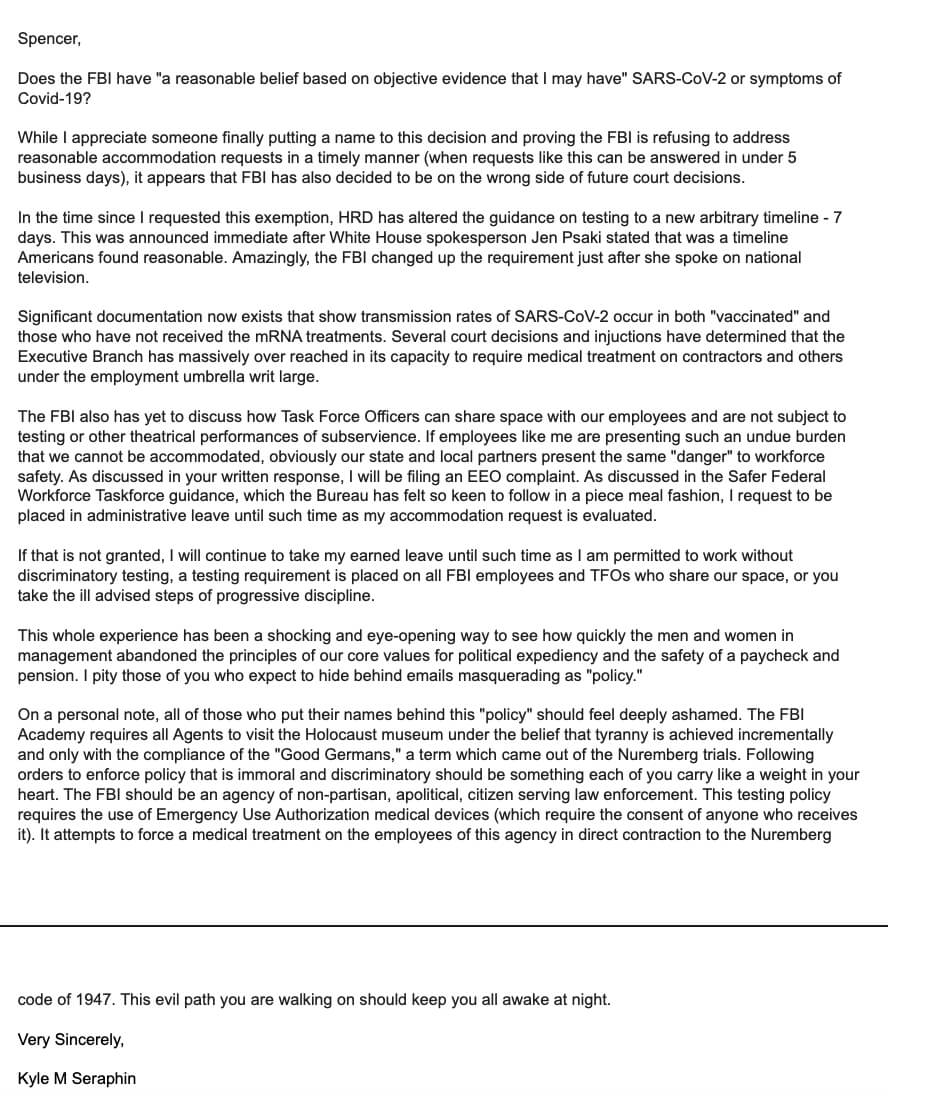
FBI whistleblower Kyle Seraphin reported on X that Evans denied all religious accommodations for agents who resisting taking the experimental COVID injections in 2021..
Some of the fired executives were apparently notified while Kash Patel, Trump’s pick to be the next FBI director, was answering questions during his confirmation hearing in the Senate Thursday.
During the Senate Judiciary Committee hearing, Patel said he was unaware of any plans by the Trump administration to punish FBI personnel.
“Are you aware of any plans or discussions to punish in any way, including termination, FBI agents or personnel associated with Trump investigations?” asked Sen. Cory Booker (D-N.J.).
“I am not aware of that, senator,” Patel replied.
Until Patel in confirmed, Brian Driscoll remains the Bureau’s acting director.
DON'T LET THE DOOR HIT YOU IN THE ASS
The top FBI officials asked to leave were at the executive assistant director level or special agent in charge level,including “those who oversee cyber, national security and criminal investigations, according to CNN.
The FBI Agents Association officials met with FBI director nominee Kash Patel in recent weeks to raise those concerns, urging him to protect agents who did their work investigating violent crimes with oversight from judges, FBI supervisors and Justice Department lawyers, according to people briefed on the meeting. Patel listened but offered no reassurances, the people briefed on the meeting said.
The Trump administration has allegedly been focused on pushing out leaders who were promoted by disgraced former FBI Director Christopher Wray.
Wray announced his early retirement from the Bureau on January 12, after Trump promised to fire him, and then-Acting Director Paul Abbate retired on Inauguration Day.
Trump named Brian Driscoll to serve as acting director in one of his first moves after he was sworn in. Tom Ferguson, a former agent and aide to Rep. Jim Jordan (R-Ohio), arrived at the FBI headquarters to work as a policy adviser shortly after Trump took office.
Driscoll “most recently served as the commander of the FBI’s Hostage Rescue Team (HRT) and Critical Incident Response Group’s (CIRG) Tactical Section chief,” according to a press release.
The purge comes after the FBI raided hundreds of Trump supporters who trespassed at the U.S. Capitol on January 6, 2021, and Mar-a-Lago over Trump’s alleged mishandling of classified documents.
ONE FOOT ON THE BANANA PEEL
According to CNN, the hundreds of FBI agents assigned to those cases are now “bracing for the possibility that they could be forced out or punished, similar to what has happened to dozens of career Justice Department lawyers.”
Some agents say the criticism belies the fact that FBI agents and supervisors can’t choose which assignments they are given as part of their job. The FBI workforce is broadly conservative, and many agents initially had qualms about being assigned to the Capitol attack and Trump cases, viewing the prosecutions as heavy-handed, people familiar with the matter say. Some Justice Department lawyers leading January 6 cases complained that they believed agents sometimes slow-walked some of their work.
According to Seraphin, he’s hearing from multiple agents inside the FBI that the Acting Deputy Attorney General is ordering the names of “all case participants AND all case managers of January 6 prosecutions.”
The acting deputy AG is Emil Bove, Trump’s former personal criminal attorney.
Seraphin explained that in “plain terms,” Bove is seeking the names of “those who did analytical support, the supervisors, and the case agents.”
Only a few agents, including Seraphin and former special agents like Steve Friend, Marcus Allen and Garret O’Boyle had the integrity to call out their superiors and refuse to carry out unreasonable orders. All of the whistleblowers paid dearly for making their “protected disclosures,” and were suspended without pay for months before losing their jobs and security clearances.
In December of 2022, Friend told American Greatness there were hundreds of other potential whistleblowers working in the FBI, but they needed to feel that it was safe to come forward.
In a letter to Evans a year earlier, Seraphin expressed shock and disappointment that his exemption to the COVID jab was denied, presciently noting that the Bureau had “decided to be on the wrong side of future court decisions.”
“This whole experience has been a shocking and eye-opening way to see how quickly the men and women in management abandoned the principles of our core values for political expediency and the safety of a paycheck and pension,” the whistleblower wrote. “I pity those of you who expect to hide behind emails masquerading as ‘policy.'”
Seraphin said the FBI leadership forcing the unjust policy on their agents should feel deeply ashamed, especially since all agents are required to visit the Holocaust Museum as a reminder that tyranny is only achieved with the compliance of “good Germans” just following orders.
“This evil path you are on should keep you all awake at night,” Seraphin concluded.
TRUMP ANNOUNCES UP TO 30K ILLEGAL IMMIGRANTS WILL BE VACATIONING AT GUANTANAMO BAY …
WASHINGTON — President Trump Wednesday said he plans to send up to 30,000 illegal immigrants to detention facilities at Guantanamo Bay, Cuba, as part of his campaign to mass-deport migrants who have committed crimes.
“Today, I’m also signing an executive order to instruct the Departments of Defense and Homeland Security to begin preparing the 30,000-person migrant facility at Guantanamo Bay,” Trump said while signing the anti-illegal immigration Laken Riley Act.
“Most people don’t even know that we have 30,000 beds in Guantanamo to detain the worst criminal illegal aliens threatening the American people.”
The Guantanamo Bay Naval Base in Cuba. AP
Trump added that “some of them are so bad, we don’t even trust the countries to hold them, because we don’t want them coming back.”
“So we’re going to send them out to Guantanamo,” he said.
“This will double our capacity immediately, right? And tough. It’s a tough, it’s a tough place to get out of.”
A smart way to pay for the Trump tax cut: auction federal assets and have DOGE handle the program in conjunction with GSA ...
The federal government owns multiple trillions of dollars of federal assets — from land to buildings to patent rights, to mineral rights, to immigrant visas, to oil fields to trucks and trains, and unused office furniture equipment.
The government could earn well over $1 trillion and perhaps as much as $10 trillion by selling off these assets that are simply hoarded (figuratively) in the dark and dusty basement of government buildings. These assets could then generate added annual tax receipts once they are utilized for productive purposes.
I’m not talking about selling the Washington Monument or Yellowstone National Park. The sales could and in most cases should be limited to American citizens and American businesses.
I’m referring to NON-environmentally sensitive properties that could be put to use growing our economy and using the money to retire some of our $35 trillion national debt.
It’s a win-win for taxpayers, our children (who will be handed a lower debt obligation), and the U.S. economy.
Some of the most valuable assets that should be put on the auction block immediately are tracts along the electromagnetic spectrum. The spectrum contains the invisible airwaves that power cellphones, Wi-Fi, and other wireless technologies — such as 5G communications.
In the past, auctioning spectrum rights to telecommunication firms and tech companies has raised more than $100 billion for the U.S. Treasury.
Congress could raise at least another $100 billion in another round of spectrum auctions. This would sell or lease space that the military doesn’t need and that other government agencies (such as local police and fire departments) are fine without.
This strategy would help stimulate the economy in two ways. First, as in the past, the revenues raised can offset any real or imagined revenue loss from the imperative of making the Trump tax cuts permanent.
A new report by the economic consulting firm National Economic Research Associates (NERA) finds that auctioning 100 megahertz of midband spectrum that’s licensed for 5G will boost U.S. GDP by more than $260 billion and create 1.5 million new jobs.
On at least four previous occasions, Congress has used dollars raised from spectrum auctions to offset tax cuts in reconciliation packages. That’s exactly what they should do again.
“Effectively allocating spectrum to meet the ever-growing need is critical to promoting American innovation and protecting our national security,” Rep. Richard Hudson (R-NC) said at the first House Energy and Commerce Subcommittee on Communications and Technology hearing of the new Congress on Jan. 23.
Hudson, chair of the subcommittee, points out correctly that the U.S. government has been conducting spectrum auctions for the past 30 years, and they have a track record of success. They are much fairer than giving bureaucrats the power to decide who gets the spectrum, which can lead to allocations that are politically or ideologically motivated, with the result that the spectrum would be used inefficiently (or not at all) by beneficiaries. Auctions are open and transparent, minimizing the risk of shady backroom deals. They ensure that the spectrum goes to those who value it most and can use it most effectively.
Anyone concerned about ensuring the uninterrupted connectivity of our electric grid system and our daily Internet connection should be all for these auctions — especially as the world goes wireless, communicating less through cables and more through satellite beams.
This is also critical to maintaining our technology lead against the Chinese communist government. One Chinese news agency reported last July that “China’s 5G network now covers every city and town in the country, as well as more than 90 percent of its villages.” We are dangerously lagging behind, and without timely spectrum auctions, the gap will grow wider.
Auctions of the spectrum and other federal assets will drive progress and prosperity — and raise revenue to pay for tax cuts or retire our debt that is soon to eclipse $40 trillion. What’s not to like about that?
Partly sourced from Stephen Moore is a visiting fellow at the Heritage Foundation. He is also an economic advisor to the Trump campaign. His new book, co-authored with Arthur Laffer, is “The Trump Economic Miracle.”
The Federal Government of the United States owns an extensive amount of property, both in terms of land and buildings. Here is a detailed breakdown:
Land Ownership: The federal government owns around 620 million acres of land, which is approximately 27% of the total land area in the United States. This land includes various types of properties such as national parks, forests, wilderness areas, wildlife refuges, and military installations, among others. The majority of this land is in the Western states, where federal ownership can exceed 80% in some states like Nevada.
Buildings: The General Services Administration (GSA) manages over 360 million square feet of space across 8,397 buildings in more than 2,200 communities. These buildings include office spaces, courthouses, laboratories, post offices, and data processing centers. However, there are also reports suggesting that the federal government owns even more structures, with some estimates including around 46,000 buildings across the country. This includes both occupied and unoccupied properties.
In summary, the Federal Government's property includes vast tracts of land and numerous buildings, making it the largest landowner in the country. The exact number of buildings can vary based on different sources and definitions of what constitutes a federal building, but the numbers above provide a comprehensive overview based on recent data and reports.
WHAT TRUMP’S FUNDING FREEZE COULD MEAN FOR UNIVERSITIES, NONPROFITS AND MORE … THE CHOPPING BLOCK!
What Trump’s funding freeze could mean for universities, nonprofits and more … CONSIDERING 30% OF STATES FUNDING & BUDGET COME FROM THE FEDERAL GOVERNMENT.
A White House directive to pause federal grants and loans raised uncertainty and fears among many who depend on federal aid before a judge intervened Tuesday to temporarily block it from taking effect.
President Donald Trump’s administration said the freeze would not affect federal assistance to individuals, such as Social Security, Medicare, food stamps, student loans and scholarships. But it said a pause is necessary to ensure funding for other programs complies with Trump’s executive orders, which aim to reverse progressive policies on transgender rights, environmental justice and diversity, equity and inclusion.
A federal judge blocked the directive just minutes before it was to kick in Tuesday. The order placed it on hold until next Monday while legal wrangling continues.
STATES ON THE EDGE
States on average receive about 30% of their revenues from the federal government, according to Federal Funds Information for States, a nonprofit that analyzes the affect of federal actions on states. Although the federal government has rescinded unspent funds in the past, it hasn’t normally halted grants on the front-end, said Marcia Howard, executive director of Federal Funds Information for States.
The grant pause is perhaps most similar to a federal government shutdown, when a congressional impasse on spending legislation delays federal payments for some state and local services. In most of those circumstances, a couple weeks delay “isn’t hugely disruptive,” Howard said.
But some state officials are nonetheless anxious.
“If the federal government coughs, Maryland catches pneumonia,” state Senate President Bill Ferguson said Tuesday, while discussing how the grant freeze could affect the state.
HIGHER EDUCATION FACES UNCERTAINTY
Universities around the country are scrambling to determine how a funding freeze could affect their research programs, students and faculty.
University of North Carolina administrators sent a campus email urging patience until decisions can be confirmed directly from federal agencies.
“The messaging is, ‘Try not to panic, and sit tight,’” said psychology professor Keely Muscatell. “But I also think it’s a lot easier said than done.”
A University of Florida memo obtained by the Associated Press indicates that the university is advising faculty to continue grant-related activities unless they have been specially told that the research has been suspended.
But at Gallaudet University in Washington, D.C., researchers said they were told to stop work on grant-funded projects. If the funding freeze goes forward, scientists may miss deadlines to present and share their work, said researcher Lorna Quandt, who has a grant application pending to fund interpreters to accompany deaf students to an upcoming conference.
The Association of Public and Land-Grant Universities said a freeze would “sideline world-leading American scientists who are working toward cures for cancer, developing breakthroughs in AI and quantum computing, driving progress in advanced manufacturing, and supporting American farmers.”
ROAD FUNDING MAY KEEP ROLLING
For many highway projects that are partially funded by federal grants, states pay the contractors directly then seek reimbursement from the federal government. There initially was widespread concern among state transportation leaders that states “would be left holding the bag,” but further clarification from the White House calmed some nerves, said Jim Tymon, executive director of the American Association of State Highway and Transportation Officials.
Although some grants, particularly those awarded at the discretion of the federal government, could still be at risk, Tymon said he is now confident the Trump administration isn’t targeting the formula-based grants that states use to set their own transportation priorities and pay for roads.
“We’re not as panicked as maybe we had been,” he said.
EARLY CHILDHOOD PROVIDERS RAISE FEARS
Some operators of federally funded Head Start centers, which work with 800,000 kids and low-income families nationwide, initially were concerned that the freeze could mean closing their doors as soon Wednesday. Operators logged on to a website where they typically draw down their federal grants and discovered they no longer had access to the money, which they need to pay their employees and vendors.
“Is it a short-term thing? Is this a glitch? Is it a long-term thing? All of those things, we just really don’t know at this point,” said Tommy Sheridan, deputy director of the National Head Start Association. “That’s really adding to the fear and the concern.”
NONPROFIT GROUPS LAUNCH A CHALLENGE
A coalition of nonprofit groups filed a lawsuit Tuesday against the funding freeze. The nonprofit Democracy Forward, a public interest litigation group (READ THE PROGRESSIVE LEFT), wrote that the White House’s memo fails to explain its legal authority “to gut the progressive left/deep state grant programs in the deep state federal government.”
The National Science Foundation postponed this week’s grant review panels and is pausing the distribution of new or existing awards.
The National Crime Victim Law Institute described the Trump administration action as a “devastating blow” to nonprofits such as the institute.
“These grants are the backbone of critical programs for those in need across this country,” executive director Meg Garvin said. “Without this funding, nonprofits face the heartbreaking reality of scaling back services, cutting essential programs, and, in some cases, closing their doors entirely.”
TRIBAL GROUPS COULD BE AFFECTED
Tribal nations, “more so than almost any other community, will be negatively impacted” by a freeze on federal funding, said John Echohawk, executive director of the Native American Rights Fund. He said tribal nations rely on federal funding for public safety, healthcare, education, infrastructure “and the basic needs of our most vulnerable citizens.”
“The United States must fulfill its trust obligation to protect Tribal treaty rights, lands, assets, and resources,” he said.
OTHER SERVICES COULD SEE DELAYS
North Carolina Gov. Josh Stein said on X he is “concerned that freezing federal funding will hurt North Carolinians, especially those recovering” from Hurricane Helene in western North Carolina. Stein, a Democrat, said he is seeking clarity from federal officials and working to ensure people in the storm-affected areas get the support they need.
The federal government also supports state programs that fund billions of dollars in drinking water and sewage infrastructure. Money the federal government already sent out could probably be used, but the pause calls into question new spending, said Alan Roberson, executive director of the Association of State Drinking Water Administrators.
The Biden administration had stipulated that some of those funds go to disadvantaged communities, a term tied to its environmental justice efforts that the Trump administration has targeted for elimination. The fate of that effort “is to be determined, and we recognize that,” Roberson said.
___
Associated Press writers Moriah Balingit in Washington, D.C.; Thalia Beaty in New York; Becky Bohrer in Juneau, Alaska; Fernando Figueroa in Austin, Texas; Stephanie Matat in West Palm Beach, Florida; Jeff McMurray in Chicago; Cheyanne Mumphrey in Phoenix; Michael Phillis in St. Louis; Adithi Ramakrishnan in New York; Gary D. Robertson and Makiya Seminera in Raleigh, North Carolina; Adrian Sainz in Memphis, Tennessee; and Brian Witte in Annapolis, Maryland.