It was the best of times, it was the worst of times, it was the age of wisdom, it was the age of foolishness, it was the epoch of belief, it was the epoch of incredulity, it was the season of light, it was the season of darkness, it was the spring of hope, it was the winter of despair, we hadPhiladelphia asked Benjamin Franklin, "Well, Doctor, what have we got, a republic or a monarchy?" With no hesitation whatsoever, Franklin responded, "A republic, if you can keep it." ~ BENJAMIN FRANKLIN 1787
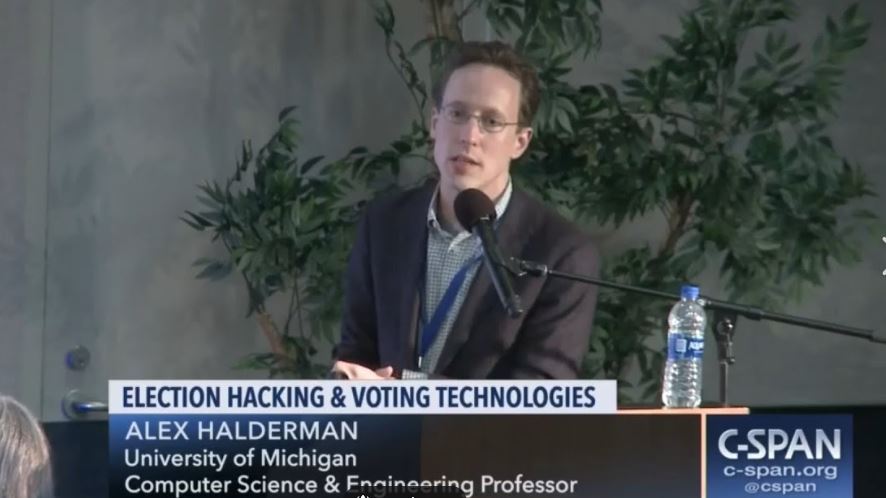
Update: After speaking with election integrity expert Garland Favorito, we discovered the courtroom display was much more serious than originally reported. J. Alex Halderman demonstrated in court how Dominion machines were hacked and altered their tabulations.
J. Alex Halderman explained how to hack into an electronic voting machine in a previous lecture.
On Friday, in a Federal Court In Atlanta, Georgia, University of Michigan Professor of Computer Science and Engineering J. Alex Halderman testified in front of Judge Amy Totenberg’s courtroom about the Dominion voting machines used in the Georgia elections since 2020.
As reported earlier, during his testimony, Halderman was able to HACK A DOMINION VOTING MACHINE and change the tabulation in front of U.S. District Judge Amy Totenberg in the courtroom!
His testimony was part of a long-running lawsuit by election integrity activists set as a bench trial.
The plaintiffs seek to remove what they say are insecure voting machines in Georgia in favor of secure paper ballots.
Following The Gateway Pundit’s explosive report on Saturday night, we spoke with Georgia reporter Amber Connor, who has been sitting in the courtroom during the trial for the past two weeks.
Amber confirmed what was reported earlier about Halderman’s demonstration live on how to hack a Dominion voting machine and change the totals using only a pen. In fact Halderman borrowed a pen from the defense attorneys for his demonstration.
The mainstream legacy news media has decided to ignore this historic case taking place in Georgia for some reason. Why is that?
Here is more from our discussion with Amber Connor:
Jim Hoft: Amber Connor, thank you for calling. I’m really anxious to hear what you had to say. Amber, you were in the courtroom for the Curling versus Raffensberger case that’s been going on since for over a week now. Maybe you could fill us in a little bit. Okay? And this explosive development that we just heard about tonight at The Gateway Pundit, which is that the expert, J. Halderman, was in the courtroom and was able to change vote totals on the Dominion machines. So maybe you could tell us a little bit about that.
Amber Connor: Just to give a background, Alex Halderman, he was the one who wrote the Halderman report that showed individuals how vulnerable the ballot marking devices that the machines that Dominion has its software on and show different ways where you can access through vulnerabilities within the ballot marking device. And a background of him is he works in Michigan. He has three degrees in computer science from Princeton University, he does security analysis of precinct programs in the US and in other countries. He’s been to Australia, India, Estonia to do these things. He’s been part of a team in California with the Secretary of State to help with forensics, and in Antrim County and in Louisiana.
When he analyzed the BMD (ballot marking device) in Georgia… And so what he did is they brought the ballot marking device and the printer up to the front (of the courtroom)… What he did is he began to show the first vulnerability and he borrowed the state defense counsel. So those representing the Georgia secretary, he asked the main counsel to borrow his pen that he was writing with. And then he goes over to the power button, leans down, he holds down the power button for between five to 10 seconds, probably 7 seconds, and it automatically puts the machine in safe mode.
…And this reboot happens. And he then shows the judge the display and it shows a picture of the on off button as he’s pushing it for five to 10 seconds to instigate the reboot. But before you reboot the whole thing there’ll be something that comes up to ask if he wants to go into safe mode, and then he pushes. Yes. So it doesn’t shut it down or reboot. He just goes into safe mode. And that allows him to open up files and change the content of files.
But that’s not all. Halderman also demonstrated how to fix the results and rig the count during an election.
Amber Connor: So you can actually install something that you’ve already pre-programmed, or you can program it at that point to do whatever you tell it to do. So that can be anything from, if they vote for George Washington, that it could then be recorded… or actually displayed as Benedict Arnold.
Georgia Secretary of State Brad Raffensperger had been hiding this report from the public for two years.
University of Michigan Professor of Computer Science and Engineering J. Alex Halderman and Security Researcher and Assistant Professor at Auburn University Drew Sringall collaborated on the report where they discovered many exploitable vulnerabilities in the Dominion Voting Systems’ ImageCast X system.
Far-left Judge Amy Totenberg sealed and covered up the results of the investigation of Dominion voting machines in Georgia and sat on the report until this week.
The report confirmed that votes can be altered in the Dominion voting machines. In fact, the report revealed that the Dominion software is vulnerable and can be hacked.
Following its release, VoterGA founder Garland Favorito joined Steve Bannon on The War Room to discuss the findings from the explosive report.
Trump-hating Secretary of State Raffensperger hid this information from the public until 2023. Why was that?
Here is a copy of the Halderman Report released in June.
Professor Halderman wrote about his findings in a blog post on Wednesday.
Back in September 2020, the Court granted the Curling Plaintiffs access to one of Georgia’s touchscreen ballot marking devices (BMDs) so that they could assess its security. Drew and I extensively tested the machine, and we discovered vulnerabilities in nearly every part of the system that is exposed to potential attackers. The most critical problem we found is an arbitrary-code-execution vulnerability that can be exploited to spread malware from a county’s central election management system (EMS) to every BMD in the jurisdiction. This makes it possible to attack the BMDs at scale, over a wide area, without needing physical access to any of them.
Our report explains how attackers could exploit the flaws we found to change votes or potentially even affect election outcomes in Georgia, including how they could defeat the technical and procedural protections the state has in place. While we are not aware of any evidence that the vulnerabilities have been exploited to change votes in past elections, without more precautions and mitigations, there is a serious risk that they will be exploited in the future.
After the report’s release, Professor Halderman tweeted that Georgia Secretary of State Brad Raffensperger would not install Dominion’s security patches before the 2024 election.
Now this… on Friday, in a Federal Court In Atlanta, Georgia, J. Alex Halderman was able to HACK A DOMINION VOTING TABULATOR In Front Of U.S. District Judge Amy Totenberg in the courtroom!
Halderman USED ONLY A PEN TO CHANGE VOTE TOTALS!
This is part of a long-running lawsuit by election integrity activists set as a bench trial.
The plaintiffs seek to remove what they say are insecure voting machines in Georgia in favor of secure paper ballots.
Trillions Spent on ‘Climate Change’ Based on Faulty Temperature Data, Climate Experts Say ... WRONG-AGAIN! <<<CLIK>>>
Meteorologist finds 96 percent of NOAA temperature stations located in ‘urban heat islands,’ including next to exhaust fans and on ‘blistering-hot rooftops.’
To preserve a “livable planet,” the Earth can’t warm more than 1.5 degrees Celsius above pre-industrial levels, the United Nations warns.
Failure to maintain that level could lead to several catastrophes, including increased droughts and weather-related disasters, more heat-related illnesses and deaths, and less food and more poverty, according to NASA.
To avert the looming tribulations and limit global temperature increases, 194 member states and the European Union in 2016 signed the U.N. Paris Agreement, a legally binding international treaty with a goal to “substantially reduce global greenhouse gas emissions.”
After the agreement, global spending on climate-related projects increased exponentially.
In 2021 and 2022, the world’s taxpayers spent, on average, $1.3 trillion on such projects each year, according to the nonprofit advisory group Climate Policy Initiative.
That’s more than double the spending rate in 2019 and 2020, which came in at $653 billion per year, and it’s significantly up from the $364 billion per year in 2011 and 2012, the report found.
Despite the money pouring in, the National Oceanic and Atmospheric Administration (NOAA) reported that 2023 was the hottest year on record.
NOAA’s climate monitoring stations found that the Earth’s average land and ocean surface temperature in 2023 was 1.35 degrees Celsius above the pre-industrial average.
“Not only was 2023 the warmest year in NOAA’s 174-year climate record—it was the warmest by far,” said Sarah Kapnick, NOAA’s chief scientist.
“A warming planet means we need to be prepared for the impacts of climate change that are happening here and now, like extreme weather events that become both more frequent and severe.”
But a growing chorus of climate scientists are saying the temperature readings are faulty and that the trillions of dollars pouring in are based on a problem that doesn’t exist.
More than 90 percent of NOAA’s temperature monitoring stations have a heat bias, according to Anthony Watts, a meteorologist, senior fellow for environment and climate at The Heartland Institute, author of climate website Watts Up With That, and director of a study that examined NOAA’s climate stations.
“And with that large of a number, over 90 percent, the methods that NOAA employs to try to reduce this don’t work because the bias is so overwhelming,” Mr. Watts told The Epoch Times. <- WORTH THE SUBSCRIPTION!!!
“The few stations that are left that are not biased because they are, for example, outside of town in a field and are an agricultural research station that’s been around for 100 years ... their data gets completely swamped by the much larger set of biased data. There’s no way you can adjust that out.”
Those who pay attention have known for years that UNRWA–the United Nations’ Relief and Works Agency–is nothing but an arm of Hamas. UNRWA has, in large part, run the schools where Gazan children are taught to hate Jews. UNRWA, like the Palestinian “stringers” used by the major wire services, has long run interference for Hamas and other terrorists. See current “Picks” by Brendan O’Neill and the Times of Israel for a great deal more.
Recently, it has come out that a number of UNRWA employees actually participated in Gaza’s October 7 massacre, helping to kill and kidnap Jews. So the UNRWA story has finally–for the first time, perhaps–reached the legacy media. Reuters is on the case, sort of. As you would expect, Reuters talks in terms of Israeli allegations:
An Israeli intelligence dossier that prompted a cascade of countries to halt funds for a U.N. Palestinian aid agency includes allegations that some staff took part in abductions and killings during the Oct. 7 raid that sparked the Gaza war.
The six-page dossier, seen by Reuters, alleges that some 190 UNRWA employees, including teachers, have doubled as Hamas or Islamic Jihad militants. It has names and pictures for 11 them.
The dossier said one of the 11 is a school counsellor who helped his son abduct a woman during the Hamas infiltration in which Israel says 1,200 people were killed and 253 kidnapped. *** Another, an UNRWA social worker, is accused of unspecified involvement in the transfer to Gaza of a slain Israeli soldier’s corpse and of coordinating the movements of pick-up trucks used by the raiders and of weapons supplies.
A third Palestinian in the dossier is accused of taking part in a rampage in the Israeli border village Beeri, one-tenth of whose residents were killed. A fourth is accused of participating in an attack on Reim, site both of an army base that was overrun and a rave where more than 360 revellers died.
And so on. The U.N. says it is shocked–shocked!–to learn that some of its employees are Hamas terrorists. But I don’t think it came as much of a surprise to the countries, including the U.S., who have cut off funding to UNRWA:
More than 10 countries, including major donors the United States and Germany, have halted their funding to the agency.
Reuters of course sees this as a problem, but I think it is entirely to the good. It has been decades since any arm of the United Nations has played a positive role in the Middle East. UNRWA has been a vehicle through which the United States, among others, has shamefully supported Gaza’s terrorist infrastructure and its perverted culture of Jew-hatred. If and when the Israelis complete their conquest of Gaza–may it come swiftly–they should bar the U.N. from any ongoing role in that territory.
More broadly, one can’t help asking: what good is the United Nations? Is there any agency of that shambling organization that is actually a positive force in the world?
I don’t know. There might be. But for the most part, the U.N. plays a negative part. Its “peacekeeping” forces seem to function mainly as enablers of rape and sexual abuse. Its General Assembly is an anti-Semitic joke. Its Security Council, the source of real power to the extent the U.N. has any power, is an archaic post-World War II arrangement where any positive action (few of which are ever proposed) can be vetoed by Russia. And more often, it is the U.S. vetoing evil resolutions.
The U.N.’s main focus in recent decades has been the Middle East, where it, as typified by UNRWA, has played a generally negative, pro-terrorist role. In areas that should be of higher priority, like Ukraine and China, what has the U.N. done? Nothing.Has the U.N. even acknowledged the Uighers’ slavery, let alone tried to remediate it? Not that I know of!
Then we have the International Court of Justice, a creature of the United Nations, which just a few days ago helpfully “ordered” Israel not to engage in “genocide” in Gaza. Thanks for that input.
So the question naturally arises: why should the United States have anything to do with the U.N.? I understand why Russia wants the U.N. to exist, and why the 57 Islamic countries that dominate the General Assembly want it to exist, and why evil regimes like Iran’s that gain political cover by being appointed to the U.N’s Human Rights Council want it to exist, and why tiny third-world countries that are hard to find on a map, but get equal votes in the General Assembly, want it to exist. But why should we want the U.N. to exist? Why should we support it?
I don’t think there is a good answer to that question. The U.N. purports to have moral authority superior to ours, but that is a lie. The U.N. has no moral authority at all; certainly less than that of the United States. The U.N. does obvious evil in the world, and I can’t see any substantial good to outweigh that evil. If there are specific agencies of the U.N. that actually do something productive, they could easily be reproduced in a post-U.N. world.
The United Nations was seen, at its birth, as a harbinger of world peace. That vision obviously turned out to be a mirage. The time has come, I think, to change the funding and address !
HOW MANY INCONSISTENCIES DOES IT TAKE BEFORE THE STORY BECOMES FICTION!!! THE CASE SUMMARY IS AT THE END ... BUT THE JUDGE DISALLOWED ALL OF IT!!!
PERHAPS THE JUDGE NEEDS AN ANAL HEARING AID, ITS HARD TO HEAR WHERE HIS HEAD IS!!!
Donald Trump in furor stormed out of a New York courtroom for a while, in the defamation suit brought by author and dating/boyfriend/sex-advice columnist E. Jean Carroll.
It was just settled against Trump for $83.3 million! The Carroll suit was largely subsidized by Reid Hoffman the billionaire capitalist, and mega-donor to the Democratic Party and leftwing causes.
The subtext of Trump’s rage, aside from the outrageous monetary size of the defamation ruling, is that he was facing—and angered—a leftwing claimant, a quite hostile leftwing judge, and a leftwing New York jury.
The civil suit serves as a mere preview of four additional leftwing criminal prosecutions, leftwing judges, and leftwing juries to come—all on charges that would never have been filed if Trump either had not run for president or been a liberal progressive.
Yet here we are.
The E. Jean Carroll case is the most baffling of all five. She, the alleged victim, did not remember even the year in which the purported sexual assault took place, nearly three decades ago. Observers have pointed out dozens of inconsistencies in her story.
It was never clear what were the preliminaries that supposedly (Trump denies meeting her) led both, allegedly, willingly to retreat together to a department store dressing room, where during normal business hours the alleged violence took place.
Moreover, the sexual assault complaint came forward decades post facto—and only after Trump was running for and then president.
Carroll eventually sued him for battery, but well after the statute of limitations had expired and thus the case seemed defunct.
Her claims of defamation injuries arise from being fired from her advice column job at ELLE magazine.
She claimed that Trump’s sharp denials and ad hominem retorts led to her career ruin. But the loss for anyone of a column at 76 does not seem such a rare occurrence, and the absence of a salaried job in one’s late seventies for four years does not seem to equate to a $83 million hit.
And note the allegation that her dispute with Trump led to her firing was strongly denied by the very magazine that cut her loose.
But then another strange thing happened. In 2022, a new law (“The Adult Survivors Act”) was passed in the New York legislature. It also post facto established a twelve-month window (beginning six months from the signing of bill) that permitted survivors of long ago alleged sexual assaults suddenly to sue the accused long-ago perpetrator—regardless of the previous statute of limitations.
That unexpected opening suddenly gave Carroll’s prior unsuccessful efforts a rebirth. And she quickly refiled with the help of arch-Trump hating billionaire Hoffman.
Yet the bill may have been introduced with Trump particularly in mind—given the legislator who introduced it, Brad Hoylman-Siga, was known as another Trump antagonist.
More interestingly, he had earlier introduced and had passed another Trump-targeted bill. That “TRUST” act had empowered particular federal Congressional committees to have access to the New York State once sealed tax returns of high-ranking government officials—such as Trump.
That bill’s generally agreed subtext was a green light for anti-Trump members of Congress to obtain legal access to Donald J. Trump's tax returns.
So there is an eerie feeling that the New York legislature may have abruptly passed legislation that was aimed at the past conduct of Donald Trump but only after he entered the political arena.
While these are not quite bills of attainder, there is something unsettling if they are post facto laws aimed at targeting the most famous and controversial man in America and the leading candidate for the presidency.
In essence they were targeted statutes designed to make Trump’s prior legally unactionable behavior suddenly quite legally actionable.
Trump will be subject to such special treatment all summer and fall.
Prosecutors Bragg, James, Smith, and Willis will synchronize their court business for maximum effect.
Trump again will face leftwing prosecutors, judges, and juries on charges that are politically driven, involving alleged behavior that is either usually not criminalized or not to the same degree as Trump’s case. (Do we remember the nearly $375,000 federal fine belatedly leveled at an exempt Obama but only five years after his 2008 illegal garnering of, and not reporting, foreign campaign contributions?)
The stakes are higher each day as Trump closes in on the nomination and thus becomes the hope of half the country to end the Biden madness.
Somehow Trump will have to stay calm, give no opening to his legion of hostile prosecutors, while conducting a nonstop campaign against Biden (and for a while Hayley), and while fighting to keep his name on various state ballots.
So what we are witnessing is not even the extralegal efforts of Steele/Fusion GPS, Perkins Coie/DNC/Hillary Clinton in 2016, or the 2020 “Russian disinformation” ruse/change the voting laws/infuse half a billion dollars to absorb the work of the registrar machinations against Trump.
We are way beyond all that. The legal system itself, hand-in-glove with leftwing politicos (compare campaign boasts of James and Willis, or prosecutorial visits to the January 6 committee and the White House) is turning the process of balloting and elections into an embarrassing farce.
Still, Trump will have to soldier on. He must stay controlled amid the tsunamis, not play into the hands of his accusers, and remember that he may soon be the only eleventh-hour hope to stop this mockery of American law, customs and traditions.
·
1.7M
Views
POST BY JOHN LEFEVRE SUMS UP THE CASE
I thought everyone knew the E. Jean Carroll vs Trump case was bogus, until I heard my mother's (late 60s Republican) uninformed take on the verdict after watching ABC Nightly News.
It's hard to find on Google, so here's what you need to know about E. Jean Carroll, most of which was deemed "inadmissible" by the judge:
- She couldn't recall the date, month, season, or year the incident happened
- She never told anyone about it, despite being publicly obsessed with her own sexuality
- The dress she claims to have been wearing didn't exist at the time
- Her description of the dressing room at Bergdorf Goodman was inaccurate, making her sequence of events impossible
- Her lawsuit was bankrolled by Jeffrey Epstein pal and Democrat (and Nikki Haley) mega-donor Reid Hoffman
- Democrats created a law (The Adult Survivors Act in 2022) to enable her lawsuit to proceed
- Her accusation is the exact plotline of an episode of Law & Order (one of her "favorite shows")
- Trump's Apprentice was also one of her favorite shows
- She has a history of falsely accusing men of r*pe, including Les Moonves
- She told Anderson Cooper, "most people think of r*pe as being sexy. Think of the fantasies."
- She made a career promoting promiscuity, even writing glowingly of sexual assault and naming her cat Vagina
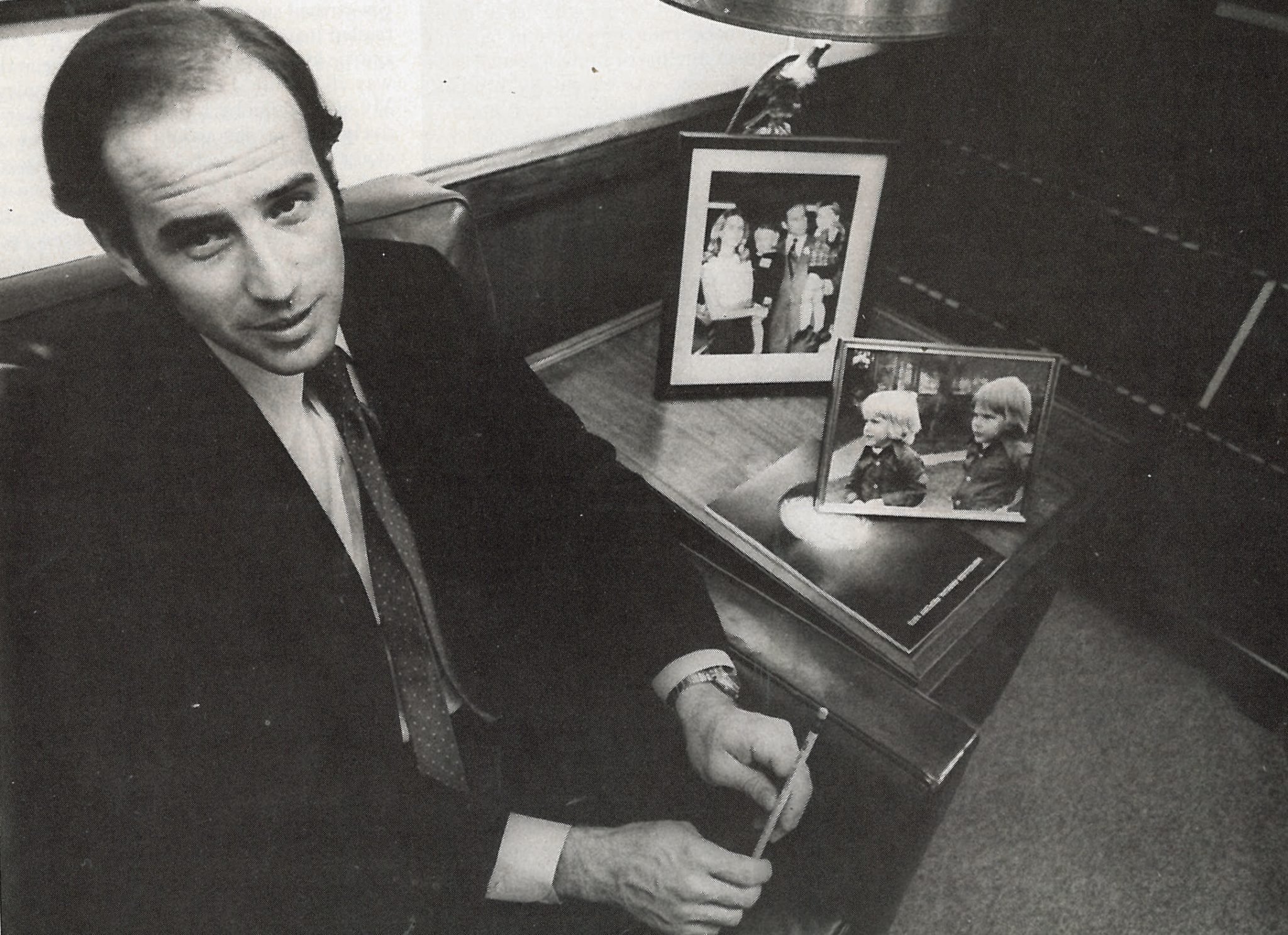
Joseph Robinette Biden, the 31-year-old Democrat from Delaware, is the youngest man in the Senate, which makes him a celebrity of sorts. But there’s something else that makes him good copy: Shortly after his election in November 1972 his wife Neilia and infant daughter were killed in a car accident. Suddenly this handsome, young man struck down in his moment of glory was prey to scores of hungry reporters clamoring to write soul-searching stories.
According to his staff he was hounded for weeks by the media. “It was awful in the beginning,” says Chazy Dowaliby, a press aide. “A few weeks after Neilia’s death we got a call from Sally Quinn of the Post. She wanted to do a story on the Senator as Washington’s most eligible bachelor. Naturally we said no but it wasn’t easy because she kept calling all the time. She wasn’t the only one. Women’s Wear Daily called morning, noon, and night. And so did every female magazine in the country. They all wanted to write some kind of weeping willow story on him and he knew it. So he told us to refuse all press calls.” Biden wouldn’t even talk to journalists like the Post‘s David Broder, and he wouldn’t appear on the “Today” show or “Face the Nation” or “Meet the Press.”
Although time has softened the pain of those early months in the Senate, Biden’s staff still protects him. The few reporters admitted in the past eighteen months have been asked to concentrate on Joe Biden, Senator, rather than Joe Biden, tragic figure. But the combination of youth, death, and a Kennedy-style upset victory continues to fascinate the press. How did an unknown attorney with only two years’ experience as a county councilman manage to topple Delaware’s firmly entrenched 63-year-old Republican Senator Caleb Boggs? Boggs, a two-term Congressman, two-term governor, and two-term Senator, wanted to retire in 1972; President Nixon persuaded him to run for a third term, suggesting that he resign after a year. Then Nixon planned to appoint Congressman Pierre DuPont to Boggs’ seat, keeping Delaware on the Republican side of the aisle. Biden spoiled the game plan. He was unknown—his statewide recognition factor was eighteen percent, compared to Boggs’ 93 percent—but he defeated Boggs in 1972.
Biden had little time to savor his victory. The week before Christmas 1972 he was in Washington putting a staff together. His wife, baby daughter, and two young sons were driving home on a highway west of Wilmington after shopping for a Christmas tree when a hay truck hit their station wagon. The car was thrown over an embankment, and Biden’s wife and daughter were killed. The sons lived—four-year-old Joseph, known in the family as Beau, was in traction for weeks. Two-year-old Hunt was hospitalized with a serious head injury.
Biden was devastated. He wanted to resign. Majority Leader Mike Mansfield persuaded him to stay, promising him several prestigious committee assignments.The Senate passed a resolution allowing him to be sworn in at the hospital bedsides of his sons. That was more than a year ago, and at the time he wasn’t sure he’d be able to stay in the Senate through 1973. He said he would resign if his Senate duties took too much time away from his sons. “They can always get another Senator, but my boys cannot get another father.”
Biden says he no longer allows himself the luxury of long-range planning, but he enjoys the prestige of being a Senator and seems committed to finishing his six-year term. In fact, he says he might consider running for President. “My wife always wanted me to be on the Supreme Court,” he says. “But while I know I can be a good Senator, and I know I can be a good President, I do know that I could never be another Oliver Wendell Holmes. I know I could have easily made the White House with Neilia. And my family still expects me to be there one of these days. With them behind me anything can happen.”
Neilia, the beautiful blonde he met during a college vacation in Nassau and married during law school at the University of Syracuse, still dominates his life.
His Senate suite looks like a shrine. A large photograph of Neilia’s tombstone hangs in the inner office; her pictures cover every wall. A framed copy of Milton’s sonnet, “On His Deceased Wife,” stands next to a print of Byron’s “She Walks in Beauty.”
In his office in the New Senate Office Building surrounded by more than 35 pictures of his late wife, Biden launched into a three-hour reminiscence. It wasn’t maudlin—he seemed to enjoy remembering aloud. He was the handsome football hero. She was the beautiful homecoming queen. Their marriage was perfect. Their children were beautiful. And they almost lived happily ever after. “Neilia was my very best friend, my greatest ally, my sensuous lover. The longer we lived together the more we enjoyed everything from sex to sports. Most guys don’t really know what I lost because they never knew what I had. Our marriage was sensational. It was exceptional, and now that I look around at my friends and my colleagues, I know more than ever how phenomenal it really was. When you lose something like that, you lose a part of yourself that you never get back again.
“My wife was the brains behind my campaign. I would never have made it here without her. It’s hard to imagine ever going through another campaign without her. She was the most intelligent human being I have ever known. She was absolutely brilliant. I’m smart but Neilia was ten times smarter. And she had the best political sense of anybody in the world. She always knew the right thing to do.
“Let me show you my favorite picture of her,” he says, holding up a snapshot of Neilia in a bikini. “She had the best body of any woman I ever saw. She looks better than a Playboy bunny, doesn’t she?
“My beautiful millionaire wife was a conservative Republican before she met me. But she changed her registration. At first she didn’t want me to run for the Senate—we had such a beautiful thing going, and we knew all those stories about what politics can do to a marriage. She didn’t want that to happen. At first she stayed at home with the kids while I campaigned but that didn’t work out because I’d come back too tired to talk to her. I might satisfy her in bed but I didn’t have much time for anything else. That’s when she started campaigning with me and that’s when I started winning. You know, the people of Delaware really elected her,” he says, “but they got me.”
Some detractors accuse him of shrouding himself in widower’s weeds, of dredging up his late wife in every speech. But Biden prides himself on being candid and honest—”That’s the only way I could be with the wife I had.” He understands the accusations: “I’m not the kind of guy everyone likes. My personality either grabs you or it doesn’t. My sister says I almost lost the campaign because of my personality, and my brother-in-law says you either love me or you hate me. I’m not an in-between type.
“I have no illusions about why I am such a hot commodity, either. I am the youngest man in the Senate and I am also the victim of a tragic fate which makes me very newsworthy. I’m sure that’s why I get so many invitations all the time. I don’t accept them and most people understand why. Rose Kennedy is always calling me to come to dinner. She has invited me at least ten times and I’ve only gone once. Most guys would kill to get invitations like that but I don’t accept them because I like to be with my children as much as possible. Whenever Ted and Joan Kennedy call me for dinner—and they call quite a bit—I usually say I have to go home. They are great because they understand why.”
His 29-year-old sister Valerie and her husband Bruce have moved into the Senator’s house to take care of the children. He commutes from Wilmington every day to be with them when they wake up in the morning and go to bed at night. They like visiting him here, and it is not unusual to see two little blondes streaking through Biden’s reception room. Both seem adjusted to the loss. Beau, now five years old, explains the situation with simplicity: “My father works in his office with the Senators and my mother is in heaven.”
Named one of the ten best-dressed men in the Senate, Joe Biden looks like Robert Redford’s Great Gatsby in natty pin-striped suits, elegant silk ties, and black tassled loafers. He dresses rich. “I’m a suit-and-tie kind of guy,” he says. “I’ve been this way all my life. I even wore a tie in college. My wife thought I dressed too conservatively and so she would buy a lot of my clothes which is probably the only reason I look so good.” He looks like a Senator—complete with receding hairline and gravelly voice. He has immense self-confidence. He doesn’t smoke and doesn’t drink. Although he makes deprecating noises about some senators and calls Congress an antiquated nineteenth-century institution, he still is proud of his position. He thoroughly enjoys being a politician. “I am proud to be a politician. There is no other walk of life which can do more good for mankind than politics. It influences every thing that happens to the American people. You might think I’m off the wall when I say this, but I believe what Plato said 2,000 years ago: ‘The penalty good men pay for not becoming involved in politics is being governed by men worse than themselves.”
He defines politics as power. “And, whether you like it or not, young lady,” he says, leaning over his desk to shake a finger at me, “us cruddy politicians can take away that First Amendment of yours if we want to.” There’s no time to pursue the point—Biden is summoned to the floor for a vote. On the way over to the Capitol he channels the conversation away from politics, talking about his family: “This is really a big deal for them. I’m the only Senator any of us have ever known. We never even knew anyone who knew a Senator before. At first my dad tried to talk me into running for governor but I told him I didn’t want to be a damn old administrator. I wanted to come to Washington and get something accomplished. He calls me champ now. He and Mike Mansfield are probably the most decent men I’ve ever known. My dad never went to college [he’s an automobile sales manager in Wilmington] and he had never been involved in politics until I started campaigning. But he loves it.”
We get to the Senate in time for him to vote. When he leaves the Senate chamber a young schoolteacher from Georgia grabs him. “Please come and say something to my students,” she begs. “You’re their Jack Kennedy.” One student asks him how he likes his job. He says, “Considering what Nixon has done to the employment situation in this country, I’m damn grateful to be employed.” The kids lap it up.
In the “Senators Only” elevator he says hello to several colleagues. Senator William Proxmire pops the question: “Hi, Joe, how are you? I understand you’re going to be getting married soon.” The Wisconsin Senator obviously read the recent UPI story about Biden and Francine Barnard, a Capitol Hill reporter for the Fort Worth Star-Telegram. Since he has another reporter with him—me—Biden is flustered. He tries to make a joke out of it: Turning to Senator Thomas Eagleton, he says, “Be careful, Tom. Ms. Kelley’s with the press and she’s here to check out those rumors about your marriage bust-up.” Eagleton smoothly changes the subject as we walk back to the office. Biden tells him a joke with an antisemitic punchline and asks that it be off the record.
Later he talks about remarriage. “I do indeed want to get married again. I hate the image of the gay, young bachelor about town. That’s just not my style. I am not a womanizer. I would like very much to fall in love and be married again because basically I am a family man. I want to find a woman to adore me again.
“And I would like very much to fall in love and marry someone exactly like Francie Barnard. I think she is bright, pretty, and engaging. I like her quiet kind of style. She’s like my wife in that way. She does not come on strong. She is the only woman I have dated and I am with her every chance I can. We spend a lot of time in Delaware because I am more comfortable at home. The first time I took her to meet my family everyone started talking about heavy romance. They didn’t understand, I guess, that I would never take out anyone my mother didn’t meet first. That might sound weird but that’s the way I am.
“In spite of all the rumors around town right now, I can look you straight in the eye and say that I have no present or future plans of getting married. Besides, why should someone like Francie marry a guy like me who is still in love with his wife, who has a political constituency and a ready made family. She deserves better than that.
“We have been seeing each other steadily since Christmas but all this press speculation is making her very nervous. She is worried that her friendship with me will jeopardize her professional status as a reporter. And, I can tell you one thing for sure: She’s not as high on the press as she used to be as a result of all the questions she’s been getting lately.”
Ms. Barnard, a pretty, 28-year-old version of Natalie Wood, admits as much in a telephone interview. She won’t talk about her romance. ‘It is an extremely personal matter,” she says. Once married, twice shy, she admits she is “very fond” of Senator Biden but says, “I don’t want to get married. I also don’t think it is good for this to get around and be talked about so much because it is not very professional for me as a journalist.”
Nothing in the First Amendment prohibits a reporter from socializing with a Senator. It’s been going on for years, and no one seems to have suffered any professional embarrassment. In fact, it’s said that Nancy Dickerson never would have become a television star had it not been for her friendship with Senator Lyndon Johnson. Syndicated columnist Marianne Means might still he just another scrambling Hearst reporter if John F. Kennedy hadn’t insisted that she cover him in the White House. And CBS correspondent Lesley Stahl frequently sees Senator Robert Dole, while writer Barbara Howar credits Senator Birch Bayh with her inside view of politics.
In spite of Ms. Barnard’s protests, romance rumors persist. Some of her friends say she is considering converting to Catholicism, and predict the couple will be married within the year. Others say she won’t consider marriage again. “Why should she?” says one woman. “She is pretty enough to attract any man she wants, smart enough to hold him, and rich enough not to need him.” Originally from Texas, where her grandfather once owned the El Paso Times, she worked for Sissy Farenthold’s first gubernatorial campaign before coming to Washington as a reporter. Here, she has worked for Jack Anderson and Sarah McClendon.
Senator Biden’s friends say he is looking for more than a wife and mother. “He also needs to find a First Lady,” says one, “a woman who enjoys politics and will help him get to the White House. I don’t know if he’ll end up marrying Francie Barnard but I do know that the woman he marries will he as rich and as pretty as she is.”
The Senator shows a healthy respect for money: “Politics is a damn expensive business. I had one hell of a time trying to raise money as a candidate. I had to put a second mortgage on roy house to get that campaign started, and I ended up spending over $300,000 to get elected. I believe that public financing of federal election campaigns is the only thing that will insure good candidates and save the two-party system. It is the most degrading thing in the world to go out with your hat in your hand and beg for money, but that’s what you have to do if you haven’t got your own resources.’
He feels the indignity is compounded by the temptation to sell out to big business or big labor for financial help, and says it’s almost impossible for a candidate to remain true to his conscience in this situation. He admits that more than once he was tempted to compromise to get campaign money. “I probably would have if it hadn’t been for the ramrod character of my Scotch Presbyterian wife,” he say’s. “I am not a rich man. And my family does not have money. If I sold every thing I own, including my house and cars, I could probably’ scratch up S200,000, but that’s nothing compared to most of the guys in the Senate.”
Unlike most other senators, Biden makes no bones about saving he is underpaid. Last September, when the Senate was debating a pay raise for itself, he said, “I dont know about the rest of you but I am worth a lot more than my salary of $42,500 a year in this body. It seems to me that we should flat out tell the American people we are worth our salt.”Before he finished his speech, the Associated Press was banging out a dispatch later picked up by William Loeb, the right-wing editor of the Manchester Union Leader. “Can you imagine the conceit and stupidity of a young man of 30 who would say that?” said Loeb in a front-page editorial. “The voters of Delaware who elected this stupid, conceited jackass to the Senate should kick him in the rear to knock some sense into him, and then kick themselves for voting for such an idiot.” Mr. Loeb ignored the rest of the speech, in which Biden said, “I believe we should strive to reach the point where members of Congress give up the right to all income but their annual salaries and we can come to that point only when our annual salaries fully reflect the magnitude of our duties and responsibilities.” Biden framed Loeb’s editorial and hung it in his office. “When you get a blast like that you really know you’re worth something,” he laughs. “I feel I’ve really paid my dues now. Some thing like that makes me know that I’ve finally arrived.”
Getting there was not easy. Sitting in her parents’ modest white house in Delaware, his sister Valerie talks about Biden’s 1972 campaign against Senator Boggs. In many ways it resembled John F. Kennedy’s 1952 campaign against Senator Henry Cabot Lodge. Both looked like impossible dreams to everyone but the Irish Catholic families of the candidates. “We knew Joey could win, so everyone in the family worked seventeen hours a day for eighteen months to make sure he did. I was his campaign manager and Neilia was his chief political strategist. My husband was his financial manager, and my younger brother was his chief fundraiser. It was really a family operation.”
When Joe Biden could afford professional campaign consultants they wanted to get rid of his wife and kid sister as campaign advisors and throw out the literature filled with family pictures. “They said that people don’t equate strength with a family man,” recalls Valerie, “and they said Joey needed to look strong in order to have a chance to win.”
Joey didn’t agree. He listened to the pros, and said, “It’s been very nice talking to you and I’ll see that someone gets you to the airport in time to get a plane out of here this afternoon.” He refused to change his style. “I am a family man, and I’d rather lose with my family than win without them.” In spite of the endorsements Boggs received from President Nixon, Vice President Agnew, Governor Nelson Rockefeller, and Senator Charles Mathias, the family man still won by 2,300 votes.
That Senate campaign may have been the most exemplary in the nation. It was free of personal attacks. The worst thing Joe Biden ever said about his opponent was, “He’s a nice guy but he’s just not an innovative Senator.” Months later when Biden attended a dinner for the defeated Senator, he said, “1 hope that I will live to have what Caleb Boggs has tonight—an unblemished reputation for integrity.”
Joe Biden reeks of decency. But he is beginning to realize now how hard it is to be innovative. “My kids are going to talk about me fifteen years from now as being a member of the House of Lords if the Senate keeps on going the way it is today,” he says. “There used to be great Senators here who really made a difference, men like Patrick Henry, Daniel Webster, and Henry Clay. But the system is so totally warped now that I doubt if even they could change things. We don’t have any of those great men anymore.There are still a few guys you can trust and respect. But just a few. Guys like Senator Bill Proxmire are great. And Hubert Humphrey is no slouch. He’s a fine Senator—articulate, bright, and knowledgeable. So is Jacob Javits. I don’t agree with him on every issue but I respect him because he talks about the issues, And Alan Cranston is a bright guy. He does his homework. He feeds the cannon and lets someone else shoot the load and take the credit. As the kids say, ‘He’s heavy.’ And Senator James Buckley has a certain intellectual consistency I respect. I’m glad he’s in the Senate. But I’m dismayed that someone like Carl Curtis is a Senator. Someone like Adlai Stevenson is a good man but he’s much more liberal than I am.”
Biden resents being called the bright young liberal of the New Left. “I hate that picture,” he says, “and I don’t care how that damn Americans for Democratic Action rates me. Those ADA ratings get us into so much trouble that a lot of us sit around thinking up ways to vote conservative just so we don’t come out with a liberal rating. When it comes to civil rights and civil liberties, I’m a liberal but that’s it. I’m really quite conservative on most other issues. My wife said I was the most socially conservative man she had ever known. I’m a screaming liberal when it comes to senior citizens because I really think they are getting screwed. I’m a liberal on health care because I believe it is a birth right of every human being—not just some damn privilege to be meted out to a few people. But when it comes to issues like abortion, amnesty, and acid, I’m about as liberal as your grandmother. I don’t like the Supreme Court decision on abortion. I think it went too far.I don’t think that a woman has the sole right to say what should happen to her body. I support a limited amnesty, and I don’t think marijuana should be legalized. Now, if you still think I’m a liberal, let me tell you that I support the draft. I’m scared to death of a professional army. I vote my own way and it is not always with the Democrats. I did vote for George McGovern, of course, but I would have voted for Mickey Mouse against Richard Nixon. I despise that man.”
Senator Biden doesn’t believe issues make much difference in an election—personality and presentation are the key. He said as much the night he addressed the Democratic Forum, a small group of Washington liberals who meet with politicians on a regular basis. “I don’t think the issues mean a great deal in terms of whether you win or lose. I think the issues are merely a vehicle to portray your intellectual capacity to the voters . . . a vehicle by which the voters will determine your honesty and candor. The central issue of my campaign—and I used all the issues from busing to the war to the economy, crime, and prison reform—was to convince the people that I was intelligent and to convince them that I was honest.
“Assuming for a moment that I was here like most of the other people you have in here who are candidates for President. If we assume I am a candidate for President and you are deciding whether or not to work for me, I could stay here all night answering your questions about how I stand on the issues. But the fact remains that you will not have raised the issues which will be the ones I will be dealing with in my last year as President.”
The talk was theoretical, but no one in that audience doubted that Senator Biden would be coming back to them in a few years as a Presidential contender. “He really put on quite a show,” said one man after the speech. “He won the audience over by being so open. I’m not sure he doesn’t use candor as a calculated device. It’s probably more deliberate than spontaneous. But it works. His performance is so professionally orchestrated it seems natural and sincere. He knows he looks good and he knows he sounds good, and I must admit, compared to the rest of those tired old hacks on Capitol Hill, he is the best and brightest hope we have right now. I’d vote for him for President.”
His sister Valerie says we will all get that chance one of these days. “Joey is going to be President someday. He was made to be in the White House. There is no one else who can lead the country. Just you wait and see.” She believes her brother is another John F. Kennedy, and she’s not alone. Even before his election Time magazine compared Joe Biden and his beautiful young family to the Kennedys and talked about Presidential possibilities some day. The Irish Catholic similarities were obvious. Both campaigned with glamor. Both were sexy. Both were elected to Congress before the age of 30. And both were struck by tragedy.
Some veteran political reporters believe that Joe Biden is much more determined to be President than Jack Kennedy ever was at 31. “Biden knows what he’s doing and where he’s going,” said one. “Kennedy pussyfooted around at that age. I much prefer the Biden style to that JFK cat-and-mouse game.”
Most journalists I talked with agreed that Joe Biden would run for President some day. One said, “There isn’t a Senator alive who doesn’t secretly believe he should be enthroned next to that little red phone in the Oval office, and Biden is no exception. But I think he might win someday.” A wire service reporter sizes up Biden’s chances as “better than 60-40.” He added, Can you imagine what they’ll be when he’s old enough to run and people know who he is?”
Senator Biden does not dismiss the subject. “Let’s do wait and see,” he says. “Come back and talk to me in a few years. By then I’ll be old enough to run. Right now, I’m too young. I’m probably the only Senator you can really believe when he says he’s not planning on running for President, at least not in 1976.”
ABORTION CURBS ENDORSED, 10-7, BY SENATE PANEL
By Bernard Weinraub, Special To the New York Times
The New York Times Archives
New York Times subscribers* enjoy full access to TimesMachine—view over 150 years of New York Times journalism, as it originally appeared.
About the Archive
This is a digitized version of an article from The Times’s print archive, before the start of online publication in 1996. To preserve these articles as they originally appeared, The Times does not alter, edit or update them.
Occasionally the digitization process introduces transcription errors or other problems; we are continuing to work to improve these archived versions.
The Senate Judiciary Committee today approved a proposed constitutional amendment that would enable Congress and individual states to adopt laws banning abortion.
By a vote of 10 to 7, the panel endorsed a measure sponsored by Senator Orrin G. Hatch, Republican of Utah, that seeks to reverse the 1973 Supreme Court decision upholding the right of women to seek abortions.
The vote today marked the first time that a full Congressional committee had supported an anti-abortion amendment and opened the way for a full-fledged floor debate on the issue. Two-Thirds Majority Needed
Senator Hatch's proposed amendment would give Congress and the states ''concurrent power to restrict and prohibit abortion.'' State laws that were more restrictive than national laws would prevail. In seeking to overturn the 1973 Supreme Court decision on abortion, the amendment says, ''A right to abortion is not secured by this Constitution.''
Constitutional amendments must be approved by two-thirds of each house of Congress and ratified by the legislatures of three-fourths of the states. Because of the controversial nature of the abortion issue, the Hatch measure is expected to produce considerable debate and possibly some delaying tactics by its opponents.
On the House side, a similar measure has been sponsored by Representative John M. Ashbrook, Republican of Ohio. No action on the measure has been taken by the House Judiciary Committee, and Congressional aides say privately that they expect the House to wait for further Senate action before taking up the abortion issue.
Dr. J.C. Willke, president of the National Right to Life Committee, termed today's vote ''a major victory'' and a ''milestone'' for groups seeking to bar abortion in the United States, but he acknowledged that the Hatch Amendment faced a tough fight in the Senate, partly because some anti-abortion forces opposed it on the ground that it did not go far enough.
The National Council of Catholic Bishops, which endorsed the proposed amendment late last year, said the committee's action was ''an auspicious event for the cause of the unborn.''
But such groups as the Planned Parenthood Federation of America, the National Abortion Rights Action League and the American Civil Liberties Union strongly criticized the vote, saying in part that the measure failed to take into account surveys showing that most Americans favored a degree of abortion rights for women. 'Repression by Extremists'
''We see this as enlarging the battle over individual and civil rights,'' said Faye Wattleton, president of Planned Parenthood. ''We see this as part of a broader agenda of repression by extremists, by those who are attempting to define morality and to enact laws that reflect their narrow interpretation of what is moral.''
Nanette Falkenberg, executive director of the abortion rights league, said, ''Every major public opinion survey shows that the majority of American people are opposed to the amendment.'' She termed the vote ''a setback but not a defeat.''
The committee's vote did not follow party lines, and several Senators who supported the measure expressed strong reservations about it.
Strom Thurmond, the South Carolina Republican who is chairman of the committee, and Alan K. Simpson, a Republican from Wyoming, said they would try to amend the proposal on the Senate floor and leave abortion rights entirely to each state.
Such a step would be anathema to most of the ''right-to-life'' groups that want an abortion ban as national policy. Biden Terms Vote Difficult
Senator Joseph R. Biden Jr., Democrat of Delaware, said that the vote was the most difficult one he had made as a Senator and that, as a Roman Catholic, he was not sure that he had ''a right to impose'' his views on an issue that would affect the entire nation. He then voted in favor of the proposed amendment.
In addition to Mr. Biden, one other Democrat, Senator Dennis DeConcini of Arizona, supported the proposed amendment. Besides Mr. Hatch, Mr. Thurmond and Mr. Simpson, other Republican Senators who voted for the measure were Paul Laxalt of Nevada, Bob Dole of Kansas, John P. East of North Carolina, Charles E. Grassley of Iowa and Jeremiah Denton of Alabama.
Democrats who voted against the measure were Senators Edward M. Kennedy of Massachusetts, Robert C. Byrd of West Virgina, Patrick J. Leahy of Vermont, Max Baucus of Montana and Howard M. Metzenbaum of Ohio.
Two Republican Senators, Arlen Specter of Pennsylvania and Charles Charles McC. Mathias Jr. of Maryland, opposed the measure. In urging approval of his proposed amendment, Senator Hatch said repeatedly that the measure ''puts us in the middle'' between ''the two extremes dominating the debate.'' The proposal itself is one of several before Congress, including a measure sponsored by Mr. East and Senator Jesse Helms, Republican of North Carolina, that would define life as beginning at conception.
A version of this article appears in print on March 11, 1982, Section A, Page 1 of the National edition with the headline: ABORTION CURBS ENDORSED, 10-7, BY SENATE PANEL.