It was the best of times, it was the worst of times, it was the age of wisdom, it was the age of foolishness, it was the epoch of belief, it was the epoch of incredulity, it was the season of light, it was the season of darkness, it was the spring of hope, it was the winter of despair, we hadPhiladelphia asked Benjamin Franklin, "Well, Doctor, what have we got, a republic or a monarchy?" With no hesitation whatsoever, Franklin responded, "A republic, if you can keep it." ~ BENJAMIN FRANKLIN 1787
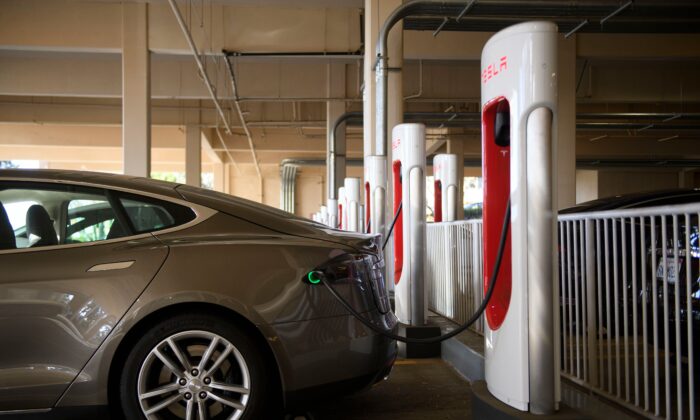
The cost to fuel electric vehicles in the United States is higher than gas-powered cars for the first time in 18 months, a consulting company said. But wait that's not all!
“In Q4 2022, typical mid-priced ICE (Internal Combustion Engine) car drivers paid about $11.29 to fuel their vehicles for 100 miles of driving. That cost was around $0.31 cheaper than the amount paid by mid-priced EV drivers charging mostly at home, and over $3 less than the cost borne by comparable EV drivers charging commercially,” Anderson Economic Group (AEG) said in an analysis.
However, luxury EVs still enjoy a cost advantage against their gas-powered counterparts.
It costs luxury EV owners $12.4 to drive every 100 miles on average if they charge their cars mostly at home or $15.95 if they charge their cars mostly at commercial charger stations in the 4th quarter of 2022.
Meanwhile, the fuel costs for luxury gas-powered cars are $19.96 per 100 miles on average.
AEG is a consulting firm based in Michigan that offers research and consulting in economics, valuation, market analysis, and public policy, according to the company’s website.
The fuel costs in the analysis are based on real-world U.S. driving conditions including the cost of underlying energy, state taxes charged for road maintenance, the cost of operating a pump or charger, and the cost to drive to a fueling station, AEG said.
Insurers List Crashed Low-Mileage Tesla on Auctions: Analysis
Insurance carriers are sending low-mileage Tesla Model Ys to salvage auctions because they are too expensive to repair.
Of more than 120 Model Ys that were totaled after collisions, then listed at auction in December and early January, the vast majority had fewer than 10,000 miles on the odometer, according to a Reuters analysis based on online data from Copart and IAA, the two largest salvage auction houses in the United States.
Copart and IAA auction listings note whether the vehicles were involved in front, rear, or side collisions, and typically include after-crash photos of each vehicle. But the listings do not disclose specific details on the type of damage suffered.
Copart listings in some cases included the names of insurance companies that had bought back crashed vehicles, then listed them at auction. Those companies include State Farm, Geico, Progressive, and Farmers. Geico is part of Warren Buffet’s Berkshire Hathaway Inc.
All the Model Ys in the Reuters analysis were 2022 or 2023 models that were built at either the Fremont plant in Northern California or the Austin, Texas, plant.
Insurance companies typically “total” a vehicle—which means to scrap it and reimburse the owner—when the estimated cost of repair is deemed too high.
An Austin-built 2022 Model Y Long Range involved in a front collision and listed by IAA in early January had a retail price of $61,388 and an estimated repair cost of $50,388. The vehicle’s owner was not listed.
A second Austin-built Model Y, involved in a side collision and listed by IAA, had a retail price of $72,667 and an estimated repair cost of $43,814.
Biden donor offered prez’s convict niece Caroline $85K job she called ‘below minimum wage’
A major donor to President Biden offered his ne’er-do-well niece a job in Los Angeles to help her get back on her feet (how far did she fall) in the summer of 2018, only for her to scoff at the $85,000 annual salary as “below minimum wage,” according to emails and text messages found on Hunter Biden’s laptop.
The drama unfolded as Caroline Biden, then 31, pleadedguilty on July 26 of that year to racking up over $100,000 in charges on a stolen credit card. She was sentenced to two years of probation, which she wanted to serve in California near her beloved cousin Hunter.
With Caroline needing a job in La-La Land for the probation department to allow her to move west, Hunter’s uncle and sometime business partner Jim Biden asked him to convince his daughter to take the offer from the Masimo Corporation, according to messages seen by the Washington Free Beacon.
“Hunter,” Jim texted July 25, the day before Caroline’s plea deal was formalized. “Caroline was made an offer and she told [Jim’s wife] Sara, not me, she couldn’t possibly {because she is an idoit} take it 85k 10% bonus full benefits, 3 week paid vacation, I [sic] week sick leave and 450 shares of stock!”
Caroline Biden scoffed at an $85,000 salary a Biden donor offered her for a job.
According to Caroline, Masimo Corporation did not offer her the job initially offered to her.
Joe Biden said he was done with Caroline after she raged against the offer.
Jim Biden also forwarded Hunter an email from Caroline with the subject line “Masimo Verbal Offer” in which she raged: “I cannot take a job full time and relocate for 85,000[.] That’s below minimum wage in California after taxes. I’m 31. I made more money every other year.”
Masimo, an Orange County-based medical device company, is headed by Joe Kiani, who the Daily Mail reported donated nearly $3 million to Biden’s 2020 presidential campaign, super PAC, and inaugural committee.
Caroline later told Hunter she “didn’t get the job” she was initially offered, but was “given an intern job at 31 years old because of your dad asking him to give me something even though I bombed it.”
Hunter Biden was told to convince his cousin to take the job.
On July 28, Caroline texted her cousin that Joe Biden “told me he was done with me yesterday.”
“I can get a job for 85K working one art deal,” she added. “I’m not a fit for the f—ing company.”
Caroline’s legal and personal issues continued into the following year, when she slammed her car into a tree in Pennsylvania while under the influence of prescription drugs.
She pleaded guilty the following year to DUI and avoided jail time, getting five-plus months of probation, with 20 days of an earlier rehab stint counted toward her sentence.
SUSPICIOUS TIMING: Pelosi Sold $3 Million of Google Stock Weeks Before Justice Department Launched Antitrust Probe
Former House Speaker and Rep. Nancy Pelosi and her husband Paul Pelosi conveniently sold around $3 million in shares of Google just before the Biden DOJ under Merrick Garland launched an antitrust investigation into the company.
“Paul Pelosi sold 30,000 shares of Google from Dec. 20 to Dec. 28, according to a financial disclosure filing the former House speaker submitted to the House Ethics Committee. The Pelosis made an undisclosed profit from the investments, according to the filing.
The trade proved timely. On Monday, the Justice Department and attorneys general from eight states—including California—sued Google over its monopoly on the digital ad market. The lawsuit could force Google to break up its online ad business, which generated nearly $55 billion in revenue for the company in the most recent quarter. Google’s stock has dropped around 6 percent since the Justice Department announced the lawsuit.
The trades are the latest in a string of questionable transactions for Paul and Nancy.
They saved roughly $600,000 in June by selling shares of microchip maker Nvidia weeks before the U.S. government placed restrictions on the company’s business in China and Russia. The Pelosis have seen their fortune grow $140 million since 2008, thanks largely to Paul Pelosi’s stock trades, according to a Washington Free Beacon analysis.”
This is pretty suspicious and reeks of corruption and inside knowledge. In the private sector trading on inside knowledge is illegal but for high ranking members of Congress it appears to be par for the course.
Pelosi and her pals seemingly corrupt stock market trades have sparked calls for stricter regulations on members of Congress to prevent them from cashing in on their positions of power and inside knowledge of future regulations, investigations and federal grants or investments.
In fact Missouri Senator Josh Hawley just introduced the aptly names PELOSI act to regulate stock trading by members of both the House and Senate:
As Pelosi and other members of Congress are rightfully criticized and questioned about their seemingly flawless ability to execute successful stock trades, Hawley recently revived an effort to enact strict controls over the investments made by members of Congress.
While he didn’t mention Pelosi specifically, it’s clear by the name of his cleverly worded proposal, the “Preventing Elected Leaders from Owning Securities and Investments (PELOSI) Act,” that the former Democratic speaker inspired it.
Hawley announced the new bill on Tuesday morning via Twitter and took a not-so-subtle shot at Paul Pelosi, the former speaker’s husband, over his whirlwind of profitable stock and options trades while his wife served as a top congressional leader.
“Members of Congress and their spouses shouldn’t be using their position to get rich on the stock market – today I’m introducing legislation to BAN stock trading & ownership by members of Congress. I call it the PELOSI Act,” Hawley wrote.
“For too long, politicians in Washington have taken advantage of the economic system they write the rules for, turning profits for themselves at the expense of the American people,” a statement from Hawley read.
“As members of Congress, both Senators and Representatives are tasked with providing oversight of the same companies they invest in, yet they continually buy and sell stocks, outperforming the market time and again.”
“While Wall Street and Big Tech work hand-in-hand with elected officials to enrich each other, hardworking Americans pay the price. The solution is clear: we must immediately and permanently ban all members of Congress from trading stocks,” the statement added
While this is a great piece of legislation and sorely needed I remain skeptical that a majority of the House and Senate will vote to eliminate any privilege that puts money directly into their own pockets.
Senior Staff Writer -- Vivek@bizpacreview.com Writers and editors can be contacted at writers@bizpcreview.com with feedback, tips, or corrections.
V. Saxena is a staff writer with a decade of experience as a professional writer, and a lifetime of experience as an avid news junkie. He holds a degree in computer technology from Purdue University. Saxena also contributes to BizPac Review.
Journalists with Project Veritas have obtained undercover footage of a top Pfizer official admitting that the pharmaceutical giant is exploring “mutating” COVID-19 so that they can “preemptively” develop new vaccines.
Think about what happened with COVID. The virus devastated the world, forcing everybody to turn to pharmaceutical giants like Pfizer for a vaccine. In the process, the company earned record profits.
If what Jordon Trishton Walker, the Pfizer Director of Research and Development, Strategic Operations, and “mRNA Scientific Planner,” said is true, does that mean Pfizer essentially wants to repeat the COVID pandemic for more profit?
Listen to Walker below to decide for yourself:
“You know the virus keeps mutating? Well, one of the things we’re exploring is, like, why don’t we just mutate it ourselves so we could preemptively develop new vaccines, right?” Walker openly admits.
He then acknowledges the massive risk that mutating an already dangerous virus entails.
“If we’re gonna do that, though, there’s a risk of, like, as you can imagine, no one wants to be having a pharma company mutating f–king viruses,” he says.
“You have to be, like, very controlled to make sure that this virus that you mutate doesn’t create something, like, [that] goes everywhere. Which, I suspect, is the way that the virus started in Wuhan, to be honest. Like, it makes no sense that this virus popped out of nowhere,” he adds.
Apparently, Walker is a believer of the lab leak theory. He’s not alone in that regard.
Walker continues by suggesting that the work Pfizer is proposing doing would be like gain-of-function research.
“You’re not supposed to do gain-of-function research with the viruses. They’d rather we not, but we do these selected structure mutations to try to see if we can make them more potent. So, there is research ongoing about that. I don’t know how that’s going to work. There better not be any more outbreaks cause, like, Jesus Christ,” he says.
He adds that Pfizer is a “revolving door for all government officials.”
“It’s pretty good for the industry, to be honest. It’s bad for everyone else in America. Because if the regulators who review our drugs, you know that once they stop being a regulator, they want to go to work for the company, they are not going to be as harsh on the company where they’re getting their job,” he says.
Now in fairness to Pfizer, Walker suggests that it’s exploring mutating the COVID virus for noble reasons.
“Part of what they [Pfizer scientists] want to do is, to some extent, to try to figure out, you know, how there are all these new strains and variants that just pop up. So, it’s like trying to catch them before they pop up and we can develop a vaccine prophylactically, like, for new variants,” he says.
“So, that’s why they like, do it controlled in a lab, where they say this is a new epitope, and so if it comes out later on in the public, we already have a vaccine working,” he adds.
But, Jordan adds, it’s only good when this type of research works.
“Some of the times, there are mutations that pop up that we are not prepared for. Like with Delta and Omicron. And things like that. Who knows? Either way, it’s going to be a cash cow. COVID is going to be a cash cow for us for a while going forward. Like obviously,” he says.
Wait, what?
Walker’s admissions have prompted massive outrage on social media. Below is just a tiny sample of that outrage:
Lawmakers in at least six states, including Texas, will ponder 2023 bills proposing to establish new “school choice” programs with Florida legislators looking to expand what is already the nation’s largest use of taxpayer dollars for private school tuitions when they convene in March.
Depending how “school choice” is defined, 47 states offered various taxpayer-funded programs in 2021 to more than 660,000 students—mostly children with special needs—according to the Florida-based National School Choice Awareness Foundation (NSCAF), a nonprofit that orchestrates the annual January National School Choice Week, which is Jan. 22 to 28 this year.
For advocates, “school choice” describes programs that give parents state money to send their children to a school of their choice, including private schools. The most common are education service accounts (ESAs), vouchers, and tax-credit scholarships.
There are 76 ESA and tax-credit programs on the books in 32 states, the District of Columbia, and Puerto Rico that offered vouchers and/or tax-credit scholarships for students based on family income to more than 350,000 students in 2021, reports EdChoice, a school choice advocacy group based in Indianapolis, Indiana.
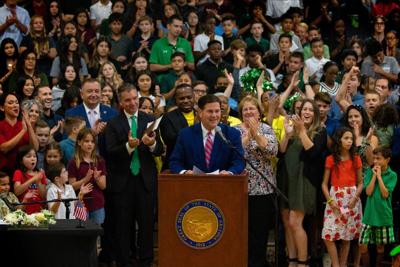
Proponents maintain that school choice is gaining acceptance among demographic and political groups that were once its most ardent opponents. For instance, Pennsylvania’s newly elected Democratic Gov. Josh Shapiro included a school choice mechanism, education savings accounts, into his successful 2022 gubernatorial campaign.
Nearly 54 percent of parents of more than 3,800 surveyed told NSCAF that there have considered a new school for their children in the past year, with the rate of dissatisfaction increasing with the age of the parents, and 65 percent expressing interest in exploring schools choice options available in their state.
NSCAF Vice President of Public Awareness Shelby Doyle told The Epoch Times that the surveys confirm years’ long trends, especially among non-white parents.
“We’ve only been doing our parent surveys for a couple of years. But for the last couple of years, this interest has been consistent from all of the different demographic groups,” she said.
Part of that increase in interest comes from a marketing tweak. School choice proponents dismiss the longtime education financing model where school districts receive per-pupil funding and instead encourage parents to think of the state’s per-pupil allocation as their child’s money that can be spent how parents want it spent—even if it is tuition at a private school.
Senior Fellow with the American Federation for Children, Corey DeAngelis, told The Epoch Times that money in state school systems should be attached to individual students, not to whatever school district is in a student’s post office zip code.
“We should fund students, not systems,” DeAngelis said.
Wisconsin has four voucher programs: one to serve students with special needs, two to serve low-income families earning up to 300 percent of the federal poverty level, and the Parental Choice Program, which serves students from low-income families statewide earning up to 220 percent of the federal poverty level.
In the Indiana Choice Scholarship Program, students from families earning up to 277.5 percent of the federal poverty line are eligible, as are all Individualized Education Plan (IEP) students in a low-performing district school.
— Tax-Credit Programs: Tax-credit scholarships (TCS) grant full or partial tax credits to donors, which may include corporations and individuals, when they contribute to nonprofits that provide private school scholarships.
There are 26 tax-credit programs across 21 states that issued 325,168 scholarships during the 2020-21 school year averaging $3,715, with 72 percent of the money coming from private sources.
Arizona, Georgia, and Montana have TCS programs that do not restrict student eligibility based on income or special-needs status. In Alabama, Florida, Iowa, Illinois, Indiana, Kansas, Louisiana, Nevada, New Hampshire, Oklahoma, Pennsylvania, Rhode Island, South Dakota, and Virginia, eligibility is based on income.
There are TCS programs in Arizona and South Carolina specifically designed for students with special needs, and one in Florida for victims of bullying or abuse.
The nation’s largest TCS program is Florida Tax-Credit Scholarship Program, which served 106,112 students enrolled in 1,945 schools during the 2020-21 school year. The average grants were $6,239—about 65 percent of the state’s per-pupil base allocation.
The scholarships are available to families earning up to 260 percent of the federal poverty level. There is $873.6 million in tax credits available annually for the program, which is equivalent to 2.9 percent of Florida’s total K-12 revenues. The tax credit cap automatically increases by 25 percent each year if at least 90 percent of the fund is used.
Pennsylvania’s two tax-credit scholarship programs, the Education Improvement Tax Credit and the Opportunity Scholarship Tax Credit, each limit participation to students from families earning no more than $77,648 plus $15,230 per each dependent child. The limit is adjusted annually based on inflation, and students with special needs have higher income limits.
In 2022, Arizona’s new school choice law went into effect on Sept. 30 after a bid to repeal it with a proposed constitutional amendment failed to gather enough signatures to get on the 2024 ballot, and the Tennessee ESA Act, a 2019 bill that created a school choice pilot program, wasn’t launched until fall 2022 after the state’s Supreme Court cleared it of legal challenges.
During their 2022 session, Arizona lawmakers adopted House Bill 2853, which expands the state’s Empowerment Scholarship Account program and removes restrictions on how the state’s 1.1 million K-12 students can spend their annual $7,000 ESA grant, including for homeschooling expenses or private school tuition.
Critics, including Save Our Schools, argue that the ESA program will siphon $76 million from public schools and funnel it into private schools and homeschooling. They predict the program will balloon to more than $1 billion a year and bankrupt the public schools the vast majority of Arizona K-12 students will still be attending.
Under the 2019 Tennessee ESA Act, eligible families could receive approximately $8,100 in public tax dollars in ESAs to help pay for private schooling tuition and other pre-approved expenses.
Beacon Center of Tennessee President and Chief Executive Officer Justin Owen told The Epoch Times that support for school choice is clearly growing in Tennessee.
“A whole lot of polls show people overwhelmingly support choice and that cuts across party lines—Republican, Democrat. It really is something that people support and I think that legislative support for it has grown, too,” he said.
Here’s a roundup of 2023 school choice bills or emerging initiatives in state legislatures across the country:
— Texas: After decades of rejections, Gov. Greg Abbott, Lt. Gov. Dan Patrick, and Texas GOP leadership are convinced Texas will finally adopt a school choice program in 2023. To that end, Sen. Mayes Middleton (R-Wallisville) has introduced SB 176, which would create a school choice program similar to Arizona’s.
SB 176 would create an ESA program that would allow families to opt out of the state’s public education system to receive the average per-pupil annual education allocation, which would be about $10,000 a year.
Rep. Matt Shaheen (R-Plano) has filed House Bill 619, which would give tax credits to individuals who make contributions to private school scholarship funds. Another measure HB 557, sponsored by Rep. Cody Vasut (R-Angleton), would authorize the state to reimburse parents for private school tuition.
The bills are the most significant push for school choice in Texas since 2017, when similar bills faced stiff opposition from rural communities, especially in North Texas,. and public schools advocates who argue that the programs degrade public schools.
— Virginia: Del. Glenn Davis (R-Virginia Beach) has filed HB 1508, which would createthe “Virginia Education Success Account Program.”
Under HB 1508, parents of any Virginia child enrolled in public school can spend an average of $6,000 annually on tuition, fees, and textbooks at private K-12 schools or use them for homeschooling expenses.
Davis told The Epoch Times that the ESAs created in his bill would spur competition among schools to garner students. “Our goal should be to improve the educational outcomes for all students,” he said, noting “too many students are trapped in schools that are failing them, especially in our historically black communities. This bill allows parents to choose the educational experience best suited for their child.”
“Virginia House Bill 1508 would fund students directly and empower families to choose the education providers that best meet their needs and align with their values,” American Federation for Children Senior Fellow Corey DeAngelis told The Epoch Times.
HB 1508 is one of four school choice-related 2023 bills filed in Virginia, including HB 1396, filed by Del. Marie March (R-Floyd), which would allow all Virginians, regardless of income or previous schooling, to be eligible for the ESA program. March’s bill has the support of Republican Virginia Gov. Glenn Youngkin.
SB 823, sponsored by Sen. Amanda Chase (R-Chesterfield), would make families earning up to 300 percent of the federal poverty line eligible for tax-credit scholarships.
HB 1371, filed by Del. Phillip Scott (R-Spotsylvania), is a “universal school choice” bill without income-based restrictions. It would make any Virginia child enrolled in a public school eligible.
— Missouri: Missouri lawmakers in 2021 created its MOScholars school choice program that is limited to families who live in a county or city with a population of at least 30,000. The program was initially capped at $25 million—enough to cover 3,450 students.
Several 2023 proposals seek to expand MOScholars, including SB 360, filed by Sen. Andrew Koenig (R-Manchester), which would make more students eligible by lowering income restrictions.
Rep. Josh Hurlbert (R-Smithville) has filed a passel of school choice-related bills, including HB 243, which is similar to SB 360; HB 242, which would make all students eligible for MOScholars; and HB 241, which would require school districts allow homeschooled students to participate in activities and sports.
SB 81, sponsored by Sen. Mary Elizabeth Coleman (R-Arnold) would create a refundable tax credit covering all eligible homeschooling expenses, while SB 226 sponsored by Sen. Nick Schroer (R-O’Fallon) would create a refundable tax credit for 100 percent of tuition parents pay for private school or a public school outside their home district.
SB 5, also introduced by Koenig, and HB 253, sponsored by Rep. Brad Pollitt (R-Sedalia) would allow students to transfer to other public schools within and outside their school districts. School districts can opt out of the program or limit the percentage of students who could transfer.
— Iowa: Iowa House Republican leaders are pushing Gov. Kim Reynolds’ proposed school choice expansion that would allocate parents $7,600 per student each school year. Her proposal would boost students participating in the state’s school choice program from 33,000 to 38,000 students in its first year, she maintains.
Critics such as Common Good Iowa say the only Iowa families that will benefit from Reynolds’ school choice plan are those who already have a choice. Of the state’s 99 counties, there aren’t any private schools in 41 and only one in another 23 counties. Opponents argue rural taxpayers without school choice will be subsidizing school choice for families in more suburban and urban areas under Reynold’s proposal.
Common Good and other opponents say the $340 million Reynolds’ school choice expansion when fully implemented would consume 9 percent of the state’s education budget but benefit only about 1 percent of the Iowa’s approximately 500,000 K-12 students.
— Montana: Sen. Theresa Manzella (R-Hamilton), who leads the Montana Freedom Caucus, said conservative priorities in 2023 include election integrity, parental rights, returning $2 billion in “surplus money” to taxpayers, judiciary reform, and promoting school choice.
— Kentucky: Lawmakers in 2021 adopted the “Education Opportunity Act,” Kentucky’s first school choice program, but it remains in limbo after the state’s Supreme Court found it unconstitutional in December 2022.
Under the approved program, state taxpayers could donate to account-granting organizations (AGOs) and receive a “near dollar-for-dollar tax credit against their income taxes.”
The donations would be funneled by AGOs into individual eligible student’s Education Opportunity Accounts (EOAs), which are essentially the same as ESAs, and could be used for various education-related expenses, including private school tuition.
The 2021 bill passed the House by one vote and was vetoed by Democrat Gov. Andy Beshear. Both chambers in the General Assembly subsequently overrode the veto in two-thirds votes to adopt the “Education Opportunity Act.”
Under the Act, students from families earning no more than 175 percent of federal poverty line—$85,800 for a family of four in 2020-21—are eligible to receive up to $4,700 in their EOAs for school expenses, including private school tuition.
The legislation was to go into effect June 29, 2021, but was legally challenged. A lower court found the legislation violated the Kentucky Constitution. Proponents appealed to the state Supreme Court, which in December upheld the lower court ruling.
EdChoice Kentucky President Andrew Vandiver told The Epoch Times that the “Kentucky Supreme Court does not set educational policy” and expects the legislature to produce proposals to remedy the court’s ruling.
Indeed, at least four proposed 2023 bills addressing school choice await Kentucky lawmakers when they convene Feb. 7 in Frankfurt.
— Florida: Florida already has the largest enrollment in school choice programs than any state in the nation but could see a dramatic expansion in voucher and tax-credit scholarships if HB 1 filed by Rep. Kaylee Tuck (R-Lake Placid) is adopted.
HB 1 would remove nearly all eligibility requirements in the state’s Family Empowerment Scholarship program, now limited to households earning at or below 375 percent of the federal poverty level. The “universal voucher” proposal would make a family of four with an income of more than $104,063 per year eligible for scholarships worth $7,250 to $7,850 per student beginning the 2023-24 school year.
Students from families that earn 185 percent or less of the federal poverty line will retain priority under HB 1, which gets its first hearing Jan. 26 before the House Choice & Innovation Subcommittee.
Proponents say lifting the financial restrictions would make 9,399 Florida special needs students on a waiting list for scholarships eligible immediately. The bill would also allow parents who home-school their children to be paid, although HB 1 limits the initial rollout to 10,000 students.
No similar bill has been filed in the Senate. Senate President Sen. Kathleen Passidomo (R-Naples) backs HB 1.
“This historic legislation empowers parents, ensuring they direct the significant funding Florida taxpayers are dedicating to education to the best education program for their child,” Passidomo said in a statement.
“Here in the free State of Florida, we trust parents to make the best decisions for their children. This visionary bill ensures school choice remains a reality for every child in every family across our great state by providing parents the chance to guide how and where the funding for their children’s education is spent.”