GREENLAND
President-elect Donald Trump revealed Tuesday that he would not rule out using military force to annex Greenland, leaving many Americans asking: “But why?”
In fact, the ice-covered Danish territory, the largest island in the world, has long been a hot topic among strategists in Washington and elsewhere — despite Copenhagen’s insistence it is not for sale — due to its location along vital shipping routes and the presence of key raw materials that are rarely found anywhere else.
“Why? A few critical reasons,” a source close to the Trump transition efforts told The Post on Tuesday when asked about the president-elect’s goal. “Sending a strong, deliberate message to Beijing. Not just talk. Action. Making America Ambitious Again.
“And the president-elect is laying out the early framework of the ‘Trump Doctrine.'”

The US is currently locked in a three-cornered fight with China as well as Russia over the Arctic region’s natural resources — such as lithium, cobalt and graphite, according to the Wilson Center, a foreign policy-focused think tank in Washington.
“There are two main reasons [to annex Greenland]. The first is the large deposits of rare earth elements needed for critical defense and electronics manufacturing,” Atlantic Council nonresident fellow Alex Plitsas told The Post.
“Second, Greenland has a legitimately large claim to the Arctic and that would provide the US with a stronger position as competition there heats up for navigation and resources.”
ARCTIC ACCESS AND RESOURCES
The US has been in a quiet contest with China and Russia over access to the Arctic for years, deploying military ice-breaker ships to the region on missions to explore the resource-rich frozen tundra.
Washington has traditionally been over-reliant on China for rare earth minerals, which are most frequently found in the Arctic in addition to Asia — and used in everything from cell phones to weapons of mass destruction.
According to Plitsas, this dependency on Beijing is “not sustainable given geopolitical realities.”
“Other major deposits exist in places like Afghanistan, which is also infeasible for a number of reasons,” he noted.

“With the increasing demand for electric vehicles, renewable energy systems, and advanced electronics, the United States heavily relies on critical materials to drive innovation and maintain its global economic competitiveness,” the Wilson Center wrote in a 2023 report.
“[Rare earth minerals] go into most forms of national defense, technologies, missiles, tanks, satellites, warships, fighter jets, and so as a result, securing them becomes a national security imperative,” explained Center for Strategic and International Studies critical minerals security program director Gracelin Baskaran.
Meanwhile, synthetic real earth elements created in labs, in Plitsas’ words, “don’t perform as well, which leaves the US vulnerable on the defense manufacturing side as tensions with China have continued to rise in recent years.”

The competition over the Arctic has grown more fierce in recent years due to climate change, which has led to melting of the ice caps that previously made resources nearly impossible to reach.
“Warming has led to more freedom of navigation in the Arctic,” Plitsas said.
But the Americans so far have been outpaced by their adversaries, in part due to the US’ limited access to the region and relatively small number of ice-breaker ships.
The problem has long vexed some Republicans, including Rep. Mike Waltz (R-Fla.), Trump’s designated national security adviser.
“In the Arctic where we will compete for natural resources, #Coast Guard needs more than one icebreaker! Russia has dozens!” he posted to X in 2017.
The Coast Guard currently has just two of the vital ships, but Waltz recently vowed to push for more in the 119th Congress in a reply to a post on X calling for “a dozen more” icebreakers.
“That’s the plan!” Waltz promised on Dec. 24.

Additional icebreakers and the acquisition of Greenland are particularly attractive prospects now that the United States is constructing more rare earth mineral processing plants — part of the recent American push to lessen its reliance on China.
But with the US home to just 1.3% of the world’s rare earth minerals — compared to China’s up to 70% — “now we need to source those rare earths from somewhere to process at home … which does give Greenland some appeal, because it could be a source of rare earth minerals,” Baskaran said.
‘Not for sale’ … "We The People of Greenland will decide"
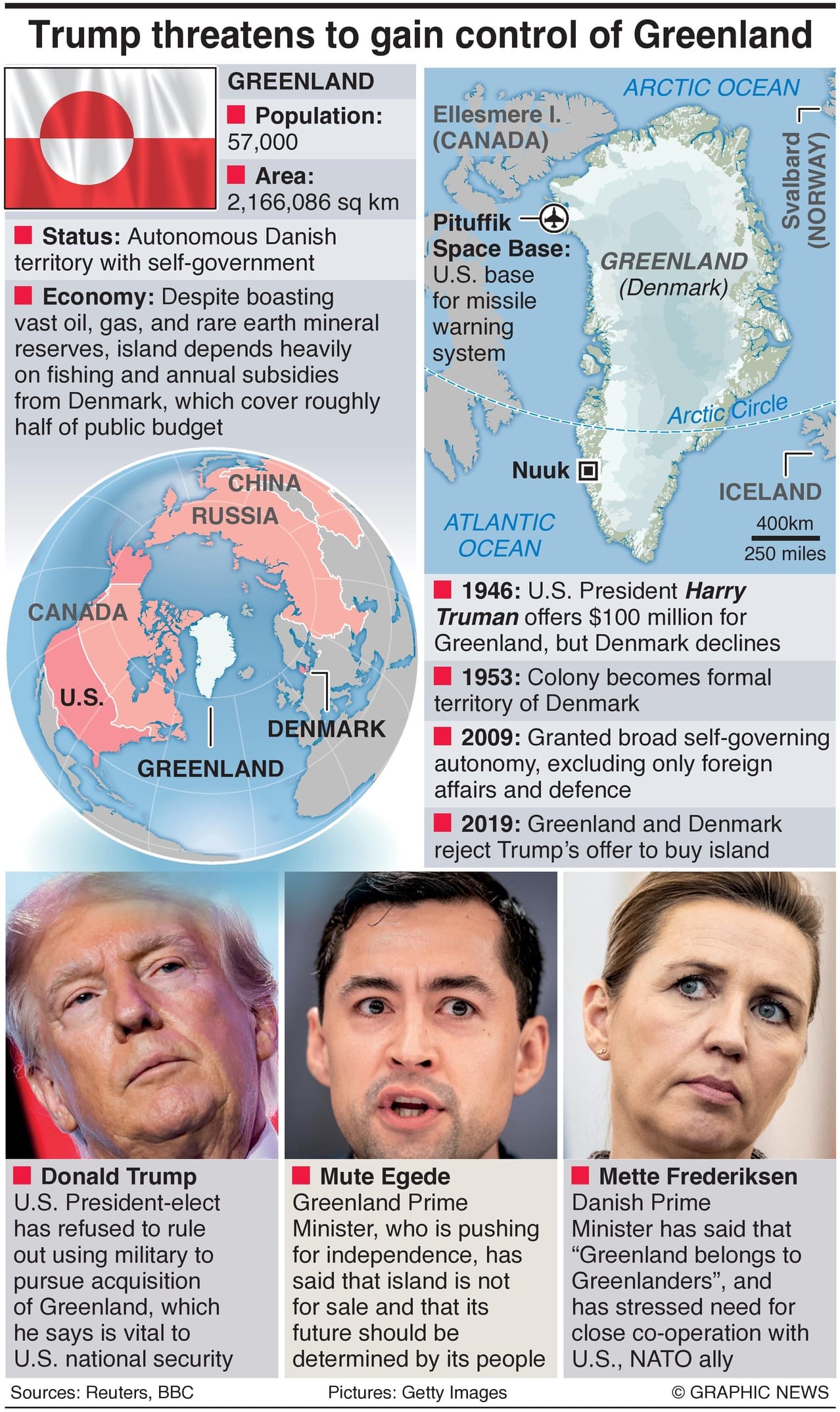
Trump’s ambition has not been well received in Denmark, where Prime Minister Mette Frederiksen reiterated Tuesday that the territory is “not for sale.”
“Greenland belongs to the Greenlanders,” Frederiksen said in an interview with Denmark’s TV 2. “On one hand, I am pleased regarding the rise in American interest in Greenland. But of course it is important that it takes place in a way where it is the Greenlanders’ decision, what their future holds.”

The island only gained full autonomy in 2009, and since then its territorial government has been working to achieve sovereignty, Greenland parliament member Kuno Fenckertold CNN on Tuesday.
“In regards to ownership, we can disagree here quite a lot, because we are working on creating a sovereign country which is Greenland, and we want to create the state of Greenland,” Fencker said, adding that the territorial government may be willing to work with the US on a free association agreement.
The US already has such arrangements with Pacific island nations such as Palau. Those compacts require Washington to provide financial assistance to the freely associated countries, and also extends the right to work and live in the United States to island citizens as “habitual residents.”
“The main [point] here is that Greenland [status] should be [a] tremendous decision, what kind of state we would like to be and also who we should cooperate with and our nearest allies, which you know, we have been under the Danish,” Fencker said.
The transition source said Trump, 78, may be willing to discuss alternate arrangements with Greenland officials short of full annexation.
“There’s flexibility in discussing the best means to strengthening America’s security, so I think it’s fair to say there’s more than one option,” the person said.


NOT A NEW IDEA
The United States has long been interested in obtaining Greenland, considering making a bid for the North Atlantic island in 1867, when it also purchased Alaska from Russia.
Roughly eight decades later, after World War II, the US bid $100 million in gold bullion for Greenland, which Denmark declined.
However, the offer led to a defense treaty that granted the US access to Thule Air Base, now Pituffik Space Base — the military’s northernmost outpost, which became critically important during the Cold War due to its proximity to Russia.
Trump floated the idea of buying Greenland in his first term, musing about the possibility publicly in 2019, only to be flatly refused by Greenland and Denmark leaders.
Pivot from the Middle-East to Arctic Circle Redefining Global Power Dynamics Isolating China's Influence … and more
President Trump first mentioned Greenland in August 2019, during his first term. He publicly expressed interest in buying the island and was, as usual, mocked by the liberal elite.
Greenland is a self-governing, autonomous territory under the Kingdom of Denmark. At Tuesday's press conference at Mar-a-Lago, Trump raised the issue again and threatened Copenhagen with steep tariffs if Denmark did not allow a vote on self-determination for Greenland's residents—whether to remain part of the Kingdom or become part of the United States. To understand why Greenland has become a focal point in global geopolitics, it’s essential to examine its historical, economic, and strategic context.
Greenland’s vast icy expanse and strategic location make it more than just a territorial prize—it’s a keystone in the Arctic power struggle, with implications for security and commerce.
The Trump campaign towards Greenland has been excellently managed so far. As the president-elect was winding down his press conference, Trump Force One, his Boeing 757, was taking off from the ice-covered island, on its return to the United States. Among the passengers were Don Trump Jr., the elder son of the President-elect and a close confidant, and Charlie Kirk, an influential youth leader who drove millions of young people to vote for Trump in November. The overall message was clear: acquiring Greenland is high on the list for the 47th president.
Curiously, the last time an American president acquired territory also involved Denmark. President Harry Truman signed the Treaty of Paris with Denmark, officially transferring the Virgin Islands to the United States. This acquisition occurred in 1917, but the formal treaty was ratified in 1947, marking the last significant territorial acquisition by the U.S. through presidential action.
WHEN NOT IF ...
If a treaty is signed in the future, Greenland’s residents could instantly acquire United States citizenship. They would continue paying taxes to Greenland (as opposed to the IRS) but enjoy full Social Security and Medicare benefits funded by the United States Treasury. They would not be entitled to vote in federal elections as they would not have voting representation in Congress or for President. In a self-determination vote, Trump hopes that most islanders would vote to secede from Denmark and join the United States.
During the press conference, Trump alluded to the proposal as a national security measure in the hopes that it would get him bipartisan Congressional support.
STRATEGIC LOCATION
Greenland is the world's largest island, with an area of approximately 836,330 square miles. The Greenland Ice Sheet covers a substantial portion of the area, with depths reaching about 2 miles. The population is relatively small, around 56,000, and they predominantly live on the southwest coast. Indigenous Inuit have inhabited the island for more than 3,000 years and are largely involved in traditional hunting and fishing. Assimilating such a small population as an unincorporated U.S. territory wouldn't be difficult if Trump offered the same benefits to Greenland residents as those enjoyed by the Virgin Islands.
Greenland's location in the Arctic makes it attractive to the United States. Currently, control over the Arctic's waters and resources is primarily determined by the United Nations Convention on the Law of the Sea (UNCLOS), with five countries that border the Arctic—Canada, Denmark (via Greenland), Norway, Russia, and the United States (via Alaska)—having substantial influence over Arctic policy.
The Arctic's significance primarily stems from the ocean's connection to the Atlantic and Pacific Oceans through various straits and passages, which are crucial for naval operations, including submarine traffic. The Arctic is believed to hold vast reserves of oil, natural gas, minerals, and fish, making it a region of economic interest. The desire to control, exploit, or access these resources could influence military strategies to protect or assert claims. As the ice recedes due to climate change, and new shipping routes—like the Northern Sea Route and the Northwest Passage - become viable, maritime governance of the region will become a top priority.
Trump referred to both Russia and China at his press conference, acknowledging that the two countries are on his radar as strategic threats to American national security. While China is not part of the Arctic Five, its recent "Partnership Without Limits" closeness to Russia concerns Washington. Russia operates the world's largest nuclear arsenal, and China has built the world's largest standing army. Both countries have technological capabilities (for example, Russia's hypersonic missile) that, in some cases, are superior to America's.
Russia has significantly increased its military presence by reopening and modernizing Soviet-era bases and investing heavily in Arctic operations. The Arctic's unique environment facilitates strategic submarine activity, particularly for nuclear-powered ballistic missile submarines, which can operate beneath the ice for extended periods. Additionally, the region's harsh conditions mean that surveillance, communication, and intelligence gathering require specialized technology for missile defense systems, which include the defense of North America from ballistic missile threats.
Trump correctly views the Arctic's military significance - involving a complex interplay of geopolitical strategy, resource control, environmental changes, and technological advancements - as far more critical to global security than the Russia-Ukraine war. "I'm talking about protecting the Free World," Trump said.
The President-elect’s words have been heard in Copenhagen. Though, in 2019, Trump’s plans for Greenland were dismissed as ‘absurd,’ much has changed since. The Danish Foreign Minister Lars Lokke Rasmussen told reporters, “We are open to a dialogue with the Americans on how we can possibly cooperate even more closely than we do to ensure that the American ambitions are fulfilled,” signaling that the Danes are not keen on jeopardizing diplomatic ties with a close ally and fellow NATO member.
Stateside, for the first time since Ronald Reagan, who single-handedly ended the Cold War without a shot being fired, we are witnessing Trump's vision for American hegemony. MAGA just took on a whole new dimension.
Greenland's strategic location and abundant natural resources have attracted interest from global powers, including China, Russia, and European Union (EU) countries. However, detailed public data on the exact amounts of foreign investment from these entities in Greenland is limited. Here's an overview based on available information:
China:
Interest in Rare Earth Elements (REEs): China has shown significant interest in Greenland's REE deposits, essential for various high-tech industries. In recent years, Chinese firms have attempted to invest in Greenland's mining sector. For instance, the U.S. and Danish officials lobbied Greenland's largest rare earths deposit developer, Tanbreez Mining, to avoid selling its project to Chinese-linked firms, highlighting the geopolitical sensitivity of such investments.
Infrastructure Projects: China has expressed interest in developing infrastructure in Greenland, including airports and mining facilities. These proposals have raised concerns among Western nations about China's strategic intentions in the Arctic region.
Russia:
- Limited Direct Investment: There is limited public information on direct Russian investments in Greenland. However, Russia closely monitors developments in the Arctic, including Greenland, due to strategic and security considerations. Russian officials have expressed concerns over U.S. intentions in Greenland, emphasizing the region's importance.
European Union (EU) Countries:
Denmark's Role: As Greenland is an autonomous territory within the Kingdom of Denmark, Danish investments play a significant role in Greenland's economy. Denmark provides substantial subsidies to Greenland and has been involved in various development projects.
EU Interests: The EU has shown interest in Greenland's critical raw materials, particularly those essential for the green transition. Efforts are underway to establish solid Foreign Direct Investment (FDI) regulations in Greenland to facilitate and manage such investments.
CONCLUSION:
While Greenland's resource potential has attracted international interest, especially from China and EU countries, specific figures on foreign investments are not extensively documented publicly. Geopolitical sensitivities and strategic considerations influence investment decisions in the region. Greenland's government continues to navigate these interests, aiming to balance economic development with national security and environmental concerns.
As of January 2025, there is no widely recognized mining company named "Critical Metals Corp." based in Australia. It's possible that the company operates under a different name or is a recent entrant to the market.
Australia plays a significant role in the global rare earth elements (REE) market. The country holds at least 4% of the world's REE reserves and has been actively developing its critical minerals sector to reduce dependence on dominant suppliers like China. Recent investments and government initiatives aim to enhance Australia's mining and processing capabilities, thereby contributing to a more diversified and resilient global supply chain for these essential materials.
For instance, the Australian government has increased financial support for the construction of the country's first rare-earths refinery, led by Iluka Resources in Western Australia. This project seeks to break China's dominance in the critical minerals supply chain.
Additionally, companies like Alpha HPA have secured significant supply deals for high-purity alumina, essential for cooling semiconductor chips in AI data centers, further strengthening Australia's position in the critical minerals market.
If "Critical Metals Corp." is a recent or emerging company in Australia, its impact on the global REE market would depend on factors such as the scale of its operations, the quality of its resource deposits, and its ability to navigate regulatory and market challenges. Given the competitive and rapidly evolving nature of the critical minerals sector, new entrants can influence market dynamics, especially if they bring innovative technologies or significant production capacities online.
For the most accurate and up-to-date information, consulting industry reports or official company releases would be advisable.
We’re watching you, Russia warns Trump over Greenland
Denmark admits it has neglected the defence of its autonomous territory as the Kremlin says Moscow has strategic interests in the Arctic ...
Trump, who takes office on January 20, has refused to rule out using military or economic action to take control of Greenland, an autonomous Arctic territory of Denmark, a Nato member state. He has also suggested that Washington could use military force to seize the Panama Canal and that Canada should become the 51st state of the US.
Mette Frederiksen, the prime minister, said on Thursday that she had asked for a meeting with Trump, but did not expect it to happen before his inauguration.
Fredericksen also downplayed Trump’s refusal to rule out military force: “I don’t have the fantasy to imagine that it’ll ever get to that,” she told Danish TV.
In Moscow, Dmitry Peskov, President Putin’s spokesman, declared: “The Arctic is a zone of our [Russia’s] national interests, our strategic interests. We are interested in preserving the atmosphere of peace and stability in the Arctic zone. We are watching the rather dramatic development of the situation very closely, but so far, thank God, at the level of statements.”

Aleksandr Moiseyev, head of the Russian navy, warned of a “confrontation” over the Arctic
WIKIPEDIA
The Kremlin has stepped up its military presence in the Arctic in recent years, opening new permanent bases and deploying its most advanced anti-aircraft missiles to the region as it seeks to control large reserves of oil and gas in disputed waters.
• Why is Trump so interested in Greenland?
Scientists say that by 2050 much of the Arctic region will be ice-free in summer, opening up new opportunities for lucrative commercial shipping along the northern sea route, a passageway from northern Europe to Asia that the Kremlin is touting as a faster alternative to the Suez Canal. China is also seeking to expand its foothold in the Arctic.
Last month Admiral Aleksandr Moiseyev, head of the Russian navy, warned of a “confrontation” between world powers over control of the Arctic.
Peskov accused European countries of failing to condemn Trump’s threats. “Europe reacts very timidly and it is of course scary to react to Trump’s words, therefore Europe reacts very cautiously, modestly, quietly, almost in a whisper,” he said.
Both France and Germany have sharply criticised Trump over his remarks.
David Lammy, the British foreign secretary, said on Thursday that he believed Trump’s remarks showed “his desire to pursue foreign policy through a lens of ‘peace through strength’ and through a degree of unpredictability”.
Lammy said: “I think what he’s got in his sights is concerns in the Arctic — which we share — about Russian and Chinese influence. Of course, there are US troops based in Greenland and a US base.
“[Trump] knows that Greenland is a kingdom of Denmark, but he also knows that there is a debate in Greenland in relation to their self-determination. I think he knows what he’s up to.”
Trump’s comments will be “music to many ears in Moscow and Beijing,” according to Professor Michael Clarke, former director-general of the Royal United Services Institute in London.
“Another drift back into an imperialist world where the big powers think they have a natural right to take whatever they want,” he wrote on X.
Mute Egede, Greenland’s prime minister, flew to Denmark to meet both Frederiksen and King Frederik X on Wednesday. Egede favours independence for his homeland and has said it is not for sale.
On Thursday night, party leaders from across the political spectrum gathered for an extraordinary meeting on the crisis with Frederiksen in Denmark’s parliament. Previously, in 2019, she rebuffed an offer from Trump to buy Greenland.
