TARIFFS WON’T SAVE THE US DOLLAR … THIS SHOULD BE READ CAREFULLY!

In a November 30 Truth Social post, President-elect Trump threatened BRICS states—Brazil, Russia, India, China, South Africa, Iran, Ethiopia, Egypt, and the United Arab Emirates, plus more states in the process of joining—with 100 percent tariffs on their exports to America if they dared to attempt replacing the US dollar as an international trade currency:
The idea that the BRICS Countries are trying to move away from the Dollar while we stand by and watch is OVER. We require a commitment from these Countries that they will neither create a new BRICS Currency, nor back any other Currency to replace the mighty U.S. Dollar or, they will face 100 percent Tariffs, and should expect to say goodbye to selling into the wonderful U.S. Economy. They can go find another “sucker!” There is no chance that the BRICS will replace the U.S. Dollar in International Trade, and any Country that tries should wave goodbye to America.
When one examines international trade data in detail, however, some curious anomalies in Trump’s statements become evident. For one thing, the world needs the BRICS economies for both merchandise exports and imports far more than the world needs America. China (including Hong Kong) all by itself is a bigger importer and far bigger exporter of goods than America. America only accounts for 13 percent of the world’s merchandise imports and less than 9 percent of its merchandise exports. If the world’s economy were to fragment into rival currency/trade blocs, most countries outside of North America would regard access to BRICS markets, not to America’s markets, as being a higher priority.
A NAFTA bloc and its US dollar would be competing on unfavorable terms with a BRICS bloc, a Euro bloc, and maybe a Japanese-led bloc for access to the natural resources and other factors of the less-industrialized countries. Fears of being cut off from natural resources, in turn, incentivizes hostile blocs to turn into hostile military alliances, and for their trade and currency wars to turn into world wars.
For another thing, Trump’s threats mean nothing to states that are already under severe sanctions like Russia and Iran. They export practically nothing to America. It is Chinese manufacturers who have the most to lose by the BRICS bloc antagonizing Trump, with their annual export revenues on the order of $450 billion at stake (about 3/4ths of all BRICS exports to America). However, Chinese dictator Xi has undoubtedly calculated that China’s economy is likely going to be targeted by American statists anyway, so he has every incentive to preemptively create a sanctions-proof international medium of exchange in spite of risks to export markets, just as BRICS has already created an independent wire payments system and an independent multinational credit institution to bypass American-aligned institutions. Trump’s brazen threat only provides more evidence that the American government is not a trustworthy steward of an international monetary system, and thus makes migration away from a dollar-dominated system towards some sort of alternative money even more urgent and compelling for every state that fears arousing Washington’s ire.
Yet another odd thing about Trump’s threat is that trade barriers hurt Americans as well as foreigners. It is not simply that case that big box retailers are filled from floor to ceiling with inexpensive Chinese-made consumer goods that Americans can’t seem to get enough of. The data show that China is a critical supplier of electronics and machinery too, something which American businesses depend heavily on for their own productivity. Tariffs do nothing to address the root causes of America’s deindustrialization, but suddenly cutting off access to Chinese-made capital goods and forcing diversions of scarce inputs to sectors where America lacks comparative advantages to make up for lost imports means tremendous losses of productivity and real incomes for American workers. Tariffs can certainly accelerate the deindustrialization process and the decline of the middle class and make dollar-denominated accounts and assets even more unattractive to foreigners. Carrying out Trump’s threat would be spectacularly counterproductive for the Americans who voted for Trump.
To be sure, a fragmentation of the world’s economy into rival blocs hurts everyone, not just Americans, so Trump’s threat might just be a bluff to gain an advantage in trade negotiations, and won’t do any real damage unless his bluff gets called. Even as a mere negotiating ploy, Trump’s demands don’t make sense. What Trump doesn’t seem to understand is that the continual creation of fiat dollars and dollar substitutes out of thin air hurts everyone too. Continued dependency of the world on fiat dollars is not an acceptable outcome, not even for Americans. Using threats of economic chaos to try to keep the current failing system in place is madness.
Not only are America’s predatory elites (who happen to be fiercely anti-Trump) ruthlessly exploiting the entire world with what former French President Valéry Giscard d’Estaing famously called the American government’s “exorbitant privilege” of fiat dollar creation to commandeer the productivity of others, the use of dollar-denominated US Treasury securities as the principal reserve asset for the world’s banking system means that this system is at risk of a catastrophic collapse in the event of a dollar hyperinflation. The dollar’s role as the leading trade currency is a mere byproduct of the foreign demand for dollar-denominated US Treasury securities. It is this dubious choice of reserve asset as a substitute for gold that poses an existential hyperinflationary threat to the entire global monetary system.
With the fiat US dollar having lost well over 98 percent of its purchasing power in terms of gold since President Nixon cut the last links to gold in 1971, calling it “mighty” as Trump did, is a gross exaggeration. The US dollar in its current form is not mighty, it is an absolute disgrace. It is doomed to failure even without an overt challenge from the BRICS states. Some heavy fiscal distress followed by a sudden loss of confidence in our ever-inflating dollar would be quite sufficient to bring it down and all dollar-dependent currencies along with it. A dollar hyperinflation under the present system is the single greatest man-made risk threatening the continuity of civilization apart from a nuclear war. Imagine a world where all the world’s supply chains are broken and even the “essential businesses” are all shut down everywhere due to all money becoming worthless.
Instead of vainly defending the fragile monetary status quo with threats of economic destructionism, Trump should be leading America—and as much of the rest of the world as he can—away from the fiat dollar and back towards a decentralized gold standard, or better yet, towards an improved, decentralized gold standard that is coupled to a 100 percent reserve rule for all risk-free money substitutes. Americans too need a better form of money than the fiat dollar. To the extent that America’s enemies can find a way to escape a failing fiat dollar by turning towards some sort of basket of gold and fiat currencies, is it wise for America not to implement an even better gold-based monetary reform of its own, and encourage its allies to do the same? Instead of fearing international monetary competition and attempting to hide from it, why not try to win the competition by coming up with an even better form of money?
While many economists outside the Austrian school may scoff at calls for sound money and concerns about hyperinflation risks, it is curious that their misguided allegiance to “empirical” and econometric methods has not led them ponder the dreadful history of the hundreds of fiat money experiments that have been tried and have invariably failed over the past millennium, beginning with the very first example of a fiat currency dating from exactly 1,000 years ago in China. Surely even those who are immune to the indisputable logic of purposeful action must concede that, in all the historical records available to us, tariffs and other more severe interventions have never been successful in saving fiat monies from the scourge of continual depreciations (usually over a span of decades) followed by utter oblivion and economy-wide chaos. Only a transition back to precious metals has ever averted a hyperinflationary disaster. There isn’t the slightest indication that the dollar differs from these historical precedents in any important respect, aside from the fact that the threat of monetary destruction is now universal. A restoration of gold backing for the dollar, not tariffs, is the only viable plan for making the US dollar great again.
Status of US Dollar as Global Reserve Currency: USD Share Hits 30-Year Low as Central Banks Pile on Other Currencies & Gold
by Wolf Richter • Jan 5, 2025 • 106 Comments
If the rate of decline over the past 10 years continues, the dollar’s share will sink below 50% by 2034.
By Wolf Richter for WOLF STREET.
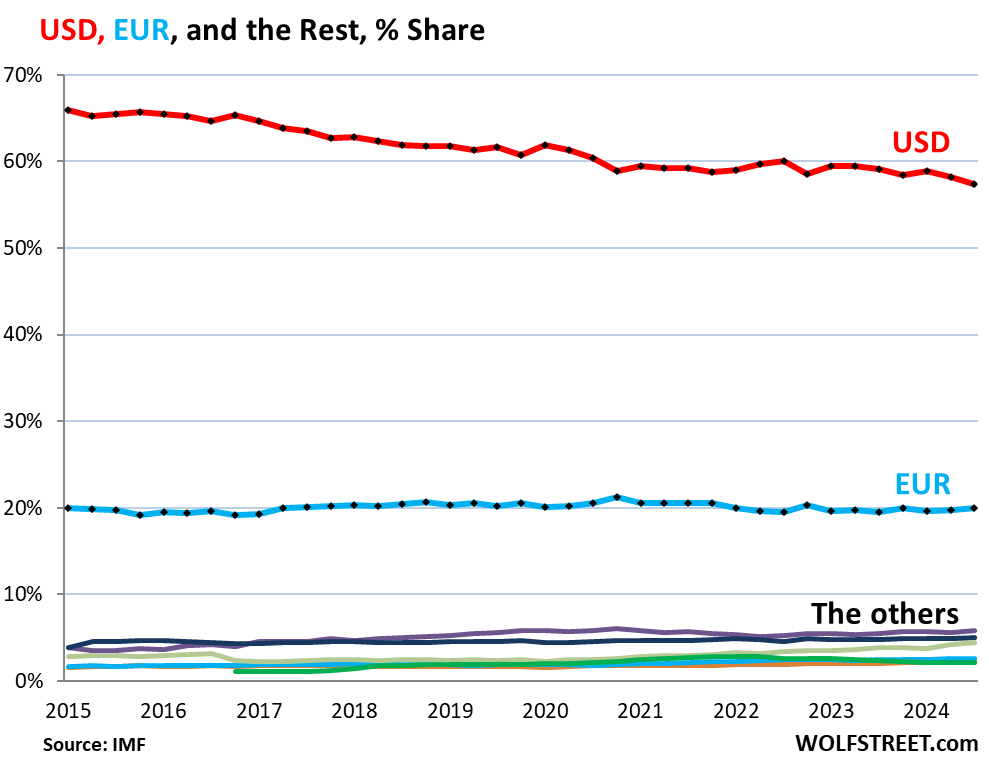
The US dollar lost further ground as global reserve currency among many reserve currencies held by central banks. Its share has been zigzagging lower for many years as central banks have been diversifying their holdings to assets denominated in currencies other than the dollar. And they’ve also been diversifying into gold. But the dollar remains by far the dominant global reserve currency.
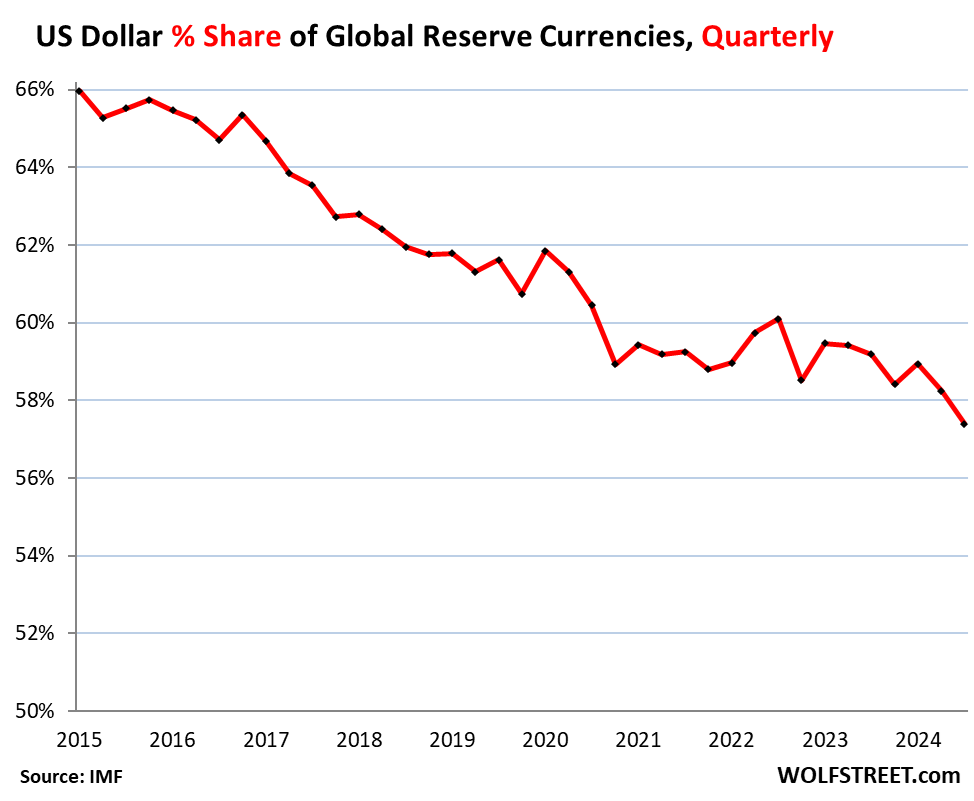
The share of USD-denominated foreign exchange reserves fell to 57.4% of total exchange reserves the lowest since 1994, according to the IMF’s COFER data for Q3 2024. USD-denominated foreign exchange reserves include US Treasury securities, US agency securities, US MBS, US corporate bonds, US stocks, and other USD-denominated assets held by central banks other than the Fed.
In Q1 2015, the USD’s share was still 66%. Over these 10 years, the dollar’s share of global reserve currencies has dropped by 8.6 percentage points. If this pace of decline continues, the dollar’s share will fall below 50% in less than 10 years, by the end of 2034.
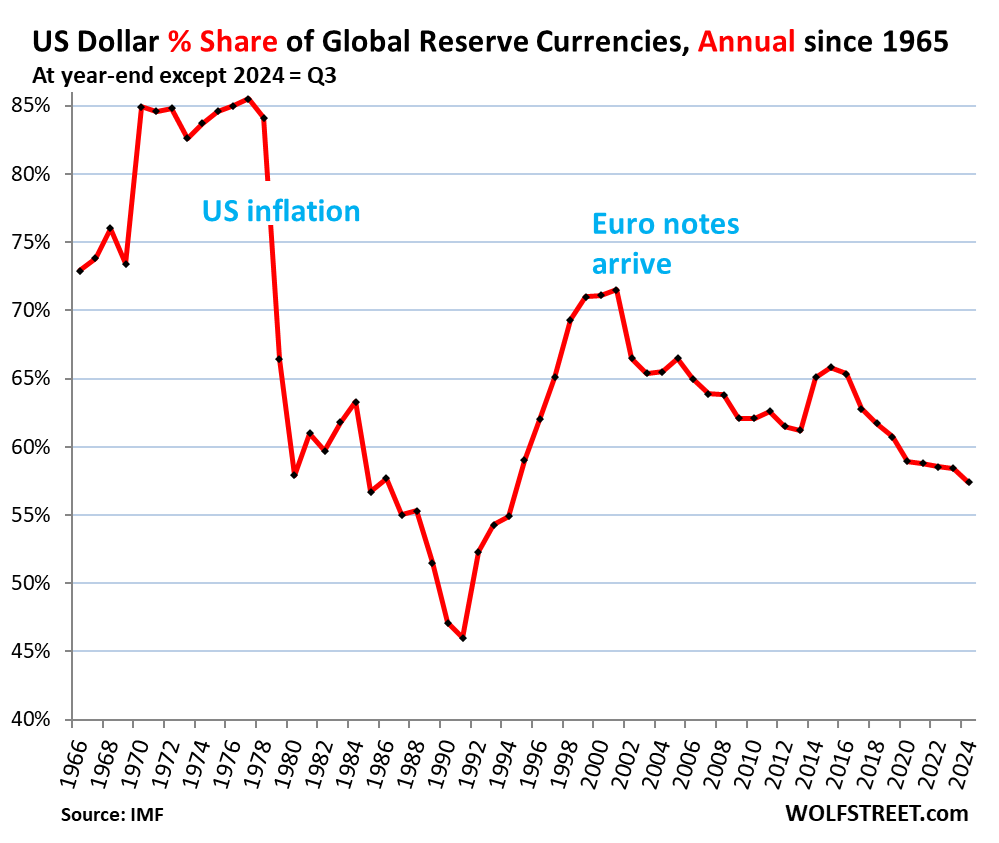
The dollar’s share had already been below 50% in 1990 and 1991, at the final leg of its long plunge from a share of 85% in 1977 to 46% in 1991, after inflation had exploded in the US in the 1970s, and eventually the world lost confidence in the Fed’s ability or willingness to get this inflation under control.
But by the 1990s, central banks loaded up on dollar-assets again, until the euro came along. This chart shows the dollar’s share at the end of each year (2024 = Q3).
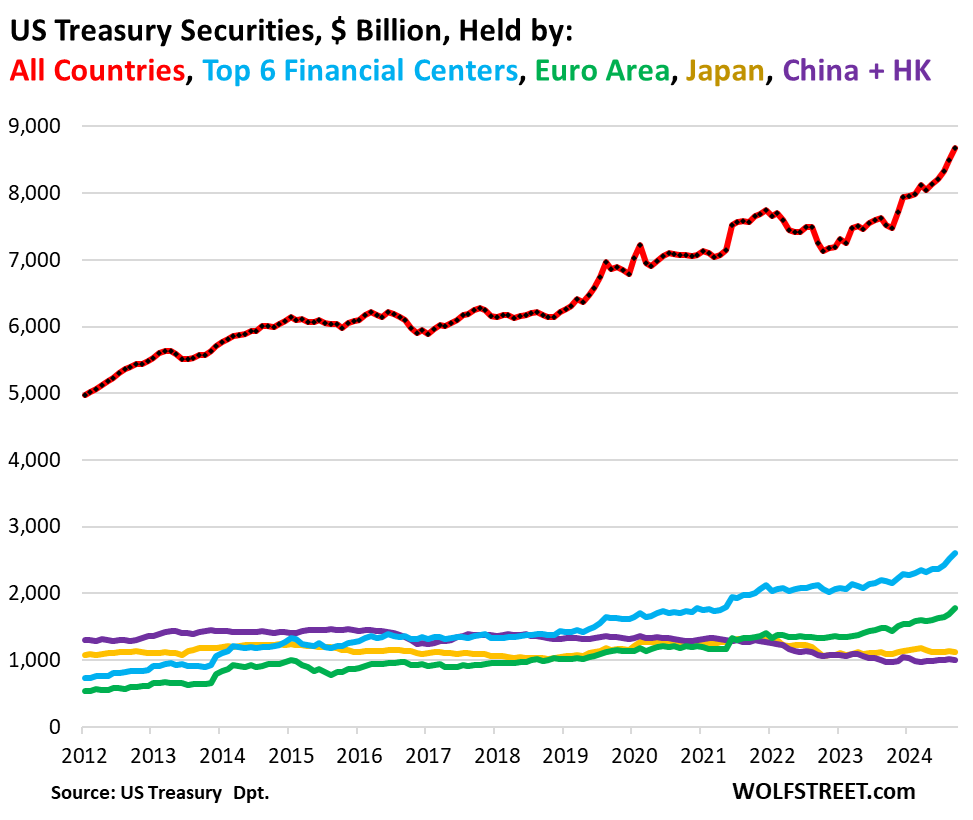
BUT THEY’RE NOT DUMPING US TREASURY SECURITIES.
Holdings of US Treasury securities by foreign central banks and other foreign holders have surged from record to record. Over the past 12 months, foreign holders added $880 billion, bringing their stash to a record $8.67 trillion, according to the Treasury Department’s TIC data earlier (we discussed the details here).
 TOTAL FOREIGN EXCHANGE RESERVES
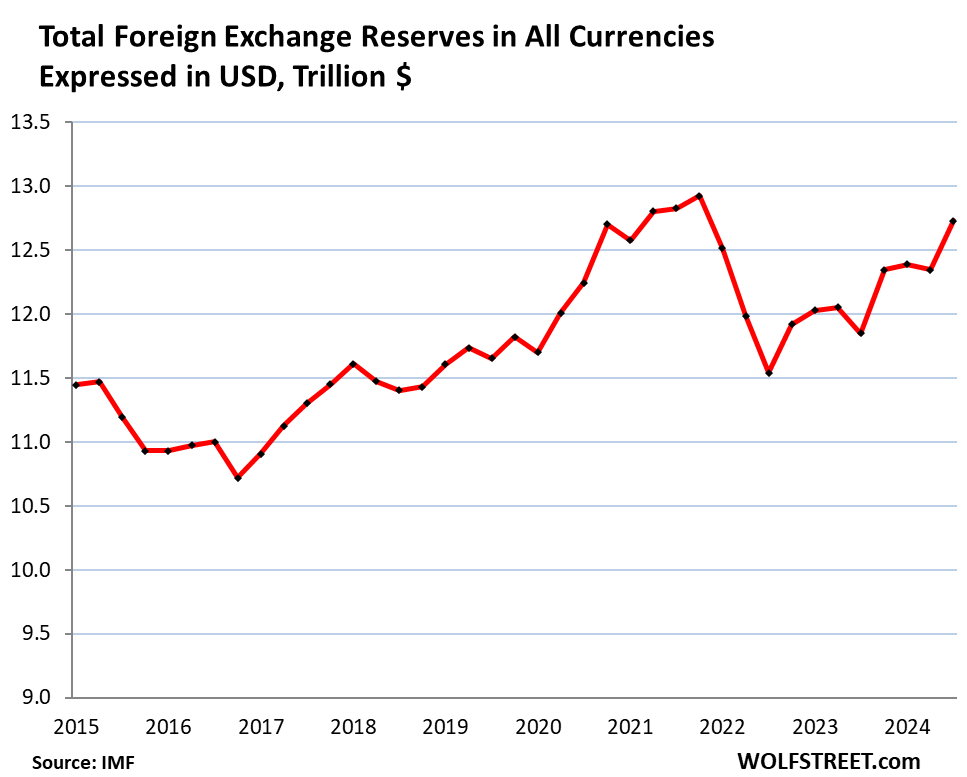
Central banks holdings of foreign exchange reserves denominated in all currencies, including in USD, rose to $12.7 trillion.
Excluded from the total are any central bank’s holdings of assets denominated in its own currency, such as the Fed’s holdings of Treasury securities and MBS, the ECB’s holdings of euro-denominated bonds, and the Bank of Japan’s holdings of yen-denominated assets.
Top holdings, expressed in USD:
- USD-denominated assets: $6.77 trillion
- EUR-denominated assets: $2.37 trillion
- YEN-denominated assets: $0.69 trillion
- GBP-denominated assets: $0.59 trillion
The other major reserve currencies.
The euro’s share, #2, ticked up to 20.0%, the highest since 2022. But the movements have been small. The euro’s share has been around 20% for years (blue in the chart below).
The other currencies are the colorful tangle at the bottom of the chart. More on those in a moment.
The rise of the “nontraditional reserve currencies.”
We will now hold a magnifying glass over the colorful tangle at the bottom of the chart above.
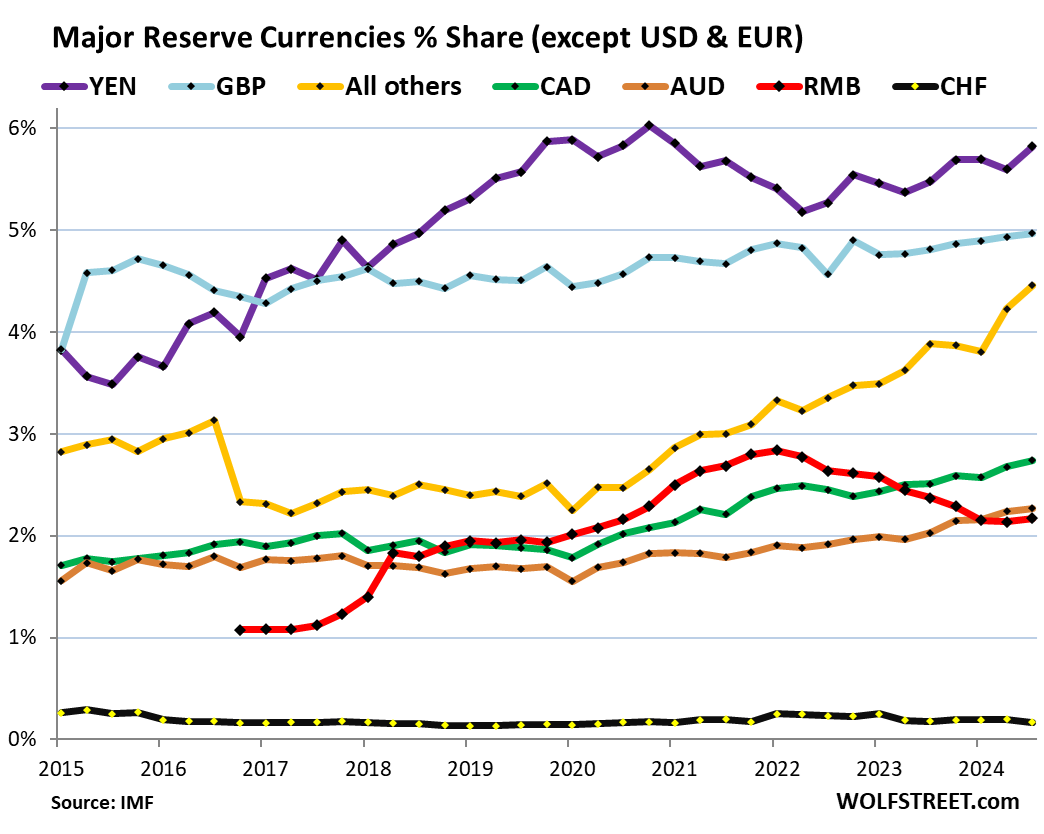
These other currencies, except for the Chinese renminbi, have all been gaining share, at the expense of the dollar, while the euro’s share has remained roughly stable.
This includes the basket of “nontraditional reserve currencies,” as the IMF calls them, that are combined into “All others” (yellow in the chart below), whose combined share has been surging since 2020.
China is the second largest economy in the world, but its currency plays only a small role as a reserve currency. And it has lost ground against the USD and other currencies since 2022.
In 2016, the IMF had added the RMB to its basket of currencies backing the Special Drawing Rights (SDR). That was a big step, and lots of folks thought that the RMB would quickly become a threat to the dominance of the USD as global reserve currency.
But central banks have not been enamored with RMB-denominated assets for a variety of reasons, including capital controls, convertibility issues, and other issues. Last year, the RMB was surpassed by the Australian dollar (AUD).
Far behind the USD and the EUR, the largest currencies by share:
- Japanese yen, 5.8% (YEN, purple).
- British pound, 5.0% (GBP, blue).
- “All other currencies” combined, 4.5% (yellow).
- Canadian dollar, 2.7% (green).
- Australian dollar, 2.3% (brown).
- Chinese renminbi, 2.2% (red).
- Swiss franc, 0.2% (blue).
Central banks diversify from the USD to other currencies.
The IMF found that there were 46 “active diversifiers” among central banks, including central banks in most of the G20 economies, according to a paper it published in 2022. It defined them as central banks that had at least 5% of their foreign exchange reserves in “nontraditional reserve currencies.”
Two factors contributed to the rise of the “nontraditional reserve currencies,” the IMF found:
- The growing liquidity of assets denominated in “nontraditional reserve currencies,” which makes them easier for central banks to trade in the quantities they deal with.
- Chasing higher-yielding assets elsewhere during the 0%-era in the US and Europe.
USD exchange rates impact foreign exchange reserves.
The USD has risen sharply against a basket of other currencies in recent months, as tracked by the Dollar Index [DXY], but remains below the 2022 high, well below the 2001 high, and hugely below the 1985 high. So we see these huge peaks and valleys, but now the dollar is about where it had been in 1977.
The DXY is dominated by the euro and the yen, the two largest trade currencies behind the USD. When euro arrived on the scene, the DXY’s local currencies that became part of the euro were replaced by the euro. At the DXY was started in 1973. Today it’s at 108.9 about where it had been during the high moments in 1973-1975 (data via YCharts):
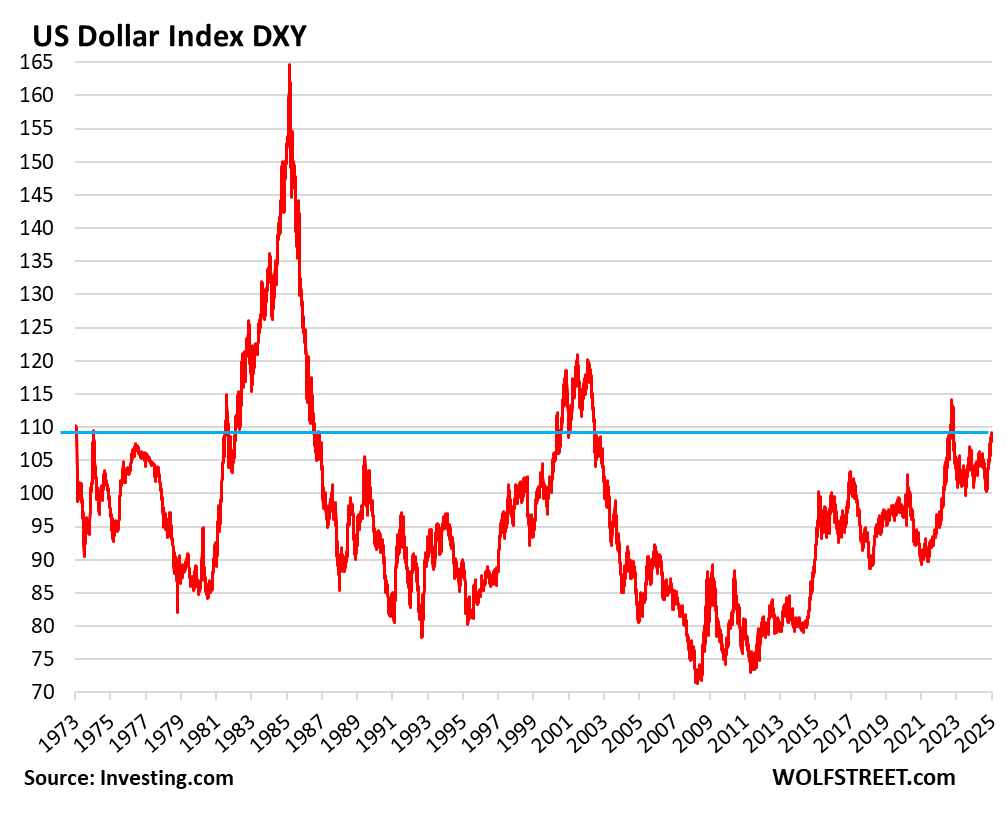
Why this matters: The IMF reports foreign exchange reserves in USD. USD holdings are obviously reported in USD. But the holdings in EUR, YEN, GBP, CAD, RMB, etc. are translated into USD at the exchange rate at the time. So the exchange rates between the USD and other reserve currencies impact the magnitude of the non-USD assets – but not of the USD-assets.
For example, the Bank of Japan’s holdings of USD-denominated assets, expressed in USD, don’t change with the YEN-USD exchange rate. But its holdings of EUR-denominated assets are translated into USD at the EUR-USD exchange rate at the time. So the magnitude of Japan’s holdings of EUR-assets, expressed in USD, fluctuates with the EUR-USD exchange rate.
The other diversification: gold.
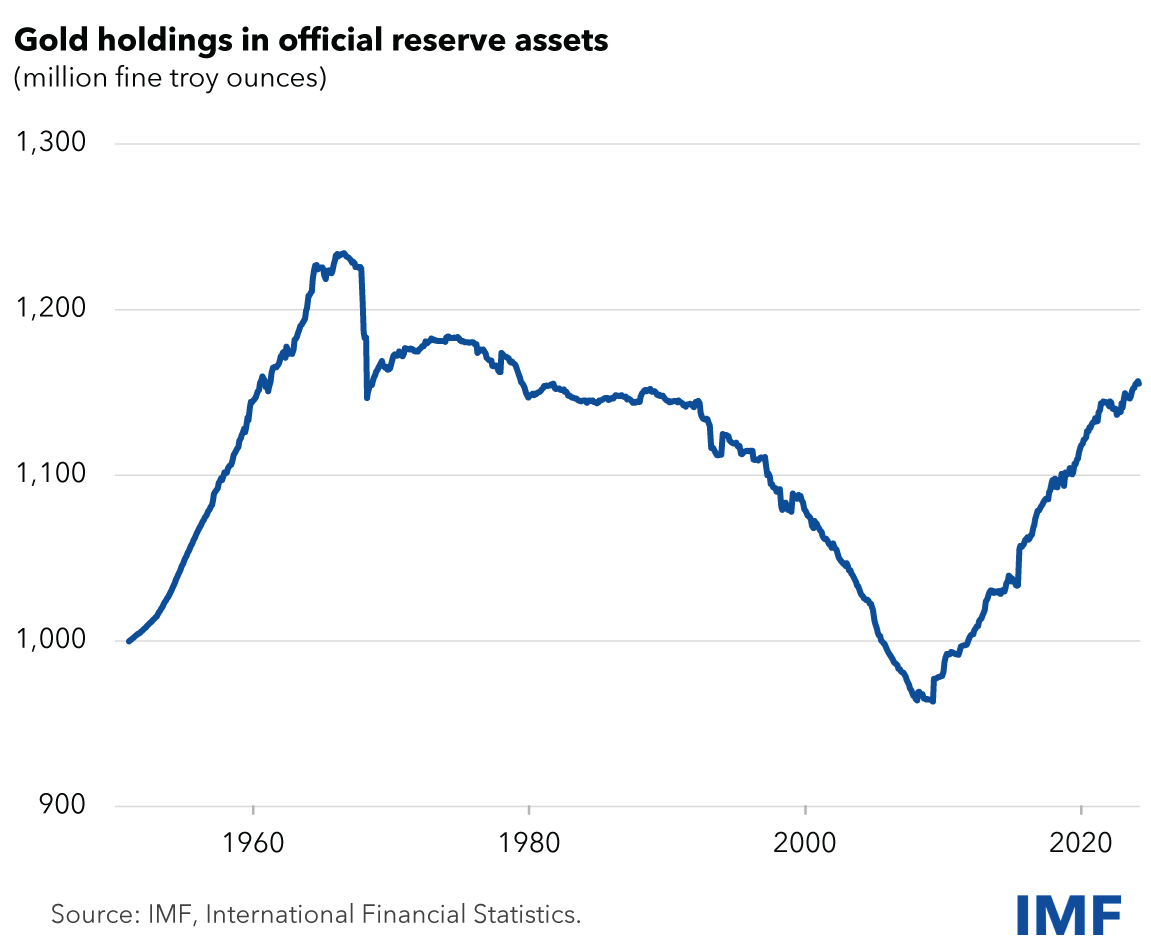
Gold bullion is not a “foreign exchange reserve” asset of central banks, and is not included in the data above. Instead, it’s a “reserve asset,” not involving foreign currency.
Central banks had spent decades unloading their gold holdings. But about 10 years ago, they started rebuilding their stash.
According to the IMF, central banks’ gold holdings have surged over this decade to 1.16 billion troy ounces – roughly $3.08 trillion, compared to $12.3 trillion in foreign exchange reserves (chart via the IMF):
Enjoy reading WOLF STREET and want to support it? You can donate. I appreciate it immensely. Click on the beer and iced-tea mug to find out how:

Would you like to be notified via email when WOLF STREET publishes a new article? Sign up here.

