
Here is a look at the debt loads of various G20 nations:
(Economist.com): "America, Britain and China are among the many countries that have adopted spend-now-pay-later policies to stave off economic disaster. But giant fiscal stimuluses, tax cuts and bail-outs are weighing heavily on public finances. In a paper prepared for the forthcoming G20 summit, the IMF sets out new forecasts for government debt. Japan's debt burden, which is already the largest of the world's big economies, will reach a sumo-sized 225% of GDP in 2010. Rich countries' debt is set to grow from 83.3% of GDP in 2008 to almost 100% in 2010. Developing economies will see much smaller growth from 35.7% to 37.8% in two years, but these countries also have lower debt tolerance than rich ones."
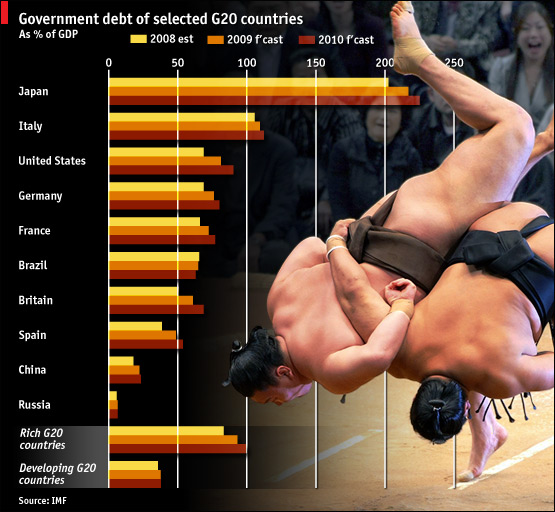
Graphic Courtesy of Economist.com
The fact that Japan has the highest debt load of any G20 nation while also being one of the nations that the U.S. is most indebted to is quite interesting, for the simple fact that it's probably not a good thing when the #1 debtor nation is owed a lot of money by the #3 debtor nation.
At the moment we're neck deep in an economic crisis caused by businesses and consumers using debt to fuel faux growth, and/or as a substitute for actual income. Don't be surprised if the next economic crisis is caused by governments doing the same thing, as the debt loans of many of these nations are unsustainable over the long-term. At some point something is going to give and the bill is going to come due.
Currency Disputes Hang Over G-20 Summit
President Barack Obama and other top leaders were arriving in Seoul, South Korea, for a two-day Group of 20 summit with the ambitious agenda of remaking the world economy to nurture stable growth and prevent a repeat of the financial meltdown in 2008.
But that gathering, and a weekend summit of Pacific Rim leaders in the Japanese port city of Yokohama, are taking place as those nations struggle to reconcile conflicting strategies for achieving those aims.
G-20 officials -- whose countries comprise 85 percent of all economic activity -- have pledged not to use their currencies as trade weapons. (THERE'S ALWAYS A BUTT IN THESE NEGOTIATIONS.) But tensions reignited last week when the U.S. Federal Reserve announced a $600 billion bond buying plan that angered many trading partners.
Obama, defended the Fed's move as a way to hasten a narrowing of huge gaps in trade and investment by engineering a weaker U.S. dollar -- thus putting pressure on countries with large trade and foreign exchange surpluses.
Other countries complain excess cash may flood into their markets seeking higher returns, pushing their currency values higher, squeezing their exporters and inflating bubbles in stocks or other assets that could destabilize their financial systems.
"At issue are critical agendas, such as establishing a clear guideline on limiting current account surpluses and deficits to sustainable levels and recent moves by Washington to print more money, were put on the table, but only highlighted differences between member countries, . . ."
Such issues were left unresolved to allow work on other issues that must be included in a declaration at the summit's end, he said.
The G-20 first convened a leaders summit two years ago and has since supplanted the Group of Seven advanced nations as countries like China and India gained economic and political stature in their own right.
The aim is to craft a new global economic order to replace one powered by the U.S. running huge trade deficits while countries like China, Germany and Japan accumulate vast surpluses. One U.S. proposal, for example, calls for setting guidelines for when such imbalances might become potentially destabilizing.
China announced Wednesday that its trade surplus surged to its second-highest level this year in October, raising pressure on Beijing over its currency, which the U.S. and other trading partners say is kept artificially weak, making its exports more competitive overseas.
Beijing maintains that the focus on its currency policies is misplaced.
If either side "chooses a confrontational approach, I think everybody will come out as losers," said Vice Foreign Minister Cui Tiankai, an envoy to the Seoul talks.
On somewhat less confrontational issues, the G-20 leaders are expected to endorse beefing up supervision of financial institutions and to voice support for giving developing countries more say in the International Monetary Fund.
In Yokohama, trade and foreign ministers of the Asia-Pacific Economic Cooperation forum were mulling moves toward a Pacific-wide free trade zone that would encompass more than half the world's economic output.
"We are quite committed to that. We believe that open trade is indispensable to overcome the financial crisis and the economic crisis," Mexican foreign minister Patricia Espinosa said on the sidelines of the meetings.
A failure to cooperate, rather than renewed financial woes, is the biggest threat, warned a report issued Wednesday by the Pacific Economic Cooperation Council, an APEC advisory group.
Debt troubles in Europe, weak U.S. growth and tensions over trade are clouding the global outlook and contributing to an "unprecedented crisis atmosphere," the report said, citing a survey of 422 regional opinion leaders.
The report urged APEC to carry though with reforms needed to ensure more balanced, sustainable and equitable growth as the group reviews its progress toward the still unfulfilled goal, set in 1994, of achieving free trade and investment among developed members by 2010.
A regionwide arrangement, dubbed the Free Trade Area of the Asia-Pacific, could help untangle a slew of bilateral and regional agreements, and by lowering trade barriers, could boost growth.
A building block of that plan is a U.S.-backed free trade agreement called the Trans-Pacific Partnership. It now includes only four small economies -- Brunei, Chile, New Zealand and Singapore -- but the U.S., Australia, Malaysia, Vietnam and Peru are in talks to join them.
Though such moves could hurt farmers in South Korea and Japan who are outraged at the prospect of losing protective high tariffs, host Tokyo says it favors moving toward freer trade.
"In many ways, Japan has fallen behind the wave of creating freer economies," Japanese Prime Minister Naoto Kan said Tuesday. "I think it's time to steer once again toward opening the country."
A REAL EYE OPENER TO THESE COUNTRIES AND THEIR DEBT PROTOCOLS IS DETAILED IN A BOOK ENTITLED: "THIS TIME IS DIFFERENT, Eight Centuries of Financial Folly", by Carmen M. Reinhart & Kenneth S. Rogoff. 