It was the best of times, it was the worst of times, it was the age of wisdom, it was the age of foolishness, it was the epoch of belief, it was the epoch of incredulity, it was the season of light, it was the season of darkness, it was the spring of hope, it was the winter of despair, we hadPhiladelphia asked Benjamin Franklin, "Well, Doctor, what have we got, a republic or a monarchy?" With no hesitation whatsoever, Franklin responded, "A republic, if you can keep it." ~ BENJAMIN FRANKLIN 1787
Hamas uses ambulances to transport terrorists, weapons - IDF
"Most of Hamas' senior political and terrorist figures are hiding behind masks and in hospitals, especially Shifa Hospital," the terrorist said.
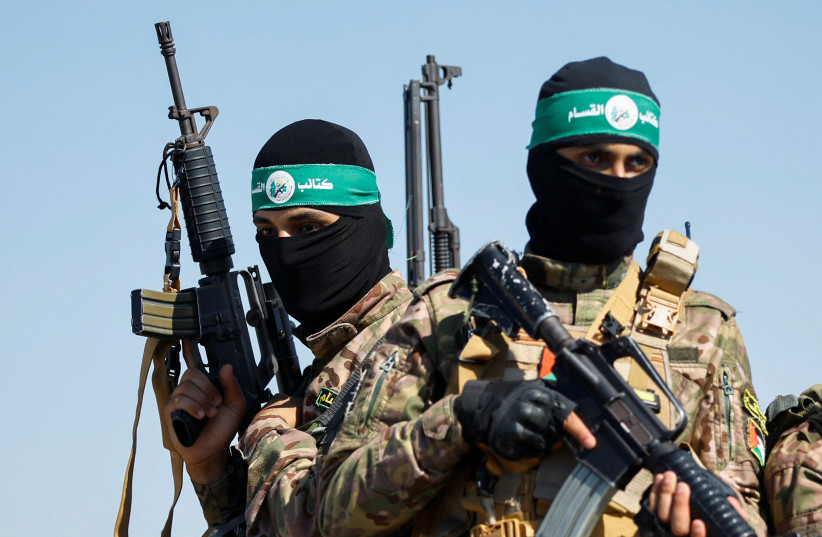
Hamas Terrorist fighters from the armed wing of Hamas take part in a military parade to mark the anniversary of the 2014 war with Israel, near the border in the central Gaza Strip, July 19, 2023.(photo credit: REUTERS/IBRAHEEM ABU MUSTAFA)
IDF Soldiers ... they don't hide behind masks!
The terrorist organization Hamas has been using hospitals, ambulances, clinics, mosques, and schools for purposes of terrorism, a Hamas terrorist admitted in a video of an interrogation released by the IDF and Shin Bet (Israel Security Agency) on Wednesday evening.
The terrorist admitted that Hamas uses ambulances to transport weapons and terrorists throughout the Gaza Strip.
"I can leave with any ambulance I want," the terrorist admitted during the interrogation.
"Al-Qassam has its own ambulances, some of which are also at the military base," he said. The terrorist was from the Nukhba Force and took part in the massacre on October 7. "The appearance of ambulances is similar to civilian ambulances so that they do not arouse suspicion or be bombed by Israel."
GAZA METRO ... ALTERNATE TRANSPORTATION
"During combat, ambulances are also used to evacuate fighters and operatives," he said. "They also transport food, IEDs, and weapons because that's the safest way to get there."
The terrorist then went on to explain how a lot of the Gaza Strip had been booby-trapped with cables leading to the operating systems in Mosques and civilian clinics.
Israel has pounded the Gaza Stripfor a 33rd day in a row as the besieged Palestinian enclave faces a growing humanitarian catastrophe.
Internationally accepted rules of armed conflict were passed under the Geneva Conventions in 1949, which state children must be protected and treated humanely. As a terrorist organization, Hamas is NOT a signatory of the Geneva Conventions. Hamas uses the Gaza population as human shields and hostages for protection.
Here are the latest casualty figures as of November 9, 1:50pm local time (11:50 GMT):
Gaza
Killed: At least 10,569
Including at least:
4,324 children
2,823 women
Injured: At least 26,475
Including at least:
8,663 children
6,327 women
Occupied West Bank
Killed: At least 175
Including 44 children and one woman
Injured: More than 2,100
Israel
Killed: At least 1,405
Injured: At least 5,600
The figures have been reported by the Palestinian health ministry, Palestine Red Crescent Society and Israeli Medical Services.
Residents Hostages in Gaza have flocked to hospitals and United Nations schools for safety, hoping that Israel will abide by international law and not attack those coordinates. Hamas uses hospitals and United Nations schools for protection and launching pads for missiles.
However, places of shelter and medical care have also not been free from Israeli attacks, due to the fact Hamas uses these facilities as bunkers.
193 medical staff have now been killed, and 57 ambulances have been destroyed. However, many of the ambulances are NOT real ones rather Hamas delivery vehicles.
18 out of 35 hospitals are out of service in Gaza, and 51 out of 72 primary medical care facilities are out of operation.
Israeli warplanes began a series of raids in the vicinity of the Al-Quds Hospital at dawn, according to the Palestinian news agency, Wafa, citing the Palestinian Red Crescent Society.
The Indonesian Hospital in Gaza City has been forced to switch to a backup generator after its main generator stalled because of a lack of fuel. The situation at the Al-Shifa Hospital has also been described as “bleak”.
(Al Jazeera)
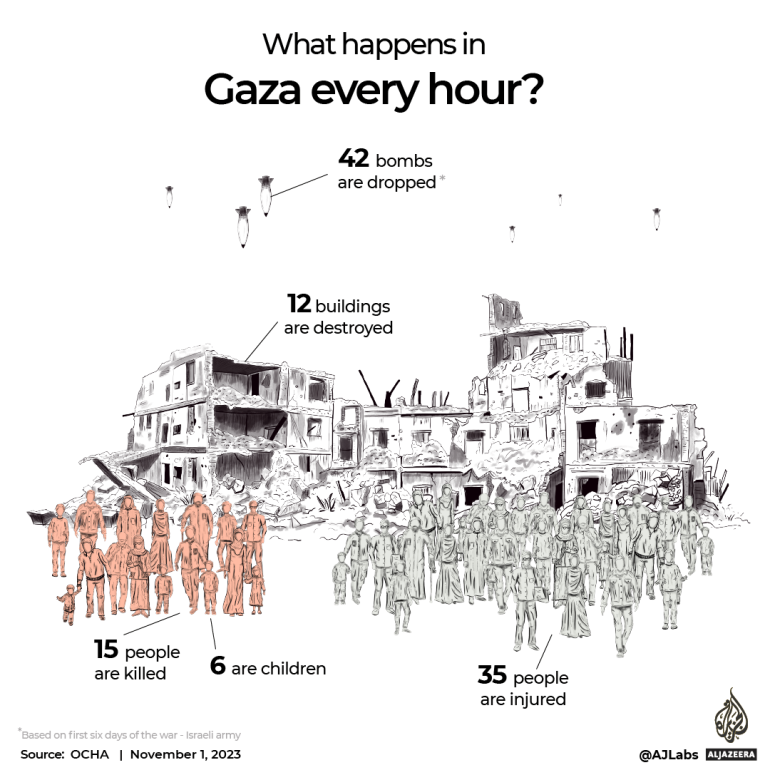
Every hour in Gaza:
15 people are killed - 6 are children
35 people are injured
42 bombs are dropped*
12 buildings are destroyed
*Based on the first six days of the war, according to the Israeli army
Journalists killed
As of November 3, at least 36 journalists have been killed, mostly Palestinians, since the Israel-Gaza war began on October 7. According to the Committee to Protect Journalists (CPJ) and International Federation of Journalists (IFJ), 31 Palestinian journalists have been killed, four Israeli journalists and one Lebanese.
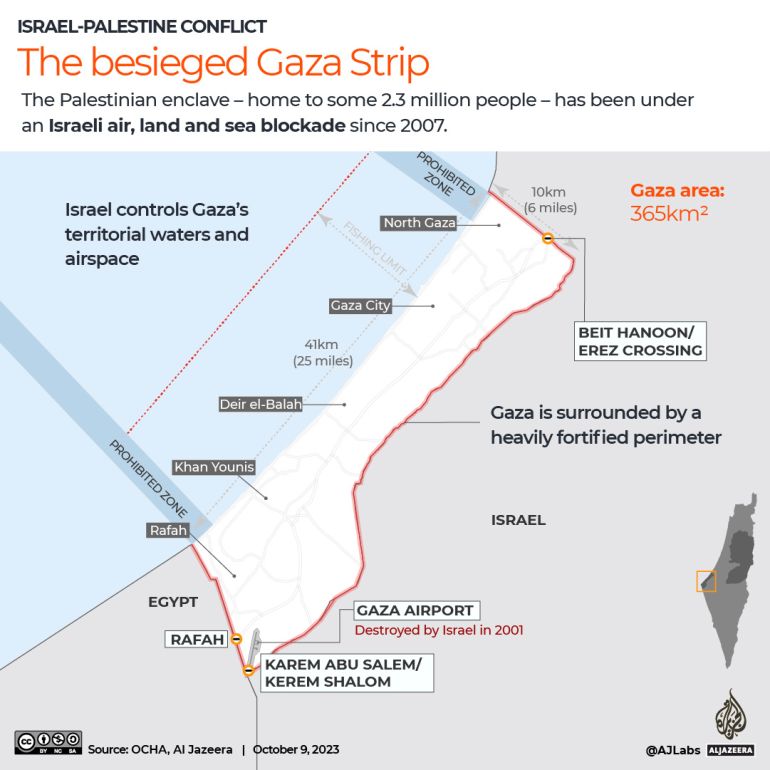
Sixteen years of Israeli blockade
Gaza has a population of about 2.3 million people living in one of the most densely populated areas in the world. Located between Israel and Egypt on the Mediterranean coast, the strip is about 365sq km (141sq miles).
Since 2007, Israel has maintained strict control over Gaza's airspace and territorial waters and restricted the movement of goods and people in and out of Gaza.
Following Hamas's attack, Israeli Prime Minister Benjamin Netanyahu has threatened to turn Gaza into a “deserted island” and warned its residents to “leave now”.
How the Hamas attack unfolded
On Saturday morning, at about 6:30am (03:30 GMT), Hamas fired a huge barrage of rockets into southern Israel with sirens heard as far away as Tel Aviv and Beersheba.
The group said it launched 5,000 rockets in the initial barrage. Israel’s military said 2,500 rockets were fired.
About an hour later, fighters crossed into Israel in an unprecedented multipronged operation through land, air and sea. Most fighters entered through breaches in security barriers separating Gaza and Israel.
Hamas surprise operation recorded the attack with cameras
At 9:45am (06:45 GMT), blasts were heard in Gaza and at 10am (07:00 GMT), Israel’s military spokesperson said the air force was carrying out attacks in Gaza.
Gun battles continued between Israeli forces and Palestinian fighters in several areas of southern Israel.
Israeli air attacks continued late into the night as did rocket fire into southern Israel.
Gaza's densely populated neighbourhoods
The Gaza Strip comprises five governorates: North Gaza, Gaza City, Deir el-Balah, Khan Younis and Rafah.
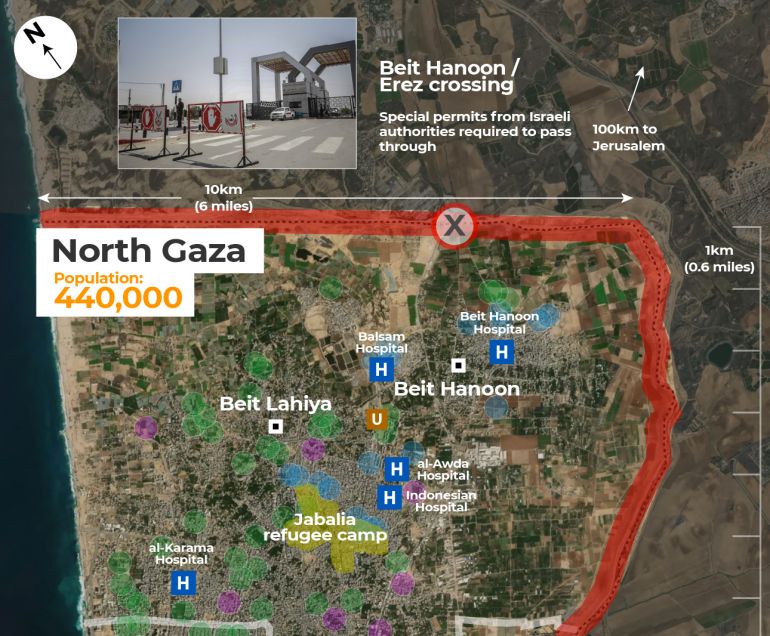
North Gaza extends for 10km (6 miles) and shares the only crossing into Israel through Beit Hanoon, also known as the Erez crossing.
North Gaza is home to the Jabalia refugee camp, the largest in the strip.
Gaza City is the largest and most populous city within the Gaza Strip, with more than 750,000 residents. Rimal, Shujaiya and Tel al-Hawa are among its most well-known neighbourhoods.
At the heart of the Rimal neighbourhood is al-Shifa Hospital – the largest medical facility in the Gaza Strip.
Deir el-Balah is one of Gaza’s largest agricultural producers. It is also home to four refugee camps: Nuseirat, al-Bureij, al-Maghazi and Deir el-Balah.
Gaza’s only operating power plant is located along the district’s boundary with Gaza City.
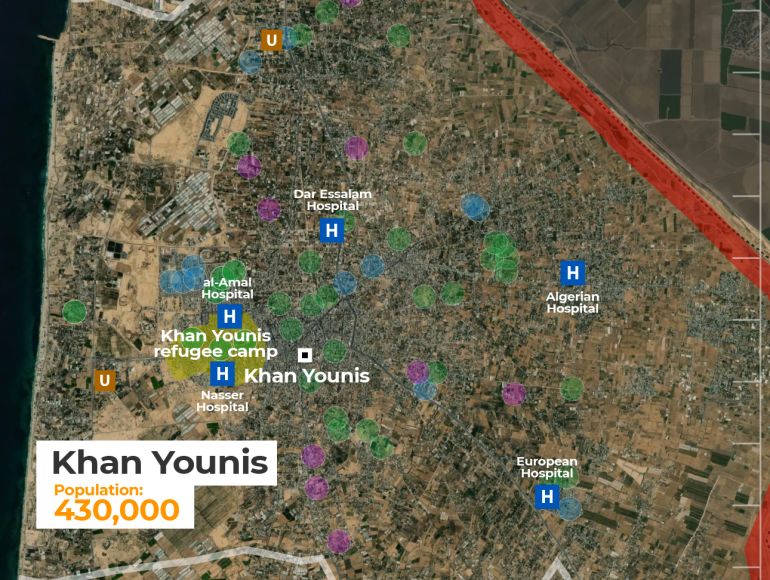
Khan Younis is home to some 430,000 people. At its centre is the Khan Younis refugee camp, where about 90,000 people live.
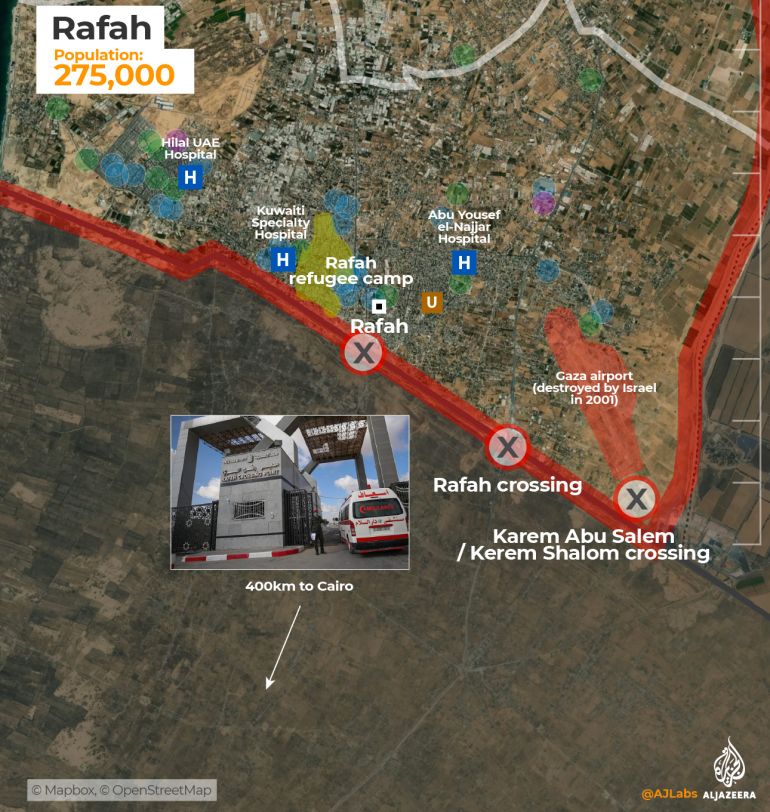
Rafah is the southernmost district of Gaza with a population of about 275,000. Rafah is also the name of the crossing with Egypt that is located here.
Both Israel and Egypt have kept their borders largely shut, and are responsible for further deteriorating the already weakened economic and humanitarian situation.
 IDF Soldiers ... they don't hide behind masks!