THERE IS NOT SUCH THING AS A LASTING PEACE IN THE MIDDLE EAST. LET ME REPEAT, "THERE IS NOT SUCH THING AS A LASTING PEACE IN THE MIDDLE EAST NO MATTER HOW MUCH MONEY IS OFFERED!"

HAMAS-ISRAEL WAR|ISRAEL-HAMAS WAR
Iran’s Foreign Minister Hossein Amir-Abdollahian said Sunday that he warned “the US and its proxy [Israel]… that if they do not immediately stop the crime against humanity and genocide in Gaza, anything is possible at any moment and the region will become out of control.” Those are "Fighting Words" ... even after Biden gave Iran $6,000,000,000 US Dollars!
Given the complexity and volatility of the situation in the Middle East, it's important to note that specific events can quickly escalate tensions and trigger further conflict.

While conflicts and violence have occurred in the region in the past, further escalations can exacerbate the situation and lead to more severe consequences.
The statement made by Iran's Foreign Minister suggests a heightened level of tension and the potential for further conflict or escalations if the situation in Gaza does not improve. Possible scenarios that could unfold include:
Escalation of military activities: If the situation in Gaza continues to deteriorate, it could lead to an escalation of military activities, including increased airstrikes, ground operations, or other forms of military intervention.
Increased regional instability: The continued crisis in Gaza could potentially destabilize the entire region, leading to increased tensions between different countries and factions in the Middle East.
Further humanitarian crises: The already dire humanitarian situation in Gaza could worsen, leading to more significant suffering for the civilian population, including shortages of food, water, and medical supplies.
Worsening diplomatic relations: Tensions between countries involved in the conflict, including the United States, Israel, and Iran, could intensify, leading to a breakdown in diplomatic relations and further isolation of certain nations in the international community.
Spillover effects: The conflict in Gaza could have spillover effects, impacting neighboring countries and potentially leading to a broader regional conflict involving multiple actors.
It's essential for international stakeholders to work towards de-escalation and the peaceful resolution of conflicts to prevent further destabilization and human suffering in the region. Diplomatic efforts and negotiations aimed at addressing the root causes of the conflict are crucial to prevent further escalation and promote lasting peace and stability in the Middle East.
“Iran is expanding its activities in the maritime arena. Over the last year, Iran has seized international tankers and attacked vessels. Today, we can confirm that Iran is methodically basing itself in the Red Sea, with warships patrolling the southern region,” Gantz told the Economist Government Roundtable conference held in Greece.
Last week, the Pentagon announced that a US Navy warship intercepted three missiles that were heading north and had been fired by Iranian-backed Houthi rebels in Yemen, and that they may have been aimed at Israel.
UN (second biggest failure) resolution urging immediate Gaza ceasefire passes with overwhelming majority
Jerusalem denounces General Assembly’s approval of ‘despicable’ Jordanian initiative that makes no mention of Hamas, vows to move forward with goal of toppling terror group
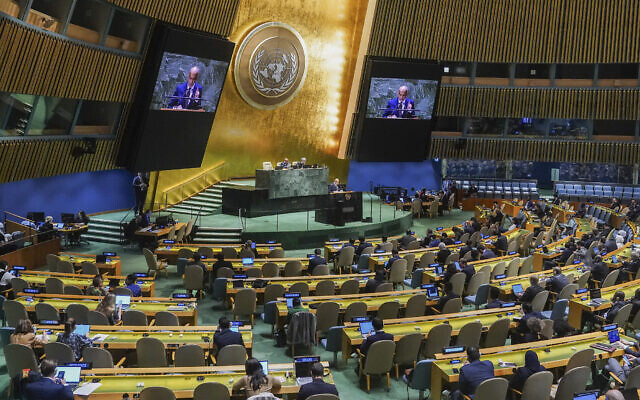
A resolution calling for an immediate ceasefire in Gaza, which made no mention of Hamas, was overwhelmingly passed by the United Nations General Assembly on Friday, drawing praise from the Islamist terror group and condemnation from Israel.
The resolution called for an immediate ceasefire in Gaza, the release of all civilians, the protection of civilians and international institutions, and ensuring the safe passage of humanitarian aid into the Strip.
The initiative was nonbinding but highlighted the overwhelming international support for the Palestinians amid Israel’s military campaign in response to the October 7 Hamas onslaught.
Israel has rejected calls for a ceasefire in Gaza, saying that it is committed to toppling Hamas to prevent another mass assault like the one that took place three weeks ago, when more than 1,400 people were killed. Gaza terrorists also took some 230 people — mostly civilians — as hostage into the enclave, releasing four of them since.
The US has also rejected calls for a ceasefire, suggesting that it would amount to a victory for Hamas. It has, however, begun suggesting that “humanitarian pauses” be considered to allow more humanitarian aid into Gaza and to ensure safe passage of civilians looking to flee the areas that the IDF is bombing most intensively in its aerial campaign across the Strip.
Israel insists it’s only targeting Hamas terrorists and infrastructure but many civilians are believed to be among those killed. The Hamas-run health ministry in Gaza claims roughly 7,000 Palestinians have been killed by Israel, but those numbers cannot be independently verified and include Palestinian terrorists killed fighting the IDF as well as civilians killed as a result of errant rockets launched by terror groups.
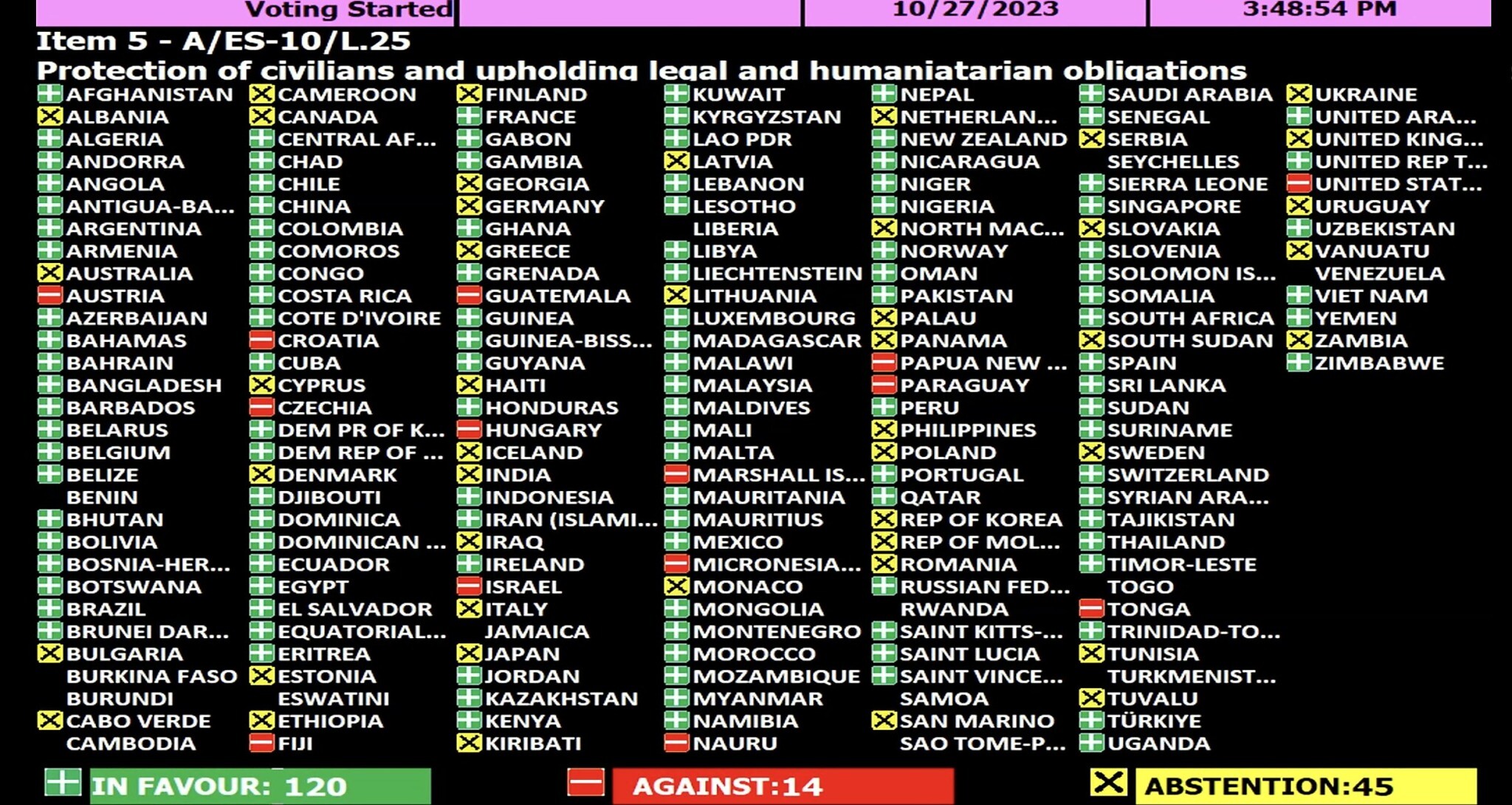
The results of a UN General Assembly vote on a resolution calling for a ceasefire in Gaza on October 27, 2023.
IT COSTS NOTHING TO VOTE
One-hundred and twenty countries voted in favor of the non-binding resolution introduced by Jordan, while just 14 — United States, Austria, Croatia, Czechia, Fiji, Guatemala, Hungary, Israel, Marshall Islands, Micronesia, Nauru, Papua New Guinea, Paraguay and Tonga — voted against it.
Forty-five countries abstained, including Australia, Canada, Finland, Germany, Greece, India, Iraq, Italy, Japan, the Netherlands, Poland, South Korea, Sweden, Tunisia, Ukraine and the UK.
France, Belgium, Ireland, Norway and Switzerland were among European nations that voted in favor.
Canada sought to have an amendment added to the resolution to include a condemnation of Hamas and a majority of members backed the proposal, but it fell short of the two-thirds majority needed to be adopted. Eighty-eight countries voted for the amendment, 55 voted against and 33 abstained.
Jordan’s ambassador to the UN called the amendment an effort to “whitewash” Israeli “atrocities” in Gaza.
Israel fumed after the vote, with Foreign Minister Eli Cohen decrying the “despicable” resolution and insisting that “Israel intends to eliminate Hamas just as the world dealt with the Nazis and ISIS.”
UN Ambassador Gilad Erdan angrily dismissed the resolution, saying Israel would continue to defend itself.
UN IS A TOTAL FAILURE AND SHOULD RELOCATE TO BRUSSELS
“This is a dark day for the UN and for mankind,” Erdan said, vowing Israel will use “every means” in fighting Hamas.
“Today is a day that will go down as infamy. We have all witnessed that the UN no longer holds even one ounce of legitimacy or relevance,” he added.
Hamas welcomed the passage of the resolution and called for its immediate implementation, including the clause calling for the entry of fuel and relief materials for civilians in the Gaza Strip.

Palestinians inspect the damage of destroyed buildings following Israeli airstrikes on Gaza City, Friday, Oct. 27, 2023. (AP Photo/Abed Khaled)
THAT'S RICH ... PEAK OF BRUTALITY
The rival Palestinian Authority’s foreign ministry also welcomed the resolution, saying that as Israel’s campaign “reaches a new peak of brutality,” there is “a solid international position rejecting Israel’s unhinged aggression.”
In a speech ahead of the vote, US Ambassador to the UN Linda Thomas-Greenfield panned the Jordanian resolution for failing to mention Hamas.
“It is outrageous that this resolution fails to name the perpetrators of the October 7th terrorist attacks: Hamas,” Thomas Greenfield said.
She also noted that the resolution doesn’t include the word “hostages,” though, it did “call for the immediate release of all civilians, demanding their safety, well-being and humane treatment in compliance with international law.”
The US envoy clarified that Palestinian civilians, UN personnel and humanitarian workers still must be protected, even though the Biden administration does not support a ceasefire.
She then highlighted the story of Al Jazeera’s Gaza bureau chief Wael al-Dahdouh, whose wife, two children and grandchild were killed in an Israeli airstrike earlier this week.

US United Nations Ambassador Linda Thomas-Greenfield addresses the UN General Assembly, Friday, Oct. 27, 2023 at UN headquarters. (AP Photo/Bebeto Matthews)
“We must not become numb to the pain and the suffering of people like Wael Al-Dahdouh… My heart breaks for Wael. My heart breaks for all -– all of the innocent civilians who are caught up in this crisis,” she says.
Pakistan’s UN Ambassador Munir Akran drew loud applause when he said the Arab-drafted resolution deliberately didn’t condemn or mention Israel or name any other party. “If Canada was really equitable,” Akram said, “it would agree either to name everybody — both sides who are guilty of having committed crimes — or it would not name either as we chose.”
On Thursday, during the first day of the debate on the resolution, nearly every speaker backed the Jordanian draft resolution, except for Erdan who told the assembly, “A cease-fire means giving Hamas time to rearm itself, so they can massacre us again.”
Erdan played a video of a Hamas terrorist trying to decapitate a Thai worker with a garden hoe during the October 7 onslaught in southern Israel, in a speech that was received with silence.
His Palestinian counterpart Riyad Mansour, however, earned loud applause when he finished his address, highlighting the global mood of the moment.
“If you do not stop it for all those who were killed, stop it for all those whose lives we can still save,” Mansour said.
