China expands influence near wealthy Florida enclave as migrants from communist country flood into US
CHINA’S GROWING PRESENCE IN AMERICA’S BACKYARD COULD GRANT THE COMMUNIST COUNTRY ACCESS TO FLORIDA’S COAST, COINCIDING WITH A DRAMATIC RISE IN CHINESE NATIONAL BORDER ENCOUNTERS.
The Caribbean region, also known as “America’s third border” due to its proximity to the US, has been financially backed by China in maritime logistics and infrastructure projects in recent years.
“I think the Chinese are trying to gain influence in a region which is very close to the American homeland,” Gordon G. Chang, an author and expert on US-China relations, told Fox News Digital.
Chang pointed to the $3.4 billion Freeport Container port project in the Bahamas, just 87 miles east of Palm Beach, Florida.
A report from the House Foreign Affairs Committee found that China invested over $10 billion in six Caribbean countries between 2005 and 2022.
The Panama Canal and Chinese influence
During his inauguration speech, President Trump repeated his desire to retake control of the Panama Canal, the vital strategic waterway that connects the Atlantic and Pacific oceans.
“Above all, China is operating the Panama Canal. And we didn’t give it to China. We gave it to Panama, and we’re taking it back,” Trump said in his inaugural address.

The US controlled it from its 1914 completion until 1999, when it was handed over to Panama under the 1977 Torrijos-Carter Treaties.
The treaties permit the US military to preserve the canal’s neutrality, allowing the US to perpetually use the waterway.
Chinese companies have invested heavily in ports and terminals near the canal. A Hong Kong-based company runs two of the five ports close to its entrances.

“This is going to take some time because China didn’t take over the Canal Zone with soldiers, they took it over with people in business attire with large checkbooks and suitcases of cash,” he said. “And the United States needs to come in with cash of its own to drive the Chinese out of the Canal Zone and Panama.”
The US has for decades turned a blind eye to the Western Hemisphere when it comes to national security, Chang said.
But the Trump administration has sought to change that in its first few weeks in office.


As evidence, Chang pointed to Secretary of State Marco Rubio’s trip to Panama as his first foreign trip as America’s top diplomat.
“I think that that shows that President Trump’s foreign policy, at least initially, will be focused on North and South America,” he said. “This is the first time in more than a century that an American president has given his primary principle focus to countries closest to the United States.”
Influx of Chinese migrants
The increase of China’s influence in the West correlates with the rising number of Chinese migrants apprehended at both the northern and southern borders.

The number of Chinese nationals has increased enormously since 2021.
There were 1,970 encounters in FY 2022, more than 24,000 in FY 2023, and 24,376 in the first half of FY 2024, according to a May 2024 report by the House Homeland Security Subcommittee on Oversight, Investigations, and Accountability.

Chang noted that the border initially saw an influx of family groups fleeing to the US from China, but now two-thirds of Chinese migrants coming into the US are single men of military age, traveling alone, and claiming they don’t speak any English.
“Border Patrol has noticed that in some of these packs, they’re coming across in packs between four and 15, that everybody in the pack has an identical kit,” he said. “That is an ominous sign.”
China Regional Snapshot: The Caribbean
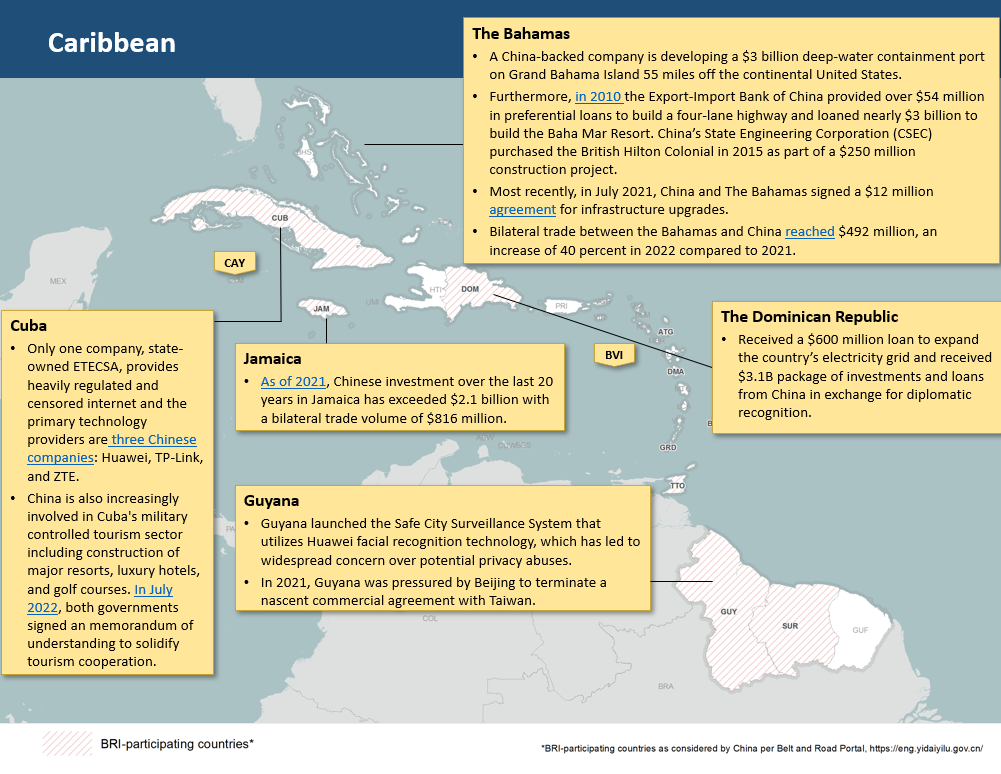
CHINA’S INFLUENCE IN THE CARIBBEAN:
China is a member of both the Inter-American Development Bank (IDB) and the Caribbean Development Bank (CDB) and an observer at the Organization of American States (OAS). Alongside Italy and Germany, China is the third largest shareholder at the CDB with 5.6% of overall shares, exponentially higher than the majority of Caribbean countries.
The People’s Republic of China’s (PRC) engagement in the Caribbean has largely focused on investments in infrastructure and developing trade relationships. As of 2022, ten Caribbean countries have signed up to Belt and Road (BRI) – Cuba, Jamaica, Dominican Republic, Antigua & Barbuda, Dominica, Barbados, Grenada, Trinidad & Tobago, Guyana, and Suriname.
The PRC is working towards diminishing the region’s ties to Taiwan as the region contains the largest bulk of Taiwan’s diplomatic allies. Today, St. Lucia, St. Vincent and the Grenadines, St. Kitts and Nevis, Haiti, and Belize remain the only Caribbean nations that recognize Taiwan.
CHINA’S TRADE AND ECONOMIC INVESTMENT IN THE CARIBBEAN
While the Caribbean’s trade with China has grown at a slower pace than overall trade with the region, it increased from $1 billion in 2002 to $8 billion in 2019, with an estimated $6.1 billion in Chinese exports and $1.9 billion in imports.
China is a major trading partner of Cuba’s and Chinese businesses are involved in the Cuba’s telecommunications, tourism, mining, and energy sectors.
Cuba is highly dependent on China and ongoing economic challenges resulted in the reconstructing of an estimated $4 billion in debt to China in 2011 and another restructuring in 2015.
CHINA’S TRADE AND ECONOMIC INVESTMENT IN THE CARIBBEAN (CONT’D).
China has invested over $10 billion in mainly six Caribbean countries between 2005 and 2022 focused on the tourism, transportation, extractive metals, agriculture, and energy sectors.
•Jamaica: $3.16 billion
•Guyana: $3.01 billion
•Trinidad and Tobago: $2.28 billion
•Antigua and Barbuda: $1 billion
•Cuba: $740 million <— Why so little?
•Bahamas: $350 million <— And less here?
CHINA’S INVESTMENT IN CARIBBEAN ENERGY SECTOR
•From 2005-2020, Chinese investment in energy and infrastructure throughout the Caribbean reached upwards of $7 billion.
•China’s SOE China National Offshore Oil Corporation (CNOOC) has a 25% stake in the Stabroek block25, an offshore crude oil deposit projected to produce upwards of 4 million barrels per day by 2025. ExxonMobil holds a 45% interest alongside Hess Guyana’s 30 percent stake.
•In 2011, China’s sovereign wealth fund acquired a 10% interest in Trinidad and Tobago-based Atlantic LNG, one of the world’s largest natural gas producers.
•In 2019, a subsidiary of Chinese national oil company CNPC (CNPC is the primary and stands for China National Petroleum Company) Great Wall Drilling, began drilling oil off Cuba’s coast as part of a joint venture with state-owned oil firm Cuba Petroleum Company (CUPET).
•In 2017, Jamaica’s Alpart alumina refinery was purchased by Chinese state-owned enterprise, Jiuquan Iron and Steel Company (JISCo) for $299 million.
•China National Corporation for Exploration and Development of Oil and Gas (CNODC) currently has a 30% stake in the consortium developing the Stabroek Block. The Stabroek Block is 6.6 million acres and holds an estimated recoverable resource of more than ten billion oil-equivalent barrels.
CHINA’S INVESTMENT IN CARIBBEAN INFRASTRUCTURE
Signature Chinese projects include:
•Hutchison Port Holdings, subsidiary of PRC affiliated Hutchison Whampoa, owns and operates the Freeport Container Port in The Bahamas.
•More than a billion dollars in highway projects in Jamaica, China Merchant Port Holdings ownership of the Port of Kingston.
•The China Harbour Engineering Company is constructing a port in La Brea to increase the of exportation of gas from Trinidad and Tobago.
•Projects in Guyana include a $256.6 million contract to the PRC to build a lengthy and strategically important bridge over the Demerara River, hundreds of millions of dollars for roadwork, including a $200 million highway from Schoonord to Parika, a $200 million upgrade to the road from Annandale to Mahaica, and improvements to road segments in the capital city of Georgetown.
•In 2020, the government of Suriname signed an infrastructure cooperation agreement for two photovoltaic (solar) microgrid projects with the China Power Construction Corporation
•In 2017, the provincial government of Gansu signed a framework agreement with the Jamaican government to invest up to $6 billion in an industrial park. That same year, Jamaica announced a $384 million loan from the China Import-Export Bank to build a road network on the island to complement a $730 million highways built earlier in 2017 in return for a 5-year concession to the Chinese construction company that included land alongside the highway to be used for development.
CHINA’S SOFT POWER IN THE CARIBBEAN
In 2016, the Chinese government published a second white paper outlining its policy for the region and states a desire to strengthen cooperation on the basis of “equality and mutual benefit” in several key areas, including exchanges and dialogues, trade and investment, agriculture, energy, infrastructure, manufacturing, and technological innovation.
PRC-backed Confucius Institutes have been established in throughout the Caribbean including Cuba, Jamaica, the Bahamas, Guyana, Trinidad and Tobago, Antigua and Barbuda, Barbados, Grenada, and Suriname.
Despite the PRC’s abysmal record on press freedoms, in 2018, the China-Caribbean Press Centre was established as an initiative by the Chinese Foreign Ministry to facilitate month-long travel and exchanges for Caribbean journalists to China.
CHINA’S SECURITY ASSISTANCE IN THE CARIBBEAN
In proportion to the Caribbean’s population, the PRC has dedicated a significant level of attention to regional security engagement.
- Also, in the second white paper released in 2016, it noted that China will “actively carry our military exchanges and cooperation” with countries in the LAC.
PLA troops deployed for eight years to Haiti under the United Nations peace keeping mission, MINUSTAH from 20014-2012.
The PRC frequently donates military and police equipment to regional counterparts, such as transport aircraft to Guyana, motorcycles to the police force of Trinidad and Tobago, and three regional visits by the PLA Navy’s hospital ship.
Cuba has sought to strengthen military ties with China, hosting the 1st Asian flotilla of three Chinese navy warships to the island before the start of COVID-19.
*Last updated: 11/14/2022
Lou Lou Lou … The new Nostradamus
